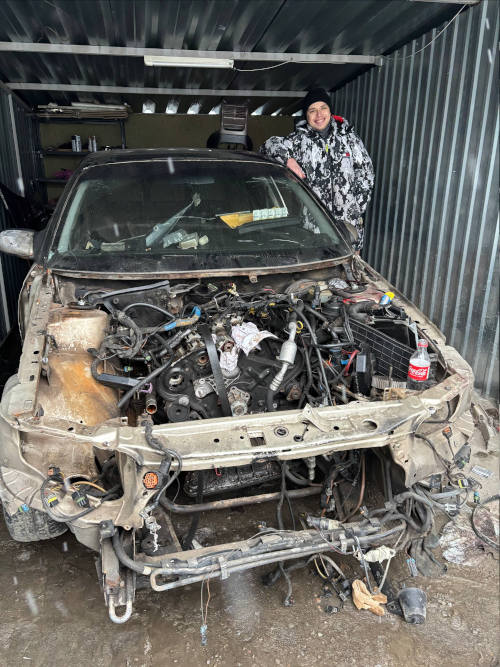
Chevrolet Silverado 2500
On the surface, an engine swap for a Chevrolet Silverado 2500 seems like it would be pretty easy. However, the layout rarely works the way the forums say. Compatibility is not something that is simply a yes or no, it is a layered condition that is impacted by model year, software (electronic architecture), and emissions. Difficulty and cost do not increase because the engine is some foreign power plant, it is because the truck's systems expect certain behaviors from the powertrain. This category begins to set the standard by outlining what compatibility means on this platform and explaining why so many swaps that check off the per-conditions still end up not working. Everything will be anchored to the factory engine offerings for reference. I will cover the direct and almost bolt-in swaps, as well as the high effort conversions later without assuming success at this stage.
TL;DR
- Engine compatibility means mechanical fit, electronic integration, and emissions survivability working together.
- Engines that physically fit still fail when torque modeling, CAN communication, or thermal assumptions do not match the truck.
- Difficulty levels describe integration burden, not fabrication effort.
- Level 1 swaps stay within factory-adjacent logic and have the highest success rate.
- Level 2 swaps stress electronics and heat management and stall without strong planning.
- Levels 3–5 swaps are full system builds, not engine replacements.
- Lowest-risk swaps reuse Silverado 2500–compatible GM engines and control strategies.
- Higher-level swaps require custom integration and often standalone engine management.
- Cross-brand swaps escalate complexity quickly due to incompatible electronics and driveline assumptions.
- The engine itself is rarely the main cost driver.
- Wiring, calibration, rework, and debugging dominate cost and time.
- Timelines stretch because integration problems compound rather than resolve linearly.
- Budgets collapse when intermittent issues force repeated teardown and redesign.
- Most failures appear after heat soak, load, or extended use, not at first start.
- Incomplete wiring, cooling limits, and driveline geometry cause delayed failures.
- OEM ECU-based swaps align best with US inspection expectations.
- Standalone ECUs increase flexibility but complicate emissions and inspection outcomes.
- Rebuilds, mild boost, or gearing changes often solve performance issues more effectively than swaps.
- The final rule is to choose the solution that delivers required performance with the least disruption to system coherence.
Before you start researching parts and pricing, check whether the swap you have in mind actually fits – and whether it's worth doing.
Check My Engine SwapChevrolet Silverado 2500 Engine Swap Compatibility Overview
What does “compatible” truly mean?
On a Silverado 2500, an engine is only “compatible” when all three of these conditions occur at the same time. An engine must be able to physically fit into the chassis and connect to the driveline without creating any abnormal loads. It must electronically integrate with the truck’s control modules in order to maintain coherence with torque requests, safety logic, and fault monitoring. Lastly, the engine must be able to pass emissions cases and the onboard diagnostics of the market it is intended for. In the US, this means all the readiness monitors must function as intended.
When fitment is treated as the only indicator of compatibility, it leads to predictable outcomes. The engine might be able to start and idle, however, the tranmission will not shift as cuommaded, the instrument cluster will report implausible data, and the truck will go into reduced power mode. These issues are not random. They are a result of the modules that were “mis-matched” and “mis-assumed” by the system. Therefore, unlike systems that are only plug and play, these systems only describe the function of the engine and other systems that may be installed.
What is Mechanical, electronic, and emissions compatibility?
Mechanical compatibility is all of the mounts, the bellhousing patterns, the accessory drive spacings, and the oil pan geometries. The body-on-frame design of the Silverado 2500 gives us plenty of room, but the design around the front crossmember, steering shaft, and front differential on 4x4 models is still pretty tight. Even little changes in crank centerline height or sump depth can change driveline angles and steering clearance.
Engine control applies electronic compatibility when measuring and communicating via the CAN bus, the output of torque, load, and state of faults. The powertrain control module works in tandem with the transmission controller, body control module, ABS, and security module. The truck may assume fault conditions when the engine controller does not use the expected terms.
US emissions compatibility is frequently forgotten about until it comes time for inspection. The engine, controller and calibration of any swap must have the correct readiness monitors for the model year of the chassis in the US market. If the engine runs clean, it is still subject to inspection failure if the evaporative, catalyst, and misfire monitoring logic does not fit the vehicle.
Why does it fit, but it still fails?
One truck with the right engine and transmission clearance to the frame still has the problem of entering reduced power during towing over and over. This is not an airflow or fueling issue, but a torque modeling one. The later generations of Silverado 2500 require aligned reporting of torque for the transmission control and stability system to work harmoniously. If the reported torque is lower or higher than what is expected, the protective strategies will come into play.
Another common failure is regarding security handshakes. The immobilizer logic for newer trucks requires the engine controller to authenticate with the body control module at startup. If this handshake does not go through, the engine will start momentarily and then shut down or stay in a reduced power mode. This is not something physical installs will fix as this issue comes down to network validation failure.
Thermal load contributes to incompatibility as well. Cooling strategies are set based on certain heat rejection profiles. An engine that fits well can overwhelm the factory’s cooling logic with a sustained load and as a result, activates the temperature based torque control. These unfortunate events can be traced to a miscalibration and not mechanical failure.
Brief generational differences (pre-2004, 2004+, and aluminum frames)
The pre-2004 Silverado 2500 models are more reliant on mechanical relationships and have more simplified electronic coordination. They fail modes are more common with track and driveline angles, and poly coupling interferences. There are electronics present, but they are less module heavy and track less of torque and safety arbitration.
Starting in 2004, the network logic is more sophisticated. There’s more module dependencies and the engine controller has to meet multiple system pressures. These trucks tend to fail in electronic seams, or conflicts, but not in physical interferences.During the aluminum frame era, the importance of mounting practices and torque sequencing increases. The frame transmits vibration differently, and the platform exhibits a greater sensitivity to NVH changes. Engines that operate satisfactorily in steel-frame trucks can cause driveline harshness in aluminum trucks if the mounts and load paths are not properly tuned to the aluminum structure.
Chevrolet Silverado 2500 Platform Reality: What It Allows and What It Punishes
A significant advantage of the Silverado 2500 is the body-on-frame construction and the longitudinal flexibility it provides when compared to unibody trucks. This also provides varying options when it comes to modular engine height and vertical extensions. Adjustments to the engine crossmember can also be made. This type of flexibility promotes greater opportunities for component swaps.
However, such opportunities come with certain constraints, and these become apparent once the truck is utilized. The towing and payload will create sustained pressure loads will start to expose the marginal mounting geometrics and driveline alignment. What seems to be an empty space with room to spare will, in fact, perform poorly when placed under operational duress.
Mechanical constraints (mounts, crossmembers, steering)
In the 2024 Silverado 2500, engine mounts also serve as structural load components while also providing protective support. The shape of the engine mount governs how the torque transfers to the frame, and any modifications made to the mounting angles will cascade changes to crossmembers and frame rails, which increases stress in certain areas.
One of the most common issues when it comes to steering is the steering shaft and gearbox, which sit in fixed positions and take up the same space in the frame, particularly in 4x4 trucks. These same areas are utilized for the exhaust and the oil pan. What may seem like an insignificant obstruction while the vehicle is still will often become the cause of contact when the frame flexes.
Differentials on four-wheel-drive models achieve even further limiting scope. Engine swaps that require different sump designs or accessory placements tend to collide with differential housings or driveshafts, forcing compromises that impair reliability.
Electronic constraints (CAN bus, BCM, ABS, Security)
Silverado 2500's electronic design assumes the engine controller joins a certain message set. There is a set of expectations regarding the engine, particularly with regards to torque requests, braking, and traction, and the response is time/impact sensitive. If the engine controller is not performing as expected, downstream modules will react to these changes in a defensive way.
The BCM and ABS modules add safety logic that depends on engine activity. Irregularities in throttle position, or the absence of messages, will result in fault states that reduce the addressable set, and these behaviors are all a part of the existing design. There is no way to get around these constraints without redesigning.
Security systems add even more complication. Newer trucks will check to see that the engine controller is authorized every time it starts and even while it runs. If it lacks authorization, the system will operate in a reduced set, regardless of the mechanical condition of the engine.
The pitfalls of processing electronic integration the first time.
In the event that electronic integration is limited, fault tracing will take longer. The truck will function in an unsteady manner, and will often present unrelated alerts that mask the real problem. The more attempts to override the system, the more complicated the problem will become. Mechanical shortcuts exhibit the same pattern. Temporary mounts or clearance adjustments can move over time and alter alignment, introducing unwanted oscillation. Such adjustments create secondary symptoms that mask the primary issue, lengthening the time taken to reach resolution.
The overall impact is extended troubleshooting, rather than the immediate failure that was desired. Time spent pursuing multiple interacting faults often surpasses the time needed to properly tackle the initial fit issue.
Factory Engines Offered in the Chevrolet Silverado 2500 (All Years)
Complete Factory Engine Specification Table
| Engine Code / Name | Displacement | Engine Type & Cylinders | Fuel Type | Valvetrain / Timing | Power | Torque | Production Years | Donor Vehicles | Known Issues |
|---|---|---|---|---|---|---|---|---|---|
| Vortec 6000 (LQ4 / LQ9) | 6.0 L | V8, iron block | Gasoline | OHV, 2 valves per cylinder | 300–345 hp | 360–380 lb-ft | 1999–2007 | Silverado 2500, Suburban 2500, Express 2500 | Oil consumption, intake gasket wear |
| Vortec 8100 (L18) | 8.1 L | V8, iron block | Gasoline | OHV, 2 valves per cylinder | 320–340 hp | 440–455 lb-ft | 2001–2006 | Silverado 2500, Silverado 3500 | Fuel consumption, limited parts availability |
| Duramax 6600 (LB7) | 6.6 L | V8 turbo diesel | Diesel | OHV, 4 valves per cylinder | 300 hp | 520 lb-ft | 2001–2004 | Silverado 2500HD, Sierra 2500HD | Injector failure, fuel dilution |
| Duramax 6600 (LLY / LBZ / LMM) | 6.6 L | V8 turbo diesel | Diesel | OHV, 4 valves per cylinder | 310–365 hp | 605–660 lb-ft | 2004–2010 | Silverado 2500HD, Silverado 3500HD | EGR cooling, emissions component wear |
| Vortec 6000 (LY6) | 6.0 L | V8, iron block | Gasoline | OHV, variable valve timing | 360 hp | 380 lb-ft | 2007–2019 | Silverado 2500HD, Express 2500 | AFM-related wear, timing component fatigue |
| 6.6L V8 Gas (L8T) | 6.6 L | V8, iron block | Gasoline | OHV, variable valve timing | 401 hp | 464 lb-ft | 2020–Present | Silverado 2500HD, Silverado 3500HD | Limited long-term data, high thermal load |
Best Engine Swap Options for the Chevrolet Silverado 2500, Ranked by Difficulty
How swap difficulty levels actually work
Difficulty levels do not reflect mechanical effort. It shows integration burden. A lower level does not mean “easy.” It means the engine behaves closely enough to factory expectations that the truck’s systems mesh. As difficulty increases, the engine stops being a component, and becomes a fx4 foreign entity that needs to reconcile with the chassis, electronics, and thermal model.
Difficulty increases because of the compounding of problems. One change in the behavior of the engine impacts transmission logic, the stability control, the cooling strategy, and emissions readiness all at once. Fixing one incompatibility typically exposes two or three more, each of which requires more calibration and redesign instead of fabrication.
At higher levels, integration challenges from electronics, heat management, and design combine because of the systems of modern heavy-duty trucks. They act as a coordinated network. Intermodule agreement, or interoperability, impacts fail-safe logic, thermal protection, and the control of the systems. Integration challenges from fabrication do not intergration because cutting and welding do not control logic, network, or to withstand inspection.
Level 1 Swaps (Lowest Risk, Near Bolt-In)
Level 1 swaps succeed most often because they stay within the design envelope of the Silverado 2500. These engines share architecture, control strategies, and emissions logic with factory options, allowing existing modules to interpret engine behavior correctly. Factory-adjacent engines matter here because they preserve torque modeling and diagnostic expectations.
Electronics and emissions remain predictable at this level. Calibration alignment is achievable without reengineering the truck’s network, and cooling strategies usually scale with minor adaptation. These swaps still require diligence, but their failure modes are limited and well understood.
| Engine Code / Name | Engine Type & Cylinders | Fuel Type | Donor Vehicles & Years | Valvetrain / Timing | Swap Challenges (Specific to Silverado 2500) |
|---|---|---|---|---|---|
| 6.0L Vortec LY6 | V8, iron block | Gasoline | Silverado 2500HD 2007–2019 | OHV, VVT | Accessory drive spacing must match existing cooling stack, exhaust routing differs slightly by frame year |
| 6.6L Gas L8T | V8, iron block | Gasoline | Silverado 2500HD 2020–Present | OHV, VVT | Cooling demand increases under load, requires compatible radiator and fan control logic |
| 6.6L Duramax LBZ | V8 turbo diesel | Diesel | Silverado 2500HD 2006–2007 | OHV, 4 valves per cylinder | Fuel system integration must match existing tank and return layout, exhaust aftertreatment alignment critical |
| 6.6L Duramax LMM | V8 turbo diesel | Diesel | Silverado 2500HD 2007–2010 | OHV, 4 valves per cylinder | Emissions monitoring requires correct sensor population, added heat load stresses factory cooling margins |
Level 2 Swaps (Moderate Complexity)
Level 2 swaps introduce engines that remain within the GM ecosystem but depart from the Silverado 2500’s original calibration assumptions. Electronics and heat management begin to dominate because torque curves, airflow models, and exhaust energy differ enough to stress factory logic. Mechanical fitment is rarely the limiting factor.
Planning matters more than fabrication at this level. Without a clear strategy for module communication and thermal control, these swaps often stall after initial startup. The engine runs, but drivability degrades under real load conditions.
| Engine Code / Name | Engine Type & Cylinders | Fuel Type | Donor Vehicles & Years | Valvetrain / Timing | Swap Challenges (Specific to Silverado 2500) |
|---|---|---|---|---|---|
| 6.2L LS3 | V8, aluminum block | Gasoline | Corvette, Camaro 2010–2015 | OHV | Torque reporting mismatch affects transmission shift logic, cooling system must handle higher peak heat rejection |
| 6.2L L94 / L9H | V8, aluminum block | Gasoline | Escalade, Yukon Denali 2007–2014 | OHV, AFM, VVT | Active fuel management integration complicates calibration, oiling strategy differs under sustained towing |
| 6.6L Duramax LML | V8 turbo diesel | Diesel | Silverado 2500HD 2011–2016 | OHV, 4 valves per cylinder | High-pressure fuel system sensitivity, exhaust aftertreatment packaging challenges in earlier frames |
| 6.0L LQ4 / LQ9 (Non-native year) | V8, iron block | Gasoline | Silverado, Suburban 2000–2006 | OHV | Controller generation mismatch requires reconciliation of sensor strategies and emissions readiness |
High-Effort Engine Swaps (Levels 3–5)
Levels 3 to 5 should definitely be considered complete builds instead of engine swaps. These swaps give you new engines that have new control philosophies, physical sizes, and brand lineages that greatly differ from the Silverado 2500. When dealing with new brand lineages, there are immediate issues that arise with the electronics, driveline, and the cooling system.
Standalone engine management is _not_ an upgrade. It is a necessity for legitimate reasons. The factory modules do not, and cannot, interpret the engines' torque, fault states, safety conditions, or the protective systems for the unknowable engines. This means that there is a _true_ parallel control system that must still integrate with the truck’s chassis electronics.
The majority of effort will be redesigning packaging, transmissions, and cooling systems. Changes to the engine itself will alter the weight distribution, the routing of the exhaust, and the positioning of any accessories in the truck. If you are working with turbo charged or high-boost engines, the cooling system will have to be radically altered to accommodate changes in cooling capacity and airflow.
| Engine Code / Name | Difficulty Level | Engine Type & Cylinders | Fuel Type | Donor Vehicles | Dominant Integration Risks |
|---|---|---|---|---|---|
| 7.0L LS7 | 3 | V8, aluminum block | Gasoline | Corvette Z06 | High-rpm torque modeling conflicts, oiling system sensitivity under truck duty cycles |
| 6.7L Cummins ISB | 4 | Inline-6 turbo diesel | Diesel | RAM 2500 | Cross-brand electronics incompatibility, driveline and cooling architecture mismatch |
| 5.0L Coyote | 4 | V8, aluminum block | Gasoline | Ford F-150, Mustang | CAN bus translation, transmission integration, emissions compliance complexity |
| Supercharged LS-based builds | 5 | V8, forced induction | Gasoline | Aftermarket / Mixed | Thermal management saturation, torque control instability, driveline durability limits |
Universal Engine Swap Execution Reality
Planning & Measurement
Judging by how much the Silverado 2500 punishes hobbyists for incorrect assumptions as opposed to incorrect parts, the execution phase likely starts long before any hardware moves. Planning is a sequencing exercise, and dimensions, loads, and system expectations need to align before any work is done. Most failures at this stage come from measuring things as if they were static, failing to realize the truck will dynamically behave differently under load and frame flex. Clearances which appear generous on paper, will come and go as driveline angles, exhaust routing, and suspension travel are traversed.
As is commonly the case, measurements are most often perceived in isolation. `Engine height affects hood clearance, but it also alters driveshaft angle and transmission output alignment.` Centerline placement influences steering clearance, and oil pan behavior under braking. If the plan disregards these relationships, the consequences will pile up as the costs of solutions and the extent of problems increase come correction time.
Engine Removal
Removal is often and most adequately described as a mechanical reset, yet, it is also sets the reference for everything that comes next. The mistake is most often the assumption that the engine bay is now a neutral space, free of constraints. In reality, post removal, wiring paths, module locations, and cooling interfaces define like boundaries that are fully fixed and will persist.
Mistakes are hard to spot. Sometimes harnesses get shortened or rerouted. Reference points get removed and load paths are not recorded, destined to be forgotten. These choices do not immediately halt progress, but can make things difficult when systems are required to work together again.
Fit & Clearance Testing
Fit and clearance testing should be viewed as validation points, not just because the engine “fits.” Under load, the Silverado 2500 frame will flex, while components that have static clearances can interfere dynamically. These issues are revealed when steering shafts, brake boosters, and front differentials are considered.
Mistakes made with clearance are usually not addressed during the initial assembly, only to fail later. The position of the exhaust will change due to the expansion of heat. The reaction of the engine will shift the mounts due to torque. These changes will expose spacing that seemed acceptable during the test fit, only to leave the need for further work when systems have already been integrated.
Mounting & Driveline Geometry
Where the engine is located is defined by the engine mounts, but it also determines how forces are introduced to the chassis. On a Silverado 2500, mounts have to be dealt with the torque, the braking loads, and the frame twist all at once. Bad geometry transfers brake torque and frame twist into crossmembers or driveline components that aren’t meant to take it.
Driveline geometry errors often go unrecognised until it is too late. Vibration occurs under load, not at idle, and U-joint wear occurs over an extended period. These symptoms are traced back to mounting issues with small angular deviations, and subsequently unappreciated changes once torque increases.
Wiring & ECU Strategy
This is also the stage in which the swap becomes less of a mechanical project and more of a systems engineering problem. Silverado 2500 modules use a consistent message flow hierarchy between the engine control, transmission logic, and chassis. In this case, the `cut and shunt` wiring strategy, with fragmented components, will break message flow even if each connection has been tested individually.
The control strategy applied to the ECU will dictate if the truck will see the engine function as intended. Promitive control logic systems are built upon unified frameworks concerning torque reporting and fault management. Any deviation from this logic will require some form of dedicated dissociation (or isolation) and translation (or mapping), not a form of partial integration. Unclear conditions at this level of the project will yield unpredictable systems and behaviours and make troubleshooting efforts even more difficult.
First Start & Initial Validation
The first start serves to confirm the vehicle can combust, not much more. The Silverado 2500 will runs a set of plausibility checks to see if the vehicle is functioning as intended, some of which are load, speed, or temperature dependent. Even a healthy system can have an idle that runs perfectly.
Initial validation should center on whether the system is in agreement, not on the sound or feel. Throttle delays, shift delays, or messages indicate deeper integration issues. Early on, these signs lead to more minor discrepancies that can snowball into larger issues.
Enter your vehicle and target engine to see a compatibility verdict, estimated cost, required changes, and whether it's the right move for your build.
Get My Swap VerdictEngine Swap Cost & Timeline Reality
Engine Cost Finances by Complexity
The cost of an engine swap depends more on how difficult it is to integrate an engine, rather than how much the engine actually costs. For easier engine swaps, it is usually possible to budget the costs fairly tightly, as they tend to reuse most of the previous system, and logic. As the difficulty of a swap increases, the budget becomes more open, as there is more custom built wiring, calibrating, and reconfiguration.
This isn’t a linear relationship. Just because you double an output, doesn’t mean you double a cost. Each time there is a redesign in the system, it adds a new cycle of validation.
Realistic Estimates
The same nonlinear effect occurs with time. Because of the nature of these vehicles, mechanical installation is the smallest part, as the main body of time in any project is taken up by integration, testing, and revisions. This is especially true in the vehicle has electronic systems that charge to be integrated.
Inevitably, the projects tend to stall, especially when the positive push of completing the project fades away. This phase dwarfs the previous estimates.
What Builders Always Neglect
One overlooked aspect is engine wiring. As there isn’t much visible progress, people tend to assume that it doesn’t take a huge amount of time. Even more time is drained on troubleshooting when the system is integrated as corrections and adjustments tend to have strange and unexpected interactions.
The opportunity cost is also overlooked. A truck parked for months on end represents lost utility, not merely project delay. This is especially true for the Silverado 2500, which frequently has work or towing responsibilities rather than optional use.
Common Chevrolet Silverado 2500 Engine Swap Failure Scenarios
Incomplete or Fragmented Wiring
Failures in wiring rarely prevent startups. These problems come to the surface in specific conditions, like at highway speeds or towing loads. Some issues cause signals to be missed or inconsistent, which leads to the deployment of protective strategies that result in altered transmission behavior or a reduction in power.
Many of these problems persist because symptoms are, at least on the surface, unrelated to the wiring. Marginal connections that create intermittent faults are hard to replicate, as they can be due to the heat or vibration. These issues demonstrate a tendency to avoid replication in controlled testing.
Under-Sized or Misapplied Cooling Systems
Unlike previous entries, cooling failures don’t happen immediately. These are accrued over time, and when the Silverado 2500's duty cycles come into play with sustained loads instead of brief accelerations, problems arise. Systems that are sized for peak air flow, but not sustained heat rejection, fall behind.
This loss of power can also be due to changes in the system’s calibration. As the coolant or oil begins to heat up, the system's control strategies will begin to reduce available torque. This becomes apparent to the driver as a loss in power. This is a behavior surrounding temperature management that seems to obscure the real cause of the loss of control.
Misaligned Driveline Angles
One of the earlier signs of driveline misalignment is vibration, which becomes more pronounced as time goes on. These issues arise due to the small, geometric errors that happen during a mounts installation. These errors can take a great deal of time. The increase in effort also raises the overall cost.
Problems with Belt Geometry & Accessory Drives
Accessory systems can be overlooked when compared to more major core components. Issues with belt path misalignment or mismatched loads on the accessory can lead to new reliability issues that are seemingly unrelated to the engine swap.
These failures happen after long periods of operation when heat due to friction on the bearings and belting leads to failures. This can leave the vehicle with critical systems like power steering or charging inoperable, leading to severe usability issues.
Legal & Emissions Considerations (US)
OEM ECU-Based Swaps
OEM ECU-based swaps remain the closest to the inspection unobstructed expectation. Emissions monitors, fault reporting, and readiness states remain intact to the inspection equipment. While these systems being intact and functional does not ensure inspection approval, it does retain the compliance systems status quo.
The primary issue is internally from the inspection system calibrated to certainty between the engine configuration and the engine calibration. The moment there is an deviation, the system perceives it as a fault, even if the engine is running clean.
Standalone ECU Swaps
Standalone control separates the engine from factory logic, which provides more control, but at the expense of compliance. Emissions monitoring as the problem not the solution, and more often than not, readiness reporting does not align to inspection expectations.
This is particularly not suited for general operation, but rather for non-road or controlled-use scenarios. For street-driven Silverado 2500 trucks, it provides a layer of complexity that exceeds the known from the first approval.
Inspection Reality
Inspection evaluates system behavior, not build intent. The truck either does or does not provide valid reporting. Visually clean or good performing does not make up for the lack of monitoring or reporting that is not valid or is implausible.
Compliance issues are often discovered at the latest stage because the inspection is done after the build is completed. Fixing these issues at that stage is often more involved than first intended design integration decisions.
When an Engine Swap Is the Wrong Solution
Rebuilding Existing Engine
Rebuilding keeps system coherence. The Silverado 2500 keeps its original control logic, cooling strategy, and driveline alignment. Reliability can actually improve because wear issues are fixed without adding new variables. For many use cases, a refreshed factory engine meets performance and durability goals more cost effectively than a swap.
Conservative Forced Induction
Mild boost increases output while keeping engine identity intact. Control strategies adapt more easily when the base architecture stays the same. Thermal and driveline demands rise, but are within predictable limits. This approach often solves the power problems without a complete swap.
Gearing & Drivetrain Optimization
Adjustments to the engine can only go so far. Many performance issues stem from the engine’s limits. Altering the ratios of the drivetrain can improve tow and accelerate without changing engine behavior. These changes operate within factory logic to preserve reliability and compliance.
Final Rule: Choosing the Right Tool
In a Chevrolet Silverado 2500, an engine swap is a more rational systems decision. Power, reliability, legality, and usability interrelate, regardless of whether they are recognized. The most effective answer reconciles these variables instead of sacrificing one to improve another.
The most decisive principle is straightforward: Select the answer that will bring the necessary performance with the least disruption to the system's coherence. When an engine swap is that answer, go all in on integration. When it is not, live with the fact that in some instances, restraint is the more effective choice of engineering.
Frequently Asked Questions
Why does the Silverado 2500 react differently to engine swaps than half-ton GM trucks?
The Silverado 2500 operates under heavier duty cycles and stricter torque management expectations than half-ton platforms. Its transmission logic, stability systems, and cooling strategies assume sustained load rather than short bursts of acceleration. When an engine behaves outside those assumptions, the truck responds defensively, even if the same engine feels fine in a lighter chassis.
This difference explains why swaps that appear proven in 1500-series trucks can struggle in a 2500. The issue is not physical strength but system coherence under work conditions like towing, heat soak, and prolonged high-load operation.
How much do production year differences actually matter for swap outcomes?
Production year changes alter failure modes more than installation difficulty. Earlier trucks tolerate mechanical variation but expose weaknesses through vibration, driveline wear, and accessory conflicts. Later trucks enforce tighter electronic validation, where mismatched signals trigger protective behavior.
Treating all Silverado 2500 years as equivalent leads to incorrect expectations. A swap that behaves acceptably in one generation may fail differently in another, even when the hardware looks similar.
Why do some swaps feel fine unloaded but fail during towing or hauling?
Unloaded driving rarely exercises the systems that expose incompatibility. Under tow, the truck increases cooling demand, torque arbitration, and transmission coordination. Any mismatch in torque reporting or thermal strategy becomes visible only at that point.
These failures often appear as reduced power or inconsistent shifting rather than obvious faults. The engine itself may be healthy, but the system no longer agrees on how much load it is carrying.
What makes diesel swaps behave differently from gasoline swaps on this platform?
Diesel engines integrate more tightly with fuel delivery, exhaust aftertreatment, and thermal management systems. The Silverado 2500 expects specific exhaust energy and temperature behavior to coordinate regeneration and load control. Deviations disrupt that balance.
As a result, diesel swaps amplify integration issues rather than hide them. Small mismatches propagate quickly into drivability and compliance problems that do not appear in gasoline configurations.
Why does torque management matter more than peak power on the Silverado 2500?
The truck’s control systems prioritize predictable torque delivery over absolute output. Transmission shift timing, traction control, and stability systems rely on accurate torque estimates to function safely under load.
When an engine produces torque outside expected models, the truck compensates by limiting power or altering behavior. This response protects the drivetrain but frustrates builders who focus only on horsepower figures.
How does cooling strategy influence long-term swap reliability?
Cooling on the Silverado 2500 is designed around sustained heat rejection, not brief spikes. An engine that generates acceptable temperatures during short drives can overwhelm the system during extended work.
Thermal stress accumulates gradually, degrading sensors, wiring, and control logic. Reliability issues surface weeks or months later, making the root cause harder to trace back to cooling assumptions.
Why do wiring issues often appear intermittent rather than constant?
The truck’s electronic network performs plausibility checks that depend on operating conditions. Heat, vibration, and load alter signal quality and grounding behavior. Marginal connections pass basic tests but fail under stress.
These intermittent issues resist diagnosis because they disappear during inspection or light driving. The underlying problem persists until operating conditions repeat.
What causes driveline vibration to show up late in a swap project?
Driveline angles may fall within tolerance at rest but shift under torque and frame flex. The Silverado 2500’s long wheelbase and load capacity magnify small geometric errors.
Vibration increases gradually as components wear. By the time it becomes obvious, corrective work often requires partial disassembly.
Why do accessory drive problems tend to get overlooked?
Accessory systems sit outside the core engine and transmission focus, yet they experience continuous load. Belt alignment, pulley speed, and bearing stress change when engine placement or output changes.
Failures emerge after extended use rather than initial testing. Loss of steering assist or charging capacity undermines vehicle usability even when the engine itself performs well.
How early should emissions considerations influence swap decisions?
Emissions behavior is baked into control strategy, not added at the end. Decisions about engine management and integration determine whether readiness and diagnostics remain coherent.
Addressing compliance late forces redesign of choices that seemed settled. Early alignment avoids revisiting integration under pressure.
Why do standalone control strategies change the character of the truck?
Standalone systems isolate the engine from factory logic, shifting coordination responsibility away from the vehicle. The Silverado 2500 no longer shares assumptions about torque, faults, or protection strategies.
This isolation increases flexibility but reduces cohesion. The truck behaves more like a collection of independent systems than a unified platform.
When does rebuilding the existing engine outperform swapping?
Rebuilding preserves the original integration that defines how the Silverado 2500 operates under load. Control logic, cooling, and driveline geometry remain aligned.
In many cases, addressing wear and restoring factory performance meets real-world needs more reliably than introducing a new system.
Why do swaps often solve the wrong problem on work-oriented trucks?
Many complaints trace back to gearing, thermal margins, or calibration rather than engine capability. Swapping the engine treats a symptom rather than the underlying constraint.
Without identifying the true limitation, a swap adds complexity while leaving the original issue unresolved.
Stop comparing specs in your head. Enter your Chevrolet Silverado 2500 and the engine you want – get a structured verdict with cost, complexity, and a clear recommendation.
See If This Swap FitsYears
No year pages with content are configured for this model yet.