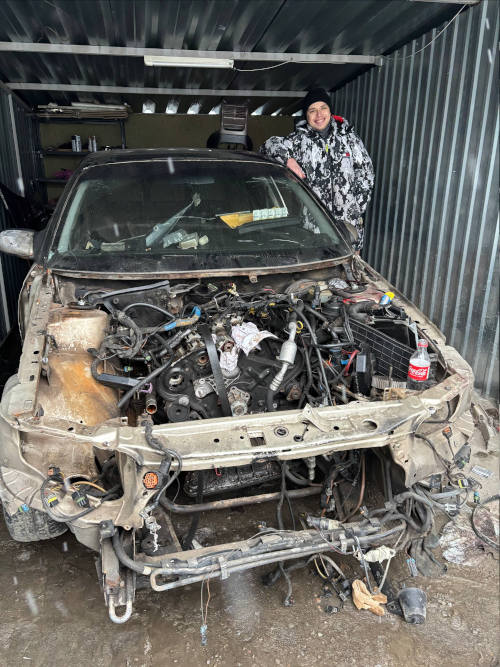
Chevrolet Tahoe
Many Chevrolet Tahoe engine swap projects fail for reasons that, while boring, are not due to a lack of creativity. Though the physical engine swap seems straightforward, issues such as compatibility, integration breakdown, and the various elements of the swap (electronics, emissions, logic, and the different networks of the vehicle) causee a lot of vehicles to the idea of potential engine swaps. Engine swap projects are not just about the engine and vehicle, as there are other promises and an endless predictability of fulfilling other untapped core elements of the vehicle. The true costs of an imbalanced drain or a shallow lip go up the worse the integration. By stating some of the baseline elements as unmeasured and inferring other unmeasured baseline core elements, this article will surf along the edge of a bypass line. The rest of the article covers measure, and ooutliningthe engines, modified behavior of the Tahoe platform, and measuring the engines. Full conversions, bolt-in conversions, and direct conversions (and also those that are not) will fit within the bounds. Most of the framework and direct measurements will be confined to the engines spread.
TL;DR
- Engine compatibility means mechanical fitment, electronic integration, and emissions survivability working together.
- An engine that physically fits can still fail due to CAN communication, torque modeling, or emissions logic.
- Difficulty Levels 1–5 represent system integration depth, not fabrication effort.
- Difficulty increases non-linearly because electronics, heat management, and calibration compound together.
- Level 1 swaps stay factory-adjacent and succeed because electronics and emissions behavior remain predictable.
- Level 2 swaps introduce generational gaps where planning and calibration matter more than metal work.
- Levels 3–5 function as full system builds that often require standalone ECUs and redesigned support systems.
- Cross-brand swaps escalate complexity quickly because control logic, transmissions, and networks no longer align.
- Engines are rarely the main cost; wiring, calibration, rework, and integration dominate budgets.
- Timelines stretch because testing, revision, and validation replace straightforward assembly.
- Budgets collapse when wiring refinement, heat management fixes, and calibration iteration are underestimated.
- Most failures appear later under heat, load, or time, not at first start.
- Common failure patterns include fragmented wiring, marginal cooling, driveline misalignment, and accessory geometry issues.
- OEM ECU-based swaps retain the highest chance of inspection survivability in the US.
- Standalone ECU swaps trade control flexibility for inspection and compliance uncertainty.
- Rebuilds, mild boost, or gearing changes often solve the real problem with less risk than swapping.
- Final rule: choose the solution that preserves system balance, not the one that maximizes engine change.
Before you start researching parts and pricing, check whether the swap you have in mind actually fits – and whether it's worth doing.
Check My Engine SwapTahoe Engine Swap Compatibility Overview
What does compatible mean?
In engine swap lingo, “compatible” means more than just checking a single box. It means passing a trio of assessments for everyday usability, inspections, and long-term ownership. The mechanical fitment means passing the first gate, which involves the physical dimensions, mounting geometry, and alignment of the drivetrain. Then, the powertrain must be able to electronically integrate and communicate with the rest of the vehicle. Finally, the emissions and inspections tests must determine if the swap can legally and practically remain on the road.
If a swap satisfies only one or two of the criteria, it will ultimately fail in practice. There is, for example, a mechanically perfect installation that is in constant fault states, which is not compatible. There is also a fully wired engine that fails the readiness monitors, which is not compatible. The Tahoe clients can appreciate true compatibility. They recognize that the vehicle is not simply a constant work in progress, rather that it has the capabilities to operate like a factory-engineered vehicle.
What is the compatibility of mechanics, electronics, and emissions?
Mechanical compatibility is the most visible, and also the most misunderstood. It involves issues such as engine bay clearance, location of mounts, oil pan geometry, alignment of accessory drives, mild exhaust routing, and capacity of cooling. The problems all of these issues create, such as driveline wear and heat soak, as well as vibration, can all be solvable with some solid fab work.
The majority of swaps fail because of electronic issues. These modern Tahoes expect the engine control module to communicate on a live CAN bus. This conversation dictates torque requests, throttle control, stability control, transmission shifting, and even HVAC control. If the engine controller doesn’t speak to the Tahoe in the right dialect, the vehicle thinks there’s a fault, and reduces functionality.
Emmissions issues are the final limit. The Tahoe’s network expects to seelession readiness monitors, catalyst efficiency, evaporative system logic, and misfire detection. Even a brand new, powerful engine will fail inspection if it doesn’t follow the Tahoe’s network and makes the right control adjustments.
Engines that look right, but are still wrong.
Tight engine bays, like the Tahoe’s, can make a vehicle look complete while still being a failure. An engine can be unusable if it’s torque modeling is wrong. The Tahoe’s flooring system needs to be able to control the throttle and then engine controller estimate. If the estimate is missing, the transmission shifts poorly, clutches burn faster, and the vehicle goes into a limp mode.
The final threat is security handshakes. The later Tahoe’s ECM, BCM, and key system have encrypted authorizations that require the engine controller to complete a handshake. If it can’t, the vehicle may start once, then not at all, regardless of your wiring being perfect.
Thermal management can also reveal false compatibility. Engines that create more heat than the factory cooling package is designed for, may last a short sample, but can survive short drives, but can fail under towing or high ambient temps. This will lead to detonation control interventions, power reductions, or overheating.
Chevrolet Tahoe Platform Reality: What It Allows and What It Punishes
What are the advantages and limitations of a body-on-frame construction?
The Frame of a Tahoe lets the Tahoe gain a modular drivetrain, enough space, and strength. The Tahoe has enough engines bays and frames accept loads through defined mount points, so we can assume that Tahoe’s frame is modular enough. The Tahoe’s frame shares a lot of parts with other GM trucks.
This architecture, however, has some limits. The frame can only accept loads at certain points and from certain angles. When an engine swap occurs, stress will be transferred to steering components, crossmembers, and exhaust structures. This may lead to the vehicle developing cracks and squeaks, or becoming misaligned.
Engine crossmembers, steering, and mechanical constraints
Engine mounts also help with locating devices and define the reaction paths. The Tahoe has frame mounts that are designed to control frame roll under load. This results in poor placements. When frame mounts are positioned poorly, frame rails tend to wear out unevenly and increase the noise, vibration, and harshness in the ride.
The placement of crossmembers also affects the design of the oil pan and the front differential clearance on the 4x4 models. The rear of the engine also has a steering shaft and rack, so there is critical space that’s occupied. Any sort of interference requires compromises that may affect the routing of the exhaust or steering geometry.
Another common restriction is brake booster clearance. Service accessibility problems, along with heat exposure problems, which appear after prolonged use, can be caused by taller intake manifolds or changes in engine angles.
Electronic constraints (CAN bus, BCM, ABS, security)
The Tahoe’s engineers designed its unique circuitry with the engine integrated as a participant in the network, rather than as a stand-alone component. The BCM has to receive certain predetermined messages related to engine torque, idle speed, and specific malfunction states. The ABS and traction control systems use these messages to know when to engage or disengage.
When an engine controller is unable to send validated data, the subunits go into some extra conservative mode. This can result in the disabling of traction control, the malfunctioning of cruise control, and the instrument cluster being out of sync with the real parameters. None of these issues are resolved by simply running better wires.
The systems that deal with security are the ones that have to be consistent. Key authorization, VIN matching, and locking of a module to a specific function are done at the system boot and during system operation. Any discrepancy in these elements results in the presence of hard-to-trace channel faults.
Why shortcuts create long-term debugging debt
Shortcuts rarely fail immediately, instead, they fail slowly, and progressively result in the illumination of fault indicators, loss of driving performance, and some strange symptoms that are hard to explain. Each workaround means yet another piece of logic that must be remembered and maintained. During diagnostics, that will have to be defended.
The most valuable expense is time. There is no doubt that time spent solving non-existing issues will overshadow any savings that may be gained by not doing the integration properly. A change that acknowledges the reality of the platform will behave in a predictable manner. A change that does not will become a continuous engineering problem.
Factory Engines Offered in the Chevrolet Tahoe (All Years)
Complete Factory Engine Specification Table
| Engine Code / Name | Displacement | Engine Type & Cylinders | Fuel Type | Valvetrain / Timing | Power | Torque | Production Years | Donor Vehicles | Known Issues |
|---|---|---|---|---|---|---|---|---|---|
| 5.7L Vortec L31 | 5.7 L | V8, cast iron block | Gasoline | OHV, hydraulic roller | Varies by year/trim | Varies by year/trim | 1995–1999 | Chevrolet Tahoe, Suburban, Silverado; GMC Yukon | Intake gasket leaks, distributor wear, aging emissions components |
| 4.8L Vortec LR4 | 4.8 L | V8, iron block | Gasoline | OHV, hydraulic roller | Varies by year/trim | Varies by year/trim | 2000–2006 | Chevrolet Tahoe, Silverado; GMC Yukon, Sierra | Lower torque output, intake gasket wear, sensor aging |
| 5.3L Vortec LM7 / L59 | 5.3 L | V8, iron block | Gasoline / Flex Fuel (L59) | OHV, hydraulic roller | Varies by year/trim | Varies by year/trim | 2000–2006 | Chevrolet Tahoe, Suburban; GMC Yukon | Fuel system wear, intake gasket leaks, knock sensor corrosion |
| 5.3L Vortec LH6 / LC9 / LMG | 5.3 L | V8, aluminum block | Gasoline / Flex Fuel | OHV, AFM equipped | Varies by year/trim | Varies by year/trim | 2007–2014 | Chevrolet Tahoe, Suburban; GMC Yukon | AFM lifter wear, oil consumption, timing chain stretch |
| 6.0L Vortec LQ4 / LQ9 | 6.0 L | V8, iron block | Gasoline | OHV, hydraulic roller | Varies by year/trim | Varies by year/trim | 2001–2006 (limited applications) | Chevrolet Silverado, Suburban; GMC Sierra, Yukon XL | Higher fuel consumption, cooling demands, weight penalty |
| 5.3L EcoTec3 L83 | 5.3 L | V8, aluminum block | Gasoline | OHV, direct injection, VVT | Varies by year/trim | Varies by year/trim | 2015–2020 | Chevrolet Tahoe, Suburban; GMC Yukon | Carbon buildup on intake valves, high-pressure fuel system sensitivity |
| 6.2L EcoTec3 L86 / L87 | 6.2 L | V8, aluminum block | Gasoline | OHV, direct injection, VVT | Varies by year/trim | Varies by year/trim | 2015–2023 | Chevrolet Tahoe RST, High Country; GMC Yukon Denali | Fuel quality sensitivity, lifter failures in some production runs |
| 3.0L Duramax LM2 / LZ0 | 3.0 L | Inline-6, aluminum block | Diesel | DOHC, turbocharged | Varies by year/trim | Varies by year/trim | 2021–present | Chevrolet Tahoe; GMC Yukon | Emissions system complexity, DEF system maintenance |
Best Engine Swap Options for the Chevrolet Tahoe, Ranked by Difficulty
How swap difficulty levels actually work
Swap difficulty is an example of systemic integration effort as opposed to mechanical effort. Each level reflects how far the replacement engine deviates from what the Tahoe’s chassis, electronics, and thermal systems expect to see. The further away from these systems an engine is, the more assumptions embedded within the vehicle architecture misalign with the actions of the engine and the controller. There’s more to elaborate on how the systems will work together.
The curve is not linear. Integration work often doubles, when an engine is moved from a factory-adjacent engine to a slightly newer/older generation, even if the physical dimensions stay the same. It is electronics, thermal management and torque modeling, not fabrication time or engine weight, that dominate these jumps.
The higher levels require integration and cooperation across multiple subsystems. These include cooling capacity, stability systems, transmission control logic, and even control the systems emissions readiness. Good fabrication can help with mounting and packaging, but does nothing to mitigate the challenges of network validation, calibration coherence, and inspection survivability.
Level 1 Swaps (Lowest Risk, Near Bolt-In)
These swaps succeed most often because they stay within the Tahoe’s original design envelope. Factory-adjacent engines share mount geometry, bellhousing patterns, and control logic assumptions. Electronics integration remains predictable, and emissions compliance follows known paths for the given market.
| Engine Code / Name | Engine Type & Cylinders | Fuel Type | Donor Vehicles & Years | Valvetrain / Timing | Swap Challenges (Specific to Tahoe) |
|---|---|---|---|---|---|
| 5.3L Vortec LM7 / L59 | V8, iron block | Gasoline / Flex Fuel | Silverado, Suburban, Yukon (2000–2006) | OHV, hydraulic roller | Accessory drive alignment across years, knock sensor corrosion management, calibration matching to transmission strategy |
| 4.8L Vortec LR4 | V8, iron block | Gasoline | Silverado, Sierra (2000–2006) | OHV, hydraulic roller | Reduced torque output affecting towing calibration, gear ratio sensitivity, emissions equipment matching by year |
| 6.0L Vortec LQ4 / LQ9 | V8, iron block | Gasoline | Silverado, Suburban, Yukon XL (2001–2006) | OHV, hydraulic roller | Cooling capacity margin, front suspension load increase, exhaust routing clearance on 4x4 frames |
Level 2 Swaps (Moderate Complexity)
At this level, electronics and heat management begin to dominate decisions. Engines remain within the same brand family, but generational gaps introduce different control strategies, fuel systems, and thermal profiles. Planning matters more than fabrication, and many builds stall when calibration scope expands unexpectedly.
| Engine Code / Name | Engine Type & Cylinders | Fuel Type | Donor Vehicles & Years | Valvetrain / Timing | Swap Challenges (Specific to Tahoe) |
|---|---|---|---|---|---|
| 5.3L EcoTec3 L83 | V8, aluminum block | Gasoline | Silverado, Tahoe, Yukon (2015–2020) | OHV, DI, VVT | Direct injection fuel system integration, CAN message translation on older platforms, increased cooling demand under load |
| 6.2L EcoTec3 L86 | V8, aluminum block | Gasoline | Escalade, Yukon Denali (2015–2019) | OHV, DI, VVT | Thermal management under towing, torque modeling alignment with non-native transmissions, brake and driveline stress margins |
| 5.3L Vortec LH6 / LC9 | V8, aluminum block | Gasoline / Flex Fuel | Silverado, Tahoe, Yukon (2007–2013) | OHV, AFM | AFM system decisions, oil control sensitivity, calibration consistency across BCM generations |
High-Effort Engine Swaps (Levels 3–5)
Levels 3 to 5 act more as system builds than engine swaps. Mixing brands or completely different engine architectures shatter native assumptions about electronics, driveline, and thermal management. This means packaging, control systems, and extensive modifications to cooling, exhaust, and auxiliary systems are needed.
These swaps require tight coupling of engine management, transmission control, stability, and emissions systems. From a structural standpoint, the Tahoe supports all of these, but the integration risk shifts from physical part fit to holistic system fit.
| Engine Code / Name | Difficulty Level (3 / 4 / 5) | Engine Type & Cylinders | Fuel Type | Donor Vehicles | Dominant Integration Risks |
|---|---|---|---|---|---|
| LS3 6.2L | 3 | V8, aluminum block | Gasoline | Corvette, Camaro SS | Calibration harmonization with truck transmissions, cooling and exhaust capacity scaling, emissions compliance alignment |
| LT4 6.2L Supercharged | 4 | V8, aluminum block | Gasoline | Corvette Z06, CTS-V | Heat rejection limits, driveline torque tolerance, control strategy isolation from chassis systems |
| 3.0L Duramax LM2 / LZ0 | 4 | Inline-6 turbo diesel | Diesel | Silverado, Tahoe | Emissions system integration, aftertreatment packaging, CAN dependency density |
| Cummins R2.8 | 5 | Inline-4 turbo diesel | Diesel | Crate application | Standalone control reliance, driveline compatibility, inspection survivability in regulated markets |
| Ford Coyote 5.0 | 5 | V8, aluminum block | Gasoline | Mustang, F-150 | Cross-brand electronics isolation, transmission control decoupling, cooling and accessory system redesign |
Universal Engine Swap Execution Reality
Planning and Measurement
An engine swap either begins or completely fails at planning, not fabrication. This step is a system checkpoint, where assumptions are either validated or quietly carried forward until they collide later. Measurements here are not about whether an engine fits between the frame rails, but whether the entire powertrain system can exist in equilibrium once assembled.
Oftentimes, builders focus on what the engine bay looks like and overlook what it can do. Engine movement under torque, , expansion from heat, and the ability to service all originate from decisions made before removal begins. Ignoring variables here shifts risk downstream rather than stopping progress.
When planning neglects the order of operations, the other gaps resurface once the mechanical work is done. By that time, corrections are expensive because access is limited and flexibility is gone.
Engine Removal
Engine removal is viewed as a purely mechanical task, but it is also an information loss event. Once the factory engine leaves the bay, reference points disappear. hose routing, harness paths, grounding, and shielding all relationships are usually not documented are left behind. Problems occur when removal is done before mapping. Builders take out components quickly believing that replacement will be instinctive. When systems need to reconnect to new layouts, missing references hinder integration and introduce hard to identify mistakes.
This step rewards patience. Removal should keep context, not just create empty space. Losing that context means that decisions made after will be guesses.
Test Fit and Clearance
Test fitting should not be seen as a one-off task. It is an ongoing diagnostic process. A clearance that looks fine when the components are not loaded, could be a problem once loads, heat, or flex to the chassis are applied. Steering shafts, brake boosters, HVAC housings, and that front differential all fight for the same space. Failures in this phase are not obvious. Contact may not happen until the drivetrain is twisting from acceleration or the suspension is compressing unevenly. These are the sorts of issues that manifest weeks down the line as noise, vibration, or unexplained wear.
Remember that clearance is a systemic property, not a measurement. If the test fit only answers the question of “does it fit,” then it has not done its job.
Mounting and Driveline Geometry
Your mounting choices impact how forces travel through the vehicle. Engine and Transmission mounts and Crossmembers work in conjunction as a load path network. If this network deviates from chassis expectations, other systems will, negatively and unintentionally, take on loads. This effect is worsened by driveline geometry. Small angular errors, as a general rule, go unnoticed. However, they will accumulate heating, vibrations, and bearings. Such issues never show up as a single failure; they shroud consequences in a slow, steady, and gradual degradation.
This is a design checkpoint. The vehicle must accommodate the new engine’s torque characteristics as it stands. If mounting compensates for pre-emptive planning gaps, it negatively impacts long-term reliability.
Wiring and ECU Strategy
Wiring is a control strategy. Each connection expresses and assumption about how systems report, grant permissions, handle faulting, and synergize. Wiring that is constructed in a fragmented manner often only adequate enough to get the vehicle to start, which in turn hides single failure integration issues.
ECU strategy, for better or worse, defines if the engine is to act as a proper member of the control system or as an unwanted peripheral. When the control system is unable to pass the expected messages to the rest of the vehicle, the subsystems revert to their default to protective behavior, which only leads to a partial failure in functionality.
The initial stages of most wiring dilemmas remain hidden until something triggers them to be discovered. In extreme temperatures, high load shifts, or prolonged run time, detecing these issues becomes a time-consuming challenge.
First Start \& Initial Validation
The `first start` isn’t a success milestone, it’s an entry point into validation. Here, success isn’t defined by an engine that runs smoothly or an output that is consistent. It’s a matter of keeping the system coherent. It is imperative that the sensors, controllers, and actuators all have the same understanding of the vehicle’s state.
Many swaps will be successful here given that the superficial behaviors are within nominal ranges, and the internal problems are still hidden. However, most will only reveal the underlying issues after the closed-loop operations have been fully engaged. This also goes for the transmission behaviors, stability system, and emissions readiness.
Validation requires patience. It is easy to rush this phase to avoid the appearance of problems. However, it does the opposite. By coming back to this phase, problems will be set for the later stages where the access is limited, and flexibility is lost.
Enter your vehicle and target engine to see a compatibility verdict, estimated cost, required changes, and whether it's the right move for your build.
Get My Swap VerdictEngine Swap Cost & Timeline Reality
Budgeting By Difficulty Level
It costs more to do more challenging engine swaps. Budgeting for the easier swaps is more predictable because there are less variables. Starting at the easier swaps, as the work becomes more difficult, the uncertainties increase, resulting in more difficult swaps consuming more of the budget. Integrated electronics, engine calibration, and adjusting the supporting systems make everything more expensive. These costs do not correlate to the engine, the fabrication hours, or the systems that are designed to work together, and everything is close to the engine and fabrication hours.
Indirect costs can matter just as much as direct costs. Vehicles that are tied up in long and tedious builds mean less builds can be done, which makes the storage for the vehicles tied up in the builds even more costly. Also, there are the rework cycles that would be dug into the estimates.
How Long Does it Actually Take
Just like the budgets, time estimates take the biggest hit. The time estimates take the biggest hit because the early phases of the project are the only ones that are going to go by fast. The later phases are going to go much slower because they'll be searching for pieces to integrate rather than assembling pieces. With high difficulty levels, testing, adjusting, and repeating are the driving focuses of the schedule. They can't be finished because every task is built to speak to every other task. Progress requires validation over just completing a task, which stretches time on the calendar, even though the daily efforts high.
Days and weeks pass, and there are still no steps that seem to qualify as blockers. The vehicle is built, but not enough to consider finished. These time holes can go on for months at a time.
What Builders Keep Underestimating
Wiring changes take longer than builders expect. Initial connections lead to revisions as errors appear in testing. Each revision means diagnosis, access, and testing again.Heat management edits follow this pattern. Systems that appear to be working under small drive loads reveal problems under continuous high loads or ambient temps. Ignoring these problems and addressing them later adds to the workload.
Final edits on calibration extend timelines in silence. Getting the vehicle to drive nicely across all conditions takes quiet a long time and builders seem to underestimate this especially when controllers work with each other.
Common Chevrolet Tahoe Engine Swap Failure Scenarios
Incomplete or Fragmented Wiring
It is rare for wiring to simply go incomplete out of the box, but it still causes strange issues that show up unpredictably. There are many different reasons why wiring can be incomplete, including factors like temperature, vibration, and moisture, which can be the cause of faults that are very hard to find.
Over time, issues caused by incomplete wiring can worsen. For example, a warning light for a minor issue can become a major drivability problem. Faults can worsen to become bigger issues over time, making diagnosis a lot more difficult.
This problem can continue on and on, causing repetitive repairs that feel more like band-aids over time instead of an actual solution, extending the problem.
Undersized or Misapplied Cooling Systems
Cooling systems can show faults only after a longer period of driving, so the driving issue may not present itself right away. Driving situations that can result in the problem include towing and highway driving, which can cause so-called 'heat-soak.' These are the driving conditions that can cause issues.
Cooling systems that are misapplied can have trouble managing transient heat loads. Self-activation of the overheat mitigation strategies can include reducing engine output or altering timing. These can degrade performance without showing overheating signs, thus making the issue even more difficult to diagnose.
Over time, the engine and powertrain can take on more and more wear.
Misaligned Driveline Angles
Imbalances in the driveline gradually build over time. For example, new vibrations may be created, but only at specific speeds or loads. Over time, the affected range can expand as components become more affected by the vibration.
The loss of failure is often audible, along with the telling signs of wear that are created at the bearings, seals, and joints. Multiple components can be affected by the additional stress before obvious signs are present, which is often not before failure is widespread.This kind of issue usually goes back to the initial mounting choices, which put clearance above geometry.
Accessory Drive & Belt Geometry Problems
Accessory systems have very little wiggle room. Misalignment of belts leads to oscillation, noise, and premature wear. These problems are exacerbated with temperature variation and changes to the engine speed. Most of the time, these failures do not create an immediate breakdown of the vehicle. Instead, they create eroded reliability with the repeated replacement and adjustment of components.
Since accessory systems at the junction of the mechanical and thermal domains, problems tend to cascade.
Legal & Emissions Considerations (US)
OEM ECU-Based Swaps
OEM ECU-based swaps seem to have the greatest opportunity to pass inspections. When a system’s controller keeps the original emission control logic, the readiness monitors will act predictably. Inspectors evaluate outcomes. They do not care about the internal workings of the system.
There are still some integration issues, but the system meets the regulatory issue straight on. The diagnosis tools will regard the system as in line with the configuration, making the verification process easier.
This route limits the system’s overall potential. However, it brings rewards in the form of meeting regulatory compliance.
Standalone ECU Swaps
In the case of the Standalone ECU, control can be configured to be more flexible but at the cost of regulations. Standalone ECU’s focus on control versatility over the compliance of regulations. Although they do great on managing non-OEM engines, they do poorly in convincingly replicating the OEM emission system.
These systems ultimately present high operational risks in a heavily regulated marketplace.
Inspection Reality
The process of inspections evaluates the behavior of the system rather than the internal quality. If a system presents no data but functions as it is supposed to do, it will not pass. A system can be poorly built but with the right functioning parameters it will succeed.
These outcomes have a strong influence on decision making. The regulations are more than just guidelines, they constrain the design.
When an Engine Swap Is the Wrong Solution
Preserving System Coherence
Rebuilding an engine helps to maintain the coherence of the system. With the electronics, emissions, and driveline intact, the system will be reliable and legal, though the possible performance gains will be insignificant.
In many cases, and considering the use of the system, rebuilding an engine helps to restore the wear and address the loss of efficiency and drivability, without the introduction of new variables.
Conservative Induction
In cases where minor performance upgrades are needed, and within the boundaries of the existing system architecture, positive pressure performance upgrades can be utilized. In the case of a daily driven, street vehicle, there is also no reason to introduce new support systems and control strategies, as there is no reason to steer engineering focus away.
Gearing Optimizations
Power deficits can often be perceived as a result of a lack of engine output, when in fact they result from gearing. Changing the ratios can, without touching the engine, alter the focus of available torque. This also helps to maintain factory integration.
Final Rule: Choosing the Right Tool
An engine swap isn’t an end goal. It’s a means to an end. Its worth is based on how well it leads to synergy with systems of the vehicle, systems of the owner, and systems of the law. When the systems of cost, reliability, law, and usability are factored, the right answer is more often than not a conservative one.
The best answer is one that respects the balance of systems. Power improvements that integrate poorly to systems lose value over time. The right tool fixes the real problem, not the perceived one.
Frequently Asked Questions
How does the Tahoe’s body-on-frame design change engine swap decision-making compared to unibody SUVs?
The body-on-frame layout gives the Tahoe more tolerance for physical variation, but less tolerance for load-path mistakes. Engines can be physically positioned with more freedom, yet the frame expects torque and vibration to enter at specific points. When swaps ignore those expectations, stress migrates into crossmembers, steering components, and exhaust mounts.
Unibody vehicles fail earlier at the packaging stage, while the Tahoe often fails later at the durability stage. This shifts decision-making toward long-term force management rather than simple fitment. A swap that looks successful initially can degrade the vehicle’s behavior over thousands of miles if load paths are not respected.
Why do Tahoe engine swaps behave differently between pre-2004 and later generations?
Pre-2004 Tahoes operate with simpler electronic coordination and fewer inter-module dependencies. This allows more flexibility in engine control choices, but increases sensitivity to mechanical alignment and mounting accuracy. Small geometry errors tend to surface as vibration or component fatigue.
Later generations introduce tighter network logic and shared torque management across systems. Here, mechanical issues may stay hidden while electronic mismatches dominate. The generation split changes where failures appear, not whether they appear.
How does towing intent affect whether an engine swap makes sense in a Tahoe?
Towing shifts priorities from peak power to thermal stability and torque delivery consistency. Many swaps increase output but reduce thermal margin, especially under sustained load. The Tahoe’s cooling and transmission strategies are calibrated around predictable torque curves.
When a swapped engine deviates from those curves, the vehicle may protect itself by reducing power or altering shift behavior. For tow-focused use, preserving system balance often matters more than increasing engine capability.
Why do some Tahoe swaps feel strong unloaded but inconsistent under real driving conditions?
This behavior usually reflects torque modeling and transmission coordination rather than raw engine output. The Tahoe expects the engine controller to provide accurate torque estimates across operating states. When those estimates drift, drivability changes with load.
Unloaded driving hides these issues because torque demand remains low. Once weight, grade, or throttle duration increases, mismatches surface. The vehicle reacts defensively, not smoothly.
How does four-wheel-drive configuration complicate engine swaps on the Tahoe platform?
Four-wheel-drive Tahoes introduce front differential placement, driveshaft angles, and transfer case integration into the equation. These components constrain oil pan geometry, exhaust routing, and engine placement. Small compromises stack quickly.
Even when clearance exists, serviceability often suffers. Components that cannot be accessed without drivetrain removal increase long-term ownership friction. This reality influences whether a swap remains practical beyond initial completion.
Why do electronics dominate swap difficulty more than fabrication on modern Tahoes?
Fabrication solves static problems, while electronics manage dynamic behavior. Modern Tahoes coordinate engine output, transmission shifts, stability control, and even braking logic through shared data. If one participant speaks incorrectly, the system degrades.
Metal can be reshaped, but control logic must align. As difficulty increases, the effort shifts from making parts fit to making systems agree.
How should daily driving expectations influence swap choices on a Tahoe?
Daily-driven Tahoes demand predictable cold starts, consistent throttle response, and stable idle across conditions. Swaps that compromise these traits often feel impressive briefly but frustrating long-term. Minor inconsistencies accumulate into fatigue for the driver.
The platform rewards conservative decisions that preserve factory-like behavior. Reliability here is experiential, not just mechanical.
Why do some swaps remain unreliable even after extensive troubleshooting?
Persistent issues usually trace back to foundational mismatches rather than isolated faults. If the engine, transmission, and chassis controllers disagree on operating assumptions, no amount of surface correction resolves the conflict fully.
These vehicles operate in a constant state of compromise. Symptoms may change, but the underlying disagreement remains.
How does emissions system integration shape long-term usability on a Tahoe?
Emissions systems influence far more than inspections. They affect fueling strategies, catalyst protection, and fault detection logic. When integration is incomplete, the vehicle may run well yet remain in a degraded operational state.
On the Tahoe platform, emissions coherence often determines whether a swap behaves like a finished product or a perpetual project.
Why do some Tahoe owners regret engine swaps despite achieving higher output?
Regret often stems from misaligned expectations. Power gains may not translate into improved real-world performance if drivability, towing behavior, or reliability suffer. The Tahoe is frequently used as a utility vehicle, not a showcase.
When a swap compromises that utility, the added capability feels theoretical rather than practical.
How does drivetrain gearing interact with engine swap outcomes on the Tahoe?
Gearing defines how engine output translates into motion. A swap that ignores existing ratios may feel mismatched, either revving excessively or lugging under load. This creates the impression of inefficiency even with a stronger engine.
On the Tahoe, perceived performance often improves more through drivetrain optimization than through engine changes alone.
Why do some high-effort swaps function well mechanically but struggle with inspections?
Inspection processes evaluate system behavior, not mechanical craftsmanship. If data presentation does not align with expectations, the vehicle fails regardless of build quality. This disconnect surprises many builders.
The Tahoe’s inspection interaction reflects its integrated design. Mechanical excellence cannot compensate for system-level inconsistency.
How should resale and long-term ownership factor into Tahoe engine swap decisions?
Resale value correlates with predictability. Buyers assess whether a vehicle behaves like a cohesive system. Complex swaps narrow the audience to those willing to accept uncertainty.
Long-term ownership amplifies this effect. What feels manageable during a build can become burdensome years later.
What is the most common decision mistake Tahoe owners make before starting a swap?
The most frequent mistake is treating the engine as an isolated upgrade. On the Tahoe platform, the engine is a participant in a broader control and load network. Decisions made in isolation rarely hold.
Successful swaps begin by defining the vehicle’s role, then selecting changes that reinforce that role rather than challenge it.
Stop comparing specs in your head. Enter your Chevrolet Tahoe and the engine you want – get a structured verdict with cost, complexity, and a clear recommendation.
See If This Swap FitsYears
No year pages with content are configured for this model yet.