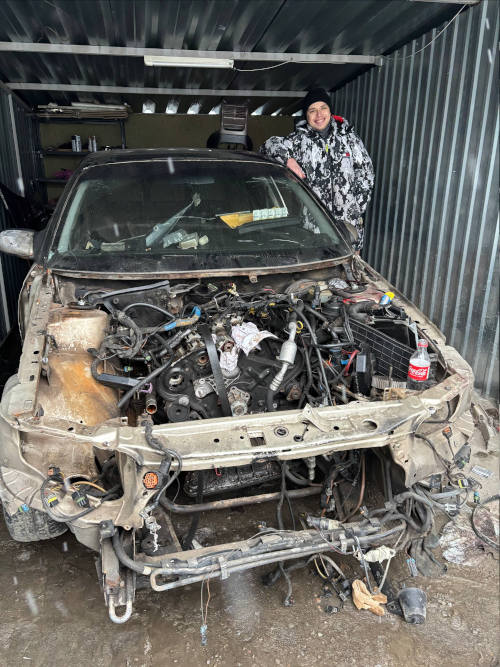
Toyota 4Runner
On paper, performing an engine swap on a 4Runner seems straightforward due to the platform's reputation for reliable mechanics and overall durability. In reality, the only factor to consider for a swap to be potentially viable is compatibility. In terms of the 4Runner, many builders fail to realize that the 4Runner is an early cross for when difficulty and cost begin to scale with respect to the integration of electronics and emissions. This category sets a hard technical benchmark, explains the reality of compatibility with this chassis, and details the reason for some swaps that still do not work. Reference point is factory engines, direct and near bolt-in swaps, and high-effort conversions will be left for later, with a technical preview.
TL;DR
- Engine compatibility on the Toyota 4Runner means mechanical fitment, electronic integration, and emissions survivability working together.
- Engines that physically fit still fail when torque modeling, immobilizer logic, CAN messaging, or thermal load do not match platform expectations.
- Swap difficulty levels measure system integration scope, not fabrication skill, horsepower, or budget size.
- Level 1 swaps stay within factory-adjacent Toyota engines and retain predictable electronics and emissions behavior.
- Level 2 swaps introduce control logic and heat management challenges that often stall projects without escalation.
- Levels 3–5 swaps become full system builds, not engine replacements, regardless of fabrication quality.
- Most builders underestimate higher levels because electronics, validation, and rework scale non-linearly.
- Lowest-risk swaps preserve Toyota control architecture and existing transmission logic.
- Swaps requiring standalone ECUs sacrifice native vehicle integration and rapidly increase complexity.
- Cross-brand swaps escalate fastest because control philosophy, diagnostics, and torque reporting no longer align.
- Engines are rarely the main cost; wiring coherence, debugging time, and iterative rework dominate budgets.
- Timelines stretch because validation and refinement take longer than physical installation.
- Budgets and motivation collapse when integration issues replace forward progress.
- Most swap failures are delayed, appearing after heat soak, sustained load, or long-term vibration.
- Common failure patterns include fragmented wiring, marginal cooling, driveline misalignment, and accessory geometry errors.
- OEM ECU-based swaps align better with US inspection expectations than standalone-managed systems.
- Legal and emissions outcomes must be planned at the architecture level, not treated as an afterthought.
- Rebuilds, conservative boost, or gearing changes often solve the real limitation without destabilizing the platform.
Before you start researching parts and pricing, check whether the swap you have in mind actually fits – and whether it's worth doing.
Check My Engine SwapToyota 4Runner Engine Swap Compatibility Overview
What does 'compatible' mean with an engine swap?
When considering an engine swap on a Toyota 4Runner, the first thing to define is the meaning of 'compatible'. In this situation,n 'compatible' holds a multi-dimensional definition. The terms of compatibility are: the engine swap must have mechanical fitment (can an engine be physically mounted, cooled, and coupled to a transmission); does it have electronic fitment (can an engine communicate with the computer system of the vehicle); and does it have fitment in regards to emissions (can this vehicle legally be driven on the road without the risk of the vehicle processing fault codes - and/or failing an emissions inspection)?
All three of these dimensions must be satisfied. An engine swap that is successful in mechanical fitment but fails in the electronic fitment dimension is still not compatible, even if the engine runs. In a real-world situation, if an engine swap has fully working mechanisms, but it does have emissions issues, it does not meet compatibility on real-world terms. In 4Runner swaps, judging compatibility on a multi-dimensional basis and thinking of it as a checklist is the most mistaken conceptual error.
Mechanical vs electronic vs emissions compatibility
In the 4Runner, mechanical compatibility is centered on longitudinal packaging, drivetrain alignment, and thermal management. Engine length, sump location, accessory drive depth, nd exhaust routing interact with the front differential on four-wheel drive models. Transmission bellhousing patterns and torque spacing further constrain viable combinations. These are visible constraints and are, therefore, easy to overemphasize.
Electronic compatibility is more opaque and often more restrictive. The engine control unit has to share validated data with the body control module, ABS module, instrument panel, and immobilizer. Newer 4Runners have some special requirements: torque reporting, throttle plausibility, and some timing on the data network. These requirements, when ignored, lead to the car cranking but failing to start, starting but having no throttle response, or going into a low-power state that cannot be resolved mechanically.
The last hurdle to clear is emissions compliance. The configure the location of the oxygen sensors and the logic in the catalyst monitor, the evaporative system, and the readiness monitors must be compliant with the certification year of the vehicle. In the US Market, a mismatched engine family can cause inspection failure despite the engine being relatively clean. This is not a tuning issue but a compliance gap.
Reasons why running engines still fail after an engine swap
Starting an engine swap is primarily about physically placing the components into the vehicle. But just because the parts fit does not mean the engine swap will be successful. Often, the documented vehicle functions do not match the available engine functions. As an example, the latter 4Runner models have a traction control system that integrates electronically modulated engine torque with shift scheduling and stability control. This means that if the new engine control unit (ECU) does not provide data about engine torque at the correct time, the vehicle will experience a resistance fault.
Engine immobilizer systems are another common cause of failure. Beginning in the mid-2000s, the starting sequence of the engine ECU, key transponder, and body control module is encrypted and requires the handshakes of the start sequence to match. An engine swap that leaves the ECU with its integrated key security components and body control module results in a no-start condition that no amount of wiring is able to bypass. Miscalculations regarding the thermal loads of a system can also lead to failure of an engine swap. This is particularly true when an aftermarket, high-output engine is placed on a vehicle with an existing automated, under-performing, thermal management system. This condition leads to excessive chronic overheating under higher loads.
Differences Across Generations (Pre-2004 vs 2004+ vs Frame)
Pre-2004 4Runners use more mechanical systems and simpler electronics. They can use more varied engine control systems, but are stricter about packaging other components. Bad mounting geometry, drive line angles, and other poor design choices are felt through vibrations, drive line wear, and frame stress.
Starting with 2004 models, the primary constraint is network logic. It is assumed that all electronic modules are communicating with one another. If a sensor is missing or if it is giving data that the computer thinks is wrong, it shuts down the system. These generations are less forgiving with even partial electronic integration, even if the engine is working.
The aluminum frame era introduces additional sensitivities to mounting practices and torque sequencing. More aluminum means that even though the 4Runner is still a body-on-frame design, it alters where the loads on the frame are coming from and going to. If mounts are too stiff, or torque is unevenly distributed on a set of bolts, there will be a gradual increase in noise, vibration, and harshness (NVH) along with faster fatigue of the fixating elements (bolts).
Toyota 4Runner Platform Reality: What It Allows and What It Punishes
4Runners Body on Frame Benefits & Limitations
4Runners have benefits when it comes to engine swaps because of the body-on-frame style construction. This design allows a separate frame to be modified without affecting the integrity of the cabin. This means replacing crossmembers can be done without being obstructed, and mounting adjustments and repositioning can be done without restriction.
However, this does not mean they can be modified with no consideration for the frame and unibody vehicles. Each frame has pre-established ways of managing and distributing loads, and any modifications to these structures without a thorough understanding of the systems will create failures. For example, if all of the engine mounts are reinforced and secured to the frame, any engine and frame vibrations will be transferred directly into the frame. On the other hand, if a mount is not secured enough, a lot of movement is going to occur in the drivetrain. Essentially, you don’t want to build for the frame’s maximum strength, but design to maintain a balance.
Ignition and Fuel System Components
In the 4Runner, these components are dominated by the steering system and, on four-wheel drive models, the front differential. Steering columns and related components take up a lot of space in the back of the engine compartment, which in turn makes it so that the turbo and exhaust manifolds have to be positioned in a certain way. In addition, the oil pan needs to be designed in a way that will not interfere with the front differential, especially when the suspension is moved through its full range of motion.
Crossmembers have both structural and packaging functions. Their relocation or alteration impacts transmission support and driveline angles. Even small changes can create vibrations that only occur when loaded or at higher speeds. This is especially true when considering brake booster clearance, which is a pervasive constraint with larger cylinder heads and rear-facing intakes.
Electronic constraints (CAN bus, BCM, ABS, security)
The later model 4Runner's electronic systems operate as a validated network instead of standalone systems. The CAN bus anticipates a specific set of message IDs, update cycles, and plausibility ranges. If an engine control unit is unknown, the body control and ABS won’t perform partial operations; instead, they shut down features.
The security systems are also a complication. The engine control unit is tied to the vehicle’s identity due to the integration of the immobilizer. Dependencies with the instrument cluster also matter, as the data logic, warning logic, and gauge behavior are derived from the instrument cluster’s shared data instead of separate sensor data. Vehicles that might seem to run when these dependencies are ignored do not have reliable operation.
Why taking shortcuts leads to integration issues further down the line
Taking shortcuts in engine swaps seems to add time at first, but actually saves time in the long run. Hard-wiring sensors and bypassing network integration may allow the vehicle to start, but it also means the vehicle can't solve problems caused by conflicting data. This can lead to intermittent issues that are hard to troubleshoot, as it may seem like everything else is working fine.
In the same way, taking shortcuts when it comes to mounts and cooling systems will make problems down the line come up sooner rather than later. The 4Runner platform is a good example of this. The issues caused by vibration, heat, and driveline wear are exposed. The real cost is in multiple iterations instead of immediate failure.
Factory Engines Offered in the Toyota 4Runner (All Years)
Complete Factory Engine Specification Table
| Engine Code / Name | Displacement | Engine Type & Cylinders | Fuel Type | Valvetrain / Timing | Power | Torque | Production Years | Donor Vehicles | Known Issues |
|---|---|---|---|---|---|---|---|---|---|
| 22RE | 2.4 L | Inline-4 | Gasoline | SOHC / Timing Chain | Approx. 116 hp | Approx. 140 lb-ft | 1984–1989 | Toyota Pickup, Celica | Timing chain guide wear, head gasket aging |
| 3VZ-E | 3.0 L | V6 | Gasoline | SOHC / Timing Belt | Approx. 150 hp | Approx. 180 lb-ft | 1988–1995 | Toyota Pickup, T100 | Head gasket failures, cooling system sensitivity |
| 5VZ-FE | 3.4 L | V6 | Gasoline | DOHC / Timing Belt | Approx. 183 hp | Approx. 217 lb-ft | 1996–2002 | Tacoma, T100 | Timing belt service interval, exhaust manifold cracking |
| 2UZ-FE | 4.7 L | V8 | Gasoline | DOHC / Timing Belt | Approx. 235–270 hp | Approx. 320 lb-ft | 2003–2009 | Land Cruiser, Sequoia | Timing belt maintenance, secondary air injection faults |
| 1GR-FE | 4.0 L | V6 | Gasoline | DOHC / Timing Chain | Approx. 236–270 hp | Approx. 266–278 lb-ft | 2003–Present | Tacoma, FJ Cruiser | Early head gasket seepage, cam timing actuator noise |
Best Engine Swap Options for the Toyota 4Runner, Ranked by Difficulty
How swap difficulty levels actually work
Swap difficulty levels refer to how many vehicle systems must be altered for the engine to work as a stable, usable powertrain in the Toyota 4Runner. This is not a measure of how much horsepower can be gained, how complicated the fabrication will be, or what the budget will be. A swap becomes more difficult as soon as it requires changes beyond the original engine bay logic, and more into electrics, thermals, and drivelines.
Difficulty increases are non-linear as a result of how modern vehicles are designed. If a factory engine does not pair with the factory assumptions embedded into the vehicle's ECU, transmission control, stability control, or emissions systems, then the integration difficulty increases. Every single workaround creates a new problem, and those problems can conflict with each other. After a point, more fabrication skill won't help because the constraints are more structural than mechanical.
Electronics are primarily responsible for the higher difficulty levels because the 4Runner expects certain behaviors like authenticated torque, variable throttle control, and specific control area network messages. Due to the 4Runner's design, heating becomes just as difficult with increased power as the factory cooling systems and airflow around the engine are designed for the 4Runner's original engine. These are the reasons why a swap that appears to have the same power or size can be more or less complicated than another swap.
Fabrication skills assist in packaging, mounting, and routing exhaust, but they can’t fill in the blanks for missing data paths or the wrong control logic. Difficulty levels indicate how much an engine sticks to the assumptions built into the 4Runner platform. The more it strays, the more the swap becomes a system build instead of just an engine replacement.
Level 1 Swaps (Lowest Risk, Near Bolt-In)
Most of these swaps work because they remain within Toyota's similar engines and control logic. They keep the factory-style communication between the engine/transmission and the rest of the vehicle and align with the 4Runner's expectations. Because of that, emissions thresholds, diagnostics, and engine compliance stay within the factory 4Runner expectations.
Here, factory adjacent engines are important because Toyota, along with the reuse of similar engines and control logic, tools, and safety, spans across multiple platforms, the sensor strategy, torque reporting, and safety assumption. Solutions remain within the scope of known solutions, even with minor adaptations. The majority of complex factory-style vehicle behavior is captured with these swaps.
| Engine Code / Name | Engine Type & Cylinders | Fuel Type | Donor Vehicles & Years | Valvetrain / Timing | Swap Challenges (Specific to 4Runner) |
|---|---|---|---|---|---|
| 1GR-FE (Later Revision) | V6 | Gasoline | Tacoma 2009–2015, FJ Cruiser | DOHC / Timing Chain | ECU calibration alignment between donor year and chassis, secondary air injection compatibility on earlier frames |
| 5VZ-FE | V6 | Gasoline | Tacoma 1996–2004, T100 | DOHC / Timing Belt | Exhaust manifold clearance near the steering shaft, aging harness condition on donor engines |
| 2UZ-FE (Non-VVT-i) | V8 | Gasoline | Land Cruiser 100, Sequoia | DOHC / Timing Belt | Front accessory spacing with radiator support, brake booster clearance under load |
Level 2 Swaps (Moderate Complexity)
At this level, outcomes start to get dominated by electronics and heat management. The engines still stay within Toyota’s ecosystem, but diverge enough in control strategy or output that integration is not trivial. These swaps seem straightforward at first glance, then stall out when network behavior or thermal limits are encountered.
In this case, planning is more valuable than fabrication because the bulk of challenges arrive once the engine runs. The usability of the vehicle is determined by factors like transmission coordination, stability control interaction, and sustained cooling under load. Builders often underestimate how quickly these swaps escalate when factory assumptions are defied.
| Engine Code / Name | Engine Type & Cylinders | Fuel Type | Donor Vehicles & Years | Valvetrain / Timing | Swap Challenges (Specific to 4Runner) |
|---|---|---|---|---|---|
| 2UZ-FE (VVT-i) | V8 | Gasoline | Land Cruiser 100 2005–2007 | DOHC / Timing Belt | CAN torque reporting mismatch with earlier 4Runner modules, higher cooling demand during low-speed operation |
| 1UR-FE | V8 | Gasoline | Tundra, Land Cruiser 200 | DOHC / Timing Chain | Physical width near frame rails, integration of electronic throttle, and stability logic |
| 1KD-FTV | Inline-4 Turbo Diesel | Diesel | Hilux, Prado (Global) | DOHC / Timing Belt | US emissions incompatibility, cooling,g, and vibration isolation challenges on gasoline chassis |
High-Effort Engine Swaps (Levels 3–5)
Instead of thinking of these as swapping engines, think of these as complete system builds. They break factory assumptions on torque delivery, network communication, and temperature handling. When it comes to cross-brand swaps, it only increases these effects with incompatibilities in electronic philosophies and sensor strategies.
At this level, the use of standalone engine management systems becomes a necessity, which cuts communication with the 4Runner’s body and safety systems. As power density increases, the complexity of packaging increases. This means the cooling, exhaust, and driveline geometry will need to be redesigned. At the upper end of the power spectrum, the personality of the vehicle changes.
| Engine Code / Name | Difficulty Level | Engine Type & Cylinders | Fuel Type | Donor Vehicles | Dominant Integration Risks |
|---|---|---|---|---|---|
| LS-Series V8 | 4 | V8 | Gasoline | GM Trucks, Performance Cars | Complete loss of native CAN integration, transmission control separation, and cooling system redesign |
| 2JZ-GTE | 4 | Inline-6 | Gasoline | Toyota Supra | Packaging length, driveline angle changes, and standalone ECU dependency |
| Diesel V8 (Various) | 5 | V8 | Diesel | Heavy-Duty Trucks | Frame load paths, emissions non-compliance, drivetrain survivability under torque |
Universal Engine Swap Execution Reality
Planning & Measurement
The success or failure of an engine swap depends largely on what happens before any actual work is done. Planning is the first reality check of the system and allows builders to see if their assumptions match reality. Static measurements do not account for suspension travel, drivetrain movement, or thermal expansion. Builders often design around a vehicle's static clearances and then discover conflicts once the vehicle is in operational temperature or load conditions.
At this stage of the project, sequencing is more important than precision. Key decisions, such as whether to keep a given transmission, what to do for the ECU, and what to do for emissions, must be made before any physical work occurs. When these decisions are left unanswered, they turn later stages of the project from progressive to corrective. This shift eats time while doing nothing to move the project forward.
Engine Removal
Removing an engine reveals the true nature of the swap's underlying platform. Hidden rust, weak engine supports, damaged wiring, and other such problems often appear only after the original powertrain is out of the chassis. When this happens, it is usually necessary to expand the scope of the project.
The biggest risk in this case is the loss of reference. Taking out parts with incomplete documentation on the relationships between the different systems introduces ambiguity later on. When a new engine is put in, the routing of hoses, the wiring harness, and the ground wires become important. Contextualizing these differences is essential to avoid suffering unnecessary delays. Test Fit & Clearance
Test fitting is more than simply confirming that the engine fits between the frame rails. It is about evaluating dynamic clearance under torque reaction, suspension compression, and steering. Some engine placements that may look acceptable at rest become problematic and contact steering components or the firewall once loaded.
While clearance issues may seem undetectable at first, over time they will manifest into problems such as vibrations, illicit transfer of heat, and abnormal wear. The further along the assembly process, the more problematic this is, as fixing these problems requires disassembling components, which will add time and disrupt flow.
Mounting & Driveline Geometry
Mounting determines how the various forces will transfer through the vehicle. Engine mounts that contradict the load paths will add stress to the frame and the drivetrain. In the same vein, errors in driveline geometry will not immediately fail something. However, they will compound the wear in the joints and the bearings.
This phase often highlights the disparity that exists between engine choice and transmission strategy. Even slight angular deviations will create detrimental oscillations at specific speeds or loads. When these things deteriorate, they are often complex and time-consuming to address, as the problem originates in the geometry and not the failing components.
Wiring and ECU Design
Wiring can either escalate or stabilize the complexity of the entire project. A broken-up approach to wiring creates systems that can technically work but are rather nonsensical. The ECU must manage the engine while also meeting the vehicle's requirements for torque, diagnostics, and the safety logic.
Issues here rarely block the first start. Instead, the issues come up as some faults that are present some of the time, lowered functionality, or some warning lights that come up for no apparent reason. Each signal inconsistency that doesn’t get resolved leads to more abstraction and takes the vehicle further from a state of predictable operation.
First Start and Initial Tests
The first start is a milestone, but more importantly, it is a diagnostic checkpoint. It is a good indicator that fuel, spark, and compression are aligned. However, it is not the end of the line. Validation comes from observing performance across different temperatures and load conditions.
Many swaps get stuck here, and that is due to the vehicle misbehaving rather more than failing altogether. Symptoms seem to come up one after the other, and it is easy to forget about the initial assumptions. The system as a whole needs to be evaluated for progress to resume.
Enter your vehicle and target engine to see a compatibility verdict, estimated cost, required changes, and whether it's the right move for your build.
Get My Swap VerdictEngine Swap Cost & Timeline Reality
Budget Estimates Based on Difficulty
There is a non-linear relationship between the expenses of an engine swap and the difficulty of the task. For simpler swaps, expenses primarily come in the form of the parts needed to be purchased and the parts that need to be integrated. In the more complex swaps, the expensive tasks will be related to wiring, the control strategy, and rework. The more complex the swap, the higher the chances that there will need to be multiple iterations for the changes made.
A significant expense is the early assumptions made, which can damage parts that will need to be replaced. Underestimations in the integrations are what cause a budget to go over more often than not.
Realistic Time Estimates
In terms of time, there is also a similar non-linear relationship to be seen. The early parts of a project move quickly. However, in the later parts of the project, which require validation and refinement, progress can become very slow and even stall.
Most of the time, more complex swaps take longer to complete because of the other parts that need to be installed and the unresolved interactions that need to be addressed. The more unresolved interactions there are, the more systems remain uninstalled because of the unresolved issues. These time constraints are often felt more in a vehicle that is currently not operational.
What Builders Consistently Underestimate
The majority of the time is spent on addressing the interactions between the systems. Testing and refinement, in particular, can not be rushed without the project suffering.
Common Toyota 4Runner Engine Swap Failure Scenarios
Incomplete or Fragmented Wiring
Failures in wiring often appear weeks after the first signs of success. Connections loosen with heat cycles and vibrations. Faulty splices expose loose connections. A fault may appear, but it is intermittent and is very difficult to reproduce.
Because symptoms vary, diagnosis drifts toward replacing components rather than correcting the system. Issues remain as long as wiring coherence is not restored.
Under-sized or Misapplied Cooling Systems
Problems with cooling systems are not apparent when the system is idling. Instead, problems become apparent when there are extreme heat conditions, low-speed operation, or sustained load conditions. Systems designed for the original engine may manage peak temps but fail to control heat soak.
Hoses, sensors, and seals become thermally stressed with repeated overheating. Frequently, collateral damage occurs before overheating indicators become evident.
Misaligned Driveline Angles
Driveline misalignment tends to manifest when there are vibrations. It gives the driver false confidence during casual driving, as the vibrations may disappear. The oscillation accelerates wear under load, though.
Damages appear late because the accumulation is gradual. Instead of replacing modern components, the correction tends to require revisiting base mount geometry.
Accessory Drive & Belt Geometry Issues
Accessory systems do not tolerate a lot of deviation, and work constantly. The belts and pulleys become misaligned and create heat and noise. Parts start to fail prematurely, and the whole system starts to work poorly. These issues often masquerade as component defects.
Accessory failures cause critical system failures, which cause more failures. Root cause resolution requires a reassessment of the placement and alignment of the engine.
Legal & Emissions Considerations (US)
OEM ECU-Based Swaps
Integrating OEM engine management into your swap allows for a more predictable outcome for passing inspections. When the integration is done correctly, factory diagnostics, readiness monitors, and emissions logic still function as the factory intended. This route decreases uncertainty, but does not guarantee compliance.
A common challenge is with differing certification logic between systems. Even with the same manufacturer, systems can prompt assumptions that trigger inspection failures, despite their operation being clean.
Standalone ECU Swaps
Standalone management allows for inspections to be ignored, but offers control compromise. These systems are "engine first" and do not offer regulatory compliance. Because of this, they typically do not include readiness reporting.
This places the outcome of the inspection on the whims of the personnel in charge of enforcement, as opposed to the design of the system. Because of this, the future use of the vehicle is limited.
Inspection Reality
Inspections are concerned with the surface. An integration that is clean and performs well, but does not include the expected data, will be a failure. Whereas a system that performs push beyond limits will be compliant.
A vehicle integration is intended to be used, and builders must view it as a function first when it comes to inspections. Ignoring this transforms a vehicle into a barely operational asset.
When an Engine Swap Is the Wrong Solution
Rebuilding Existing Engines
Rebuilding systems integration and restoring performance means addressing the wear and reliability without adding new variables. For the majority of use cases, it provides the desired outcome while having fewer secondary effects.
After the rebuild, the engine has a functioning emissions system and is drivable. That reliability often outweighs the desire for a performance increase.
Conservative Forced Induction
A mild boost can solve the performance deficit problem without having to rebuild the entire engine. Most of the time, it keeps the factory control logic and the thermal margins intact. This approach requires more discipline than ambition.
While reigns are inflating the boost, they often overshoot the goals. However, under a lot of circumstances, it is more effective than an engine swap.
Gearing & Drivetrain Optimization
Power shortages are often a byproduct of a miscalculation in gearing. Changing final drive ratios can drastically alter how a vehicle behaves without making engine bay modifications. Addressing the problem is more about creating torque at the wheels, rather than at the crank.
Drivetrain Optimization eliminates integration risks while reliability remains intact. It is truly a system-level solution to a system-level problem.
Final Rule: Choosing the Right Tool
An engine swap is more of an option than a workaround. It takes integration work and **trades** it for possible **improvements** in performance or personality. When it is made without consideration of cost, legality, and/or reliability, it creates more issues than it solves.
The best-case scenario is when a workaround is aligned with the actual constraint a vehicle is suffering from. Power, reliability, compliance, and usability are seldom all enhanced in unison. The engineering discipline is in the selection of the tool that best solves the underlying limitation with the least amount of negative secondary outcomes.
Frequently Asked Questions
Why do later-generation 4Runners react so poorly to partial electronic integration?
Later-generation Toyota 4Runners operate on the assumption that drivetrain, stability, and body systems continuously validate each other. The engine is no longer treated as an isolated unit that simply produces torque. Instead, it is a data source that must report torque intent, throttle plausibility, and load state in real time to multiple modules.
When an engine swap provides incomplete or altered data, the vehicle does not fail gracefully. Stability control, transmission logic, and even brake assist functions depend on that data. The result is often a vehicle that starts and drives but behaves inconsistently under load, cornering, or sudden throttle input.
Why do some swaps feel fine around town but fall apart on the highway in a 4Runner?
Low-speed operation masks integration weaknesses. Around town, torque demand is low, cooling systems are not fully stressed, and driveline angles remain within forgiving ranges. Many swaps appear successful during this phase.
Highway operation exposes sustained thermal load, steady-state vibration, and network behavior under continuous demand. This is where marginal cooling strategies, slight driveline misalignment, or incomplete torque modeling reveal themselves. The 4Runner platform tends to surface these problems gradually rather than catastrophically.
How does four-wheel drive change engine swap outcomes on the 4Runner?
Four-wheel-drive 4Runners impose additional constraints that two-wheel-drive platforms avoid. The front differential, transfer case, and steering components occupy critical space and restrict engine placement. Oil pan design and exhaust routing become system-level concerns rather than packaging details.
Driveline synchronization also matters more. Torque delivery must remain predictable to avoid binding or oscillation in the transfer case. Engines that produce abrupt torque changes often require additional control smoothing to coexist with the 4Runner’s four-wheel-drive logic.
Why does retaining the factory transmission matter more on this platform than expected?
The transmission in a 4Runner is tightly integrated into the vehicle’s control architecture. Shift timing, torque reduction during gear changes, and thermal protection strategies rely on continuous communication with the engine ECU. Removing or bypassing that relationship destabilizes multiple systems.
Even when a different transmission appears mechanically compatible, the loss of shared logic often forces deeper electronic intervention. This is why many swaps escalate in difficulty once transmission changes enter the equation, even if the engine itself is well understood.
Why do engine swaps in older 4Runners tolerate mechanical shortcuts but not mounting errors?
Earlier 4Runners relied less on networked electronics and more on physical relationships between components. This allows a degree of freedom in engine management and wiring that later models do not offer. However, the platform transmits mechanical loads directly through the frame.
Poor mount geometry or improper load distribution quickly manifests as vibration, noise, or accelerated wear. These vehicles favor electronic simplicity but penalize structural imprecision. The result is a swap that runs electrically but degrades mechanically over time.
How does torque delivery shape swap success more than peak power in a 4Runner?
The 4Runner’s weight, gearing, and intended use emphasize controllable torque rather than peak output. Engines that deliver torque abruptly stress driveline components and confuse stability systems. Smooth, predictable torque curves integrate more naturally.
This is why some high-output engines feel worse in practice than lower-powered alternatives. The platform rewards engines that communicate intent clearly and ramp torque progressively, even if headline numbers appear modest.
Why do cooling problems often appear months after a swap seems complete?
Initial cooling performance often reflects ideal conditions. Fresh components, clean airflow paths, and moderate use mask marginal capacity. Over time, heat soak during repeated cycles exposes limits.
The 4Runner’s engine bay prioritizes durability over airflow optimization. When a swap increases thermal density, small inefficiencies accumulate. By the time overheating becomes obvious, secondary systems have often absorbed damage.
How does emissions architecture influence engine choice more than mechanical fit?
In the US market, the 4Runner’s inspection outcome depends on the coherence of its emissions reporting rather than raw exhaust cleanliness. The vehicle expects specific readiness states and diagnostic behavior tied to its original certification.
An engine that fits mechanically but cannot reproduce those behaviors introduces persistent compliance risk. This reality narrows viable options far more than engine bay dimensions or mount geometry.
Why do some Toyota-to-Toyota swaps still behave like cross-brand swaps?
Shared branding does not guarantee shared control philosophy. Toyota evolved its network logic significantly across generations and vehicle classes. Engines from different eras may broadcast similar data with different assumptions.
When those assumptions conflict, the 4Runner responds defensively. The swap may appear logical on paper, requires extensive reconciliation to achieve stable operation.
When does a standalone ECU become a liability rather than a solution on this platform?
Standalone engine management excels at controlling engines in isolation. The 4Runner, however, expects the engine to participate in a broader system. Removing that participation simplifies some problems while creating others.
The loss of native communication affects diagnostics, stability control, and inspection readiness. For vehicles intended for regular road use, this tradeoff often outweighs the flexibility gained.
Why do engine swaps often change the driving character of the 4Runner in unexpected ways?
Driving character emerges from the interaction between engine, transmission, gearing, and control logic. Altering one element reshapes the entire system. Even a well-integrated swap shifts throttle response, shift behavior, and noise characteristics.
The 4Runner amplifies these changes because of its mass and suspension tuning. Small differences in torque delivery or engine braking become noticeable, especially off-road or during towing.
How should owners decide whether a swap aligns with how they actually use their 4Runner?
Use case matters more than ambition. Daily driving, long-distance travel, towing, and off-road use stress different systems. An engine swap that excels in one context may underperform in another.
The most successful swaps align engine behavior with the vehicle’s real-world role. When that alignment is missing, the vehicle becomes impressive on paper but frustrating in practice.
Stop comparing specs in your head. Enter your Toyota 4Runner and the engine you want – get a structured verdict with cost, complexity, and a clear recommendation.
See If This Swap FitsYears
No year pages with content are configured for this model yet.