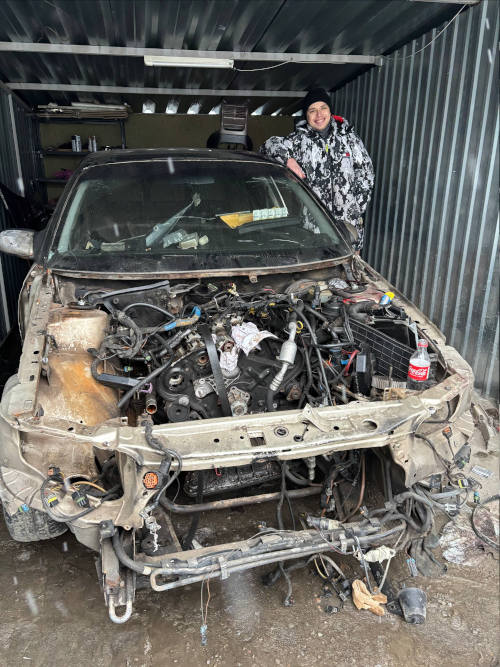
Toyota Camry
An engine swap in a Toyota Camry looks simple on paper and routinely fails in practice. The car’s long production run, shared Toyota parts bin, and massive aftermarket create a false sense of compatibility, where “it bolts in” is mistaken for “it functions as a system.” This category establishes the technical baseline for engine swap decisions by defining compatibility, exposing real difficulty levels, and framing costs as engineering consequences rather than line items. Everything here is grounded in how the Camry platform actually behaves once you move beyond factory assumptions.
The scope is deliberately narrow and structural. Factory engines are treated as the reference point, because every successful swap inherits or deviates from that baseline. Direct and near bolt-in swaps are acknowledged as part of the ecosystem and covered later, as are high-effort swaps that exceed original design intent. This section exists to prevent early decisions that silently multiply costs and debugging time months after the engine is already installed.
TL;DR
- Engine compatibility means mechanical fitment, electronic integration, and emissions survivability working together.
- Engines that physically fit still fail because CAN logic, immobilizers, torque modeling, and thermal limits do not align.
- Difficulty levels represent system complexity, not fabrication effort or engine size.
- Level 1 swaps stay factory-adjacent and succeed because electronics and emissions logic remain predictable.
- Level 2 swaps introduce heat and network conflicts that often stall progress without escalation.
- Levels 3–5 are full system builds where the platform stops cooperating by default.
- Lowest-risk swaps are Toyota engines already used in the Camry family or close derivatives.
- High-effort swaps require fabrication plus standalone ECU strategies to replace factory logic.
- Cross-brand swaps escalate complexity rapidly because drivetrain, electronics, and validation models diverge.
- The engine itself is rarely the main cost, integration time and rework dominate budgets.
- Timelines stretch because debugging abstract system conflicts takes longer than physical work.
- Budgets and motivation collapse under repeated wiring revisions, calibration limits, and partial fixes.
- Most swaps fail due to fragmented wiring, thermal overload, or driveline geometry errors.
- Failures are usually delayed and appear after heat soak, load, or months of use.
- OEM ECU-based swaps have the highest chance of inspection and emissions compliance in the US.
- Standalone ECU swaps simplify engine control but complicate legality and inspection outcomes.
- Rebuilding, mild boost, or gearing changes often solve the real problem with less risk.
- An engine swap is a tool, not a default solution, and system coherence determines success.
Before you start researching parts and pricing, check whether the swap you have in mind actually fits – and whether it's worth doing.
Check My Engine SwapToyota Camry Engine Swap Compatibility Overview
What “compatible” actually means
Compatibility in a Camry engine swap is not a single dimension. It is a three-part system that must align mechanically, electronically, and legally in emissions or inspection terms. Mechanical fitment addresses whether the engine physically mounts, clears surrounding components, and survives load paths under torque. Electronic integration determines whether the engine can communicate with the vehicle’s control modules without persistent faults or degraded functions. Emissions and inspection survivability decide whether the finished car can be registered, driven, and serviced without constant workarounds.
These layers interact. A mechanically perfect installation can fail electronically, and an electronically clean swap can still be rejected at inspection if calibration logic or catalyst behavior does not match expectations. Compatibility therefore means the engine behaves as if the car was designed for it, even if it was not. Anything less is a temporary success that accumulates failure modes over time.
The Camry amplifies this reality because it is not a performance-first platform. Toyota designed it to optimize refinement, predictability, and compliance across markets and years. Swaps that ignore that intent often work at idle and fail under real-world thermal load, transient torque, or long-term drivability conditions.
Mechanical vs electronic vs emissions compatibility
Mechanical compatibility starts with mounts and ends with heat management. Mount geometry must preserve factory load paths through the subframe and unibody, not just hold the engine in place. Crossmember clearance, steering rack proximity, brake booster envelope, and accessory drive alignment all matter because small deviations translate into vibration, steering feedback, or premature component wear. In later generations, even minor changes in engine height or tilt alter half-shaft angles and induce NVH that the chassis was never tuned to absorb.
Electronic compatibility is where most Camry swaps fail quietly. Modern Toyota ECUs expect a specific network topology, message timing, and sensor plausibility. The engine ECU does not operate in isolation, it negotiates with the body control module, ABS, immobilizer, and instrument cluster. If torque requests, load reporting, or security handshakes do not match expectations, the system degrades itself. The result is reduced throttle response, limp modes that appear randomly, or warning lights that cannot be permanently cleared.
Emissions compatibility is not only about passing a tailpipe test. It includes catalyst light-off timing, OBD readiness monitors, evaporative system logic, and misfire detection thresholds. Toyota calibrations are conservative and interconnected. An engine that runs cleanly can still fail readiness because the ECU never sees the exact operating conditions it expects. Once that happens, inspection becomes a recurring problem rather than a one-time hurdle.
Why engines that fit still fail
Physical fitment is the lowest bar and the least predictive of success. A common failure pattern is an engine that starts, idles, and drives gently, then exhibits faults under sustained load or temperature. CAN bus expectations are a primary cause. The engine ECU reports torque, load, and thermal states to other modules that rely on those values for stability control, transmission behavior, and braking logic. If those values are absent or out of range, the vehicle responds defensively.
Immobilizer and security handshakes are another silent failure mode. Toyota integrates anti-theft logic deeply, and mismatched ECUs can appear functional until a security check fails mid-drive or after a key cycle. These issues are often misdiagnosed as wiring problems when they are actually protocol mismatches. Over time, owners accumulate bypasses and reflashes that make the system fragile and unpredictable.
Thermal load and torque modeling complete the picture. An engine with higher output than stock can overwhelm the cooling package or exceed the transmission’s expected torque envelope. Even when parts survive, the ECU may intervene constantly to protect components it believes are at risk. The car feels inconsistent, not because anything is broken, but because compatibility was never achieved at the system level.
Brief generational differences (pre-2004 vs 2004+ vs aluminum frame)
Pre-2004 Camry generations impose more mechanical punishment and fewer electronic barriers. Engine bays are simpler, wiring is more discrete, and fewer modules participate in drivetrain decisions. Failures in this era tend to be physical, such as mount fatigue, exhaust clearance issues, or cooling inefficiencies. The tradeoff is less tolerance for misalignment and vibration because NVH mitigation was more passive.
From 2004 onward, network logic tightens. CAN bus traffic increases, modules cross-check each other more aggressively, and the ECU’s authority over throttle and torque expands. Mechanical installation becomes easier due to packaging refinements, but electronic integration becomes the dominant challenge. Many swaps that would have been acceptable earlier now fail due to missing or implausible data rather than physical interference.
In later aluminum-intensive eras, mounting practices and torque sequencing matter more than ever. The unibody and subframe transmit vibration differently, and small errors produce audible or tactile feedback. NVH sensitivity increases, and engines that are mechanically sound still feel wrong in daily use. Compatibility in these generations is less forgiving and more dependent on exact replication of factory assumptions.
Toyota Camry Platform Reality: What It Allows and What It Punishes
Body-on-frame advantages and limits (for SUV and trucks only)
The Camry is a unibody sedan, not a body-on-frame vehicle. It does not benefit from the structural isolation or mounting flexibility that trucks and large SUVs offer. This distinction matters because advice or assumptions borrowed from body-on-frame platforms do not translate cleanly. There is no separate frame to absorb errors, and the engine, subframe, and body act as a single dynamic system.
As a result, the Camry punishes improvisation more quickly. Mount stiffness, alignment, and load distribution directly influence ride quality and component life. Where a truck might tolerate misaligned mounts with minor consequences, a Camry transmits those forces into the cabin and surrounding systems almost immediately.
Mechanical constraints (mounts, crossmembers, steering)
Mechanical constraints in the Camry are defined by packaging density. The front subframe carries the engine, steering rack, and suspension pick-up points in close proximity. Any engine swap must respect those relationships, because altering one often compromises another. Steering shaft clearance is a frequent limitation, especially with wider or taller engines.
Mount design is not just about strength. Toyota engineers tune mounts for specific frequency ranges to isolate vibration. Changing engine mass or firing order without recalculating mount behavior introduces resonance that feels like drivetrain harshness. Crossmember modifications further complicate this, because they alter how loads flow through the unibody.
Brake booster and master cylinder clearance also constrain swaps. Vacuum routing, pedal feel, and brake assist behavior depend on stable engine vacuum or electronic equivalents. Engines that require different vacuum characteristics can degrade braking performance even when the system appears intact.
Electronic constraints (CAN bus, BCM, ABS, security)
Electronically, the Camry operates as a distributed system. The engine ECU exchanges data continuously with the body control module, ABS, transmission controller, and instrument cluster. These modules expect specific messages at specific intervals, and they validate each other’s outputs. When an engine ECU does not participate correctly, the network does not fail outright, it degrades functionality.
ABS and stability control are particularly sensitive to torque reporting. If the engine ECU cannot provide accurate or timely torque data, these systems intervene aggressively or disable themselves. Security modules introduce another layer, as immobilizer logic is often paired to both the ECU and the cluster. Partial integration results in cars that start intermittently or lose functions after software updates.
The cost of solving these issues is rarely upfront. Builders spend months chasing intermittent faults, reflashing modules, and replacing parts that are not actually defective. The platform does not forgive missing integration, it defers the penalty into long-term debugging debt.
Why shortcuts create long-term debugging debt
Shortcuts in Camry engine swaps usually target initial cost or installation time. Common examples include ignoring secondary CAN messages, bypassing security systems, or accepting persistent warning lights. These decisions appear harmless when the car runs and drives, but they accumulate hidden complexity.
Over time, each workaround interacts with others. Software updates break previously stable hacks, replacement parts behave differently, and diagnostic paths become unreliable. The builder loses a clear baseline, making every future issue harder to isolate. Costs rise not because parts are expensive, but because time and certainty disappear.
A compatible swap minimizes these risks by preserving system expectations. It does not eliminate effort, but it contains it. The Camry rewards thorough integration with stability and punishes improvisation with endless refinement work.
Factory Engines Offered in the Toyota Camry (All Years)
Complete Factory Engine Specification Table
| Engine Code / Name | Displacement | Engine Type & Cylinders | Fuel Type | Valvetrain / Timing | Power | Torque | Production Years | Donor Vehicles | Known Issues |
|---|---|---|---|---|---|---|---|---|---|
| 2S-E / 2S-FE | 2.0L | Inline-4 | Gasoline | SOHC / Timing Belt | ~92–115 hp | ~118–130 lb-ft | 1983–1991 | Camry, Celica | Aging electronics, belt service sensitivity |
| 5S-FE | 2.2L | Inline-4 | Gasoline | DOHC / Timing Belt | ~130–135 hp | ~145 lb-ft | 1992–2001 | Camry, Celica, MR2 | Oil leaks, belt-driven accessories |
| 2AZ-FE | 2.4L | Inline-4 | Gasoline | DOHC / Timing Chain | ~157–166 hp | ~162 lb-ft | 2002–2009 | Camry, RAV4, Scion tC | Oil consumption in early revisions |
| 2AR-FE | 2.5L | Inline-4 | Gasoline | DOHC / Timing Chain | ~169–178 hp | ~170 lb-ft | 2010–2017 | Camry, RAV4 | Water pump seepage, sensor aging |
| A25A-FKS | 2.5L | Inline-4 | Gasoline | DOHC / Timing Chain | ~203–206 hp | ~184 lb-ft | 2018–Present | Camry, RAV4 | High integration complexity |
| M20A-FKS | 2.0L | Inline-4 | Gasoline | DOHC / Timing Chain | ~169 hp | ~151 lb-ft | 2019–Present | Camry | Limited aftermarket support |
| 2VZ-FE | 2.5L | V6 | Gasoline | DOHC / Timing Belt | ~153 hp | ~160 lb-ft | 1988–1991 | Camry, ES250 | Tight packaging, belt maintenance |
| 1MZ-FE | 3.0L | V6 | Gasoline | DOHC / Timing Belt | ~190–210 hp | ~209 lb-ft | 1994–2006 | Camry, Avalon, ES300 | Oil sludge if poorly maintained |
| 3MZ-FE | 3.3L | V6 | Gasoline | DOHC / Timing Belt | ~210–225 hp | ~220 lb-ft | 2004–2006 | Camry, Highlander | Cooling system sensitivity |
| 2GR-FE / 2GR-FKS | 3.5L | V6 | Gasoline | DOHC / Timing Chain | ~268–301 hp | ~248–267 lb-ft | 2007–Present | Camry, Avalon, Lexus models | High thermal output, tight bay |
| 2AZ-FXE | 2.4L | Inline-4 Hybrid | Gasoline | DOHC / Timing Chain | ~147 hp combined | Varies by system | 2007–2011 | Camry Hybrid | Hybrid system integration complexity |
| 2AR-FXE | 2.5L | Inline-4 Hybrid | Gasoline | DOHC / Timing Chain | ~200 hp combined | Varies by system | 2012–2017 | Camry Hybrid | Battery and inverter dependencies |
| A25A-FXS | 2.5L | Inline-4 Hybrid | Gasoline | DOHC / Timing Chain | ~208 hp combined | Varies by system | 2018–Present | Camry Hybrid | System-level swap impracticality |
Best Engine Swap Options for the Toyota Camry, Ranked by Difficulty
How swap difficulty levels actually work
Swap difficulty levels describe how far an engine departs from what the Camry platform already understands. They are not a measure of fabrication talent, nor a linear scale of effort. Each level represents a jump in system integration complexity, where new failure modes appear that did not exist at lower levels. Mechanical fitment usually plateaus early, while electronics, thermal behavior, and network logic continue to compound.
Difficulty increases non-linearly because vehicle systems are interdependent. An engine that adds modest power can trigger disproportionate changes in cooling demand, torque reporting, and transmission behavior. Once those expectations diverge from factory assumptions, the platform responds defensively. Stability control, throttle logic, and emissions readiness all become active constraints rather than background systems.
Electronics dominate higher difficulty levels because they define how the car validates itself. CAN bus traffic, immobilizer states, torque models, and sensor plausibility checks operate continuously. Fabrication skill alone cannot resolve these conflicts. Even a perfectly mounted engine fails if the vehicle cannot reconcile what it is sensing with what it expects to see.
Heat management becomes equally decisive. Toyota calibrates the Camry for narrow thermal envelopes that prioritize longevity and refinement. Engines that operate outside those envelopes require redesign of airflow, coolant routing, and sometimes exhaust aftertreatment placement. At higher levels, the swap stops being an engine change and becomes a system build.
Level 1 Swaps (Lowest Risk, Near Bolt-In)
Level 1 swaps succeed most often because they remain inside Toyota’s design language. These engines share mounting philosophy, electronic architecture, and emissions logic with the original configuration. The platform already knows how to interpret their behavior, which keeps debugging contained. Risk exists, but it is localized rather than systemic.
Factory-adjacent engines matter because Toyota reuses strategies across families. Torque reporting, throttle control, and diagnostic routines remain familiar to the rest of the vehicle. Emissions readiness is predictable because catalyst behavior and sensor layouts align with existing expectations. The result is a swap that behaves like a higher-trim factory variant rather than a custom build.
| Engine Code / Name | Engine Type & Cylinders | Fuel Type | Donor Vehicles & Years | Valvetrain / Timing | Swap Challenges (Specific to Camry) |
|---|---|---|---|---|---|
| 2AZ-FE | Inline-4 | Gasoline | Camry, RAV4, Scion tC (2002–2009) | DOHC / Chain | Oil consumption revisions, ECU calibration matching by year |
| 2AR-FE | Inline-4 | Gasoline | Camry, RAV4 (2010–2017) | DOHC / Chain | CAN compatibility across facelift years, accessory drive differences |
| A25A-FKS | Inline-4 | Gasoline | Camry, RAV4 (2018–Present) | DOHC / Chain | High integration density, network validation with BCM and cluster |
| 1MZ-FE | V6 | Gasoline | Camry, Avalon, ES300 (1994–2006) | DOHC / Belt | Cooling capacity margin, belt service access in tighter bays |
| 2GR-FE | V6 | Gasoline | Camry, Avalon, Lexus models (2007–2017) | DOHC / Chain | Thermal load management, transmission torque expectations |
Level 2 Swaps (Moderate Complexity)
Level 2 swaps cross a threshold where electronics and heat management begin to dominate outcomes. These engines may physically fit and even share lineage with factory options, but their behavior deviates enough to stress supporting systems. Planning becomes more important than fabrication because the failure points are abstract rather than visible.
These swaps often stall because initial success masks deeper incompatibilities. The car may drive well under light load, then exhibit instability under temperature or transient torque. Without escalation into deeper integration work, progress plateaus. The builder is forced to choose between reverting or committing to a higher-effort path.
| Engine Code / Name | Engine Type & Cylinders | Fuel Type | Donor Vehicles & Years | Valvetrain / Timing | Swap Challenges (Specific to Camry) |
|---|---|---|---|---|---|
| 3MZ-FE | V6 | Gasoline | Camry, Highlander (2004–2006) | DOHC / Belt | Cooling system headroom, emissions calibration mismatches |
| 2GR-FKS | V6 | Gasoline | Camry, Lexus models (2018–Present) | DOHC / Chain | Direct and port injection coordination, network security logic |
| 2AR-FXE | Inline-4 Hybrid | Gasoline | Camry Hybrid (2012–2017) | DOHC / Chain | Hybrid system dependencies, inverter and battery coordination |
| A25A-FXS | Inline-4 Hybrid | Gasoline | Camry Hybrid (2018–Present) | DOHC / Chain | Full system integration, torque blending logic |
High-Effort Engine Swaps (Levels 3–5)
High-effort swaps must be treated as complete system builds rather than engine replacements. At these levels, the Camry no longer provides a compatible operating environment by default. Cross-brand or performance-oriented engines bring their own assumptions about drivetrain layout, cooling strategy, and electronic control. The original platform becomes a host rather than a partner.
Standalone engine management becomes necessary because factory ECUs cannot reconcile the differences. This introduces a parallel control layer that must still communicate selectively with the vehicle network. Packaging constraints intensify, as engines exceed original mass, width, or thermal output. Driveline components face loads they were never validated to handle.
Cooling, exhaust routing, and emissions strategy require redesign rather than adaptation. At this stage, success depends on managing interactions between systems rather than optimizing individual parts. The difficulty level reflects that shift in scope.
| Engine Code / Name | Difficulty Level | Engine Type & Cylinders | Fuel Type | Donor Vehicles | Dominant Integration Risks |
|---|---|---|---|---|---|
| 2JZ-GE / 2JZ-GTE | 3 | Inline-6 | Gasoline | Supra, GS300 | Packaging length, driveline alignment, standalone ECU integration |
| 1UZ-FE / 3UZ-FE | 4 | V8 | Gasoline | Lexus LS, SC | Weight distribution, cooling redesign, transmission compatibility |
| LS-series V8 | 5 | V8 | Gasoline | GM Performance Vehicles | Complete electronics replacement, chassis and driveline reengineering |
Enter your vehicle and target engine to see a compatibility verdict, estimated cost, required changes, and whether it's the right move for your build.
Get My Swap VerdictUniversal Engine Swap Execution Reality
Planning & Measurement
Planning is the first system checkpoint, and it fails most often because builders plan locally instead of globally. Measurements usually focus on whether the engine fits between the strut towers, while ignoring downstream consequences like exhaust routing, steering articulation, or service access. In the Toyota Camry, small dimensional errors compound because the engine bay is densely packaged and tightly integrated. What looks acceptable on a tape measure often becomes unserviceable once heat shields, wiring looms, and fluid lines occupy their real volume.
Another common failure at this stage is assuming symmetry. The Camry’s bay is not balanced left to right, and many constraints only appear at full steering lock, suspension compression, or engine torque reaction. Planning that ignores dynamic movement creates problems that only surface after the car is driven. By then, correcting them requires disassembly rather than adjustment.
Engine Removal
Engine removal is deceptively straightforward and often builds false confidence. The real risk is not removing the old engine, but what information is lost in the process. Reference points for driveline angles, mount compliance, hose routing, and wiring paths disappear once everything is stripped. Builders who rush this stage often rely on memory rather than documentation, which leads to misalignment later.
In the Camry platform, removal also exposes how much of the vehicle depends on the engine for context. Brackets, grounds, and harness anchors that look incidental are often part of noise suppression or signal stability strategies. Losing or relocating them without understanding their role introduces subtle problems that do not show up immediately.
Test Fit & Clearance
Test fitting is not about seeing if the hood closes, it is about discovering where the platform refuses to cooperate. Clearance issues rarely involve the main block or heads, they involve accessories, exhaust manifolds, and service envelopes. The Camry’s steering rack, brake booster, and subframe create hard limits that do not move.
The most common mistake here is treating first fit as final fit. Engines shift under torque, mounts deflect, and heat changes clearances. A configuration that looks acceptable statically may contact under load or vibration. These failures appear later as noise, wear, or intermittent faults rather than obvious interference.
Mounting & Driveline Geometry
Mounting is a system checkpoint because it defines how forces travel through the car. In a unibody sedan like the Camry, mounts do more than hold the engine, they tune vibration and protect the structure. Improper geometry changes how torque reactions load the subframe and firewall. The result is often felt as harshness or resonance rather than visible damage.
Driveline geometry failures rarely cause immediate breakdown. Instead, they shorten the life of axles, bearings, and seals. Misalignment introduces cyclic loads that components were never designed to handle. These issues surface months later, long after the swap is considered complete, and are difficult to trace back to their origin.
Wiring & ECU Strategy
Wiring and ECU strategy represent the most decisive checkpoint in modern Camry swaps. The question is not whether the engine can run, but whether the vehicle can understand it. Toyota’s network architecture expects consistent torque reporting, sensor plausibility, and security states. Partial integration creates a car that works sometimes and fails unpredictably.
Many swaps fail here because wiring is treated as a task rather than a system. Splices solve continuity but not signal integrity. Grounding strategies matter, shielding matters, and message timing matters. An ECU strategy that does not respect the rest of the vehicle forces constant compromise, usually in the form of warning lights, reduced power modes, or disabled safety systems.
First Start & Initial Validation
The first start is not a milestone, it is a diagnostic event. An engine that fires proves very little about long-term success. Initial validation must consider thermal behavior, network stability, and response under changing load. Many Camry swaps pass this checkpoint superficially and fail later because deeper validation never happens.
Problems that do not appear during the first start often emerge after heat soak or extended driving. Sensors drift, connectors expand, and control modules reassess plausibility. A swap that survives initial validation without errors is rare, and one that survives without hidden compromises is rarer still.
Engine Swap Cost & Timeline Reality
Budget Ranges by Difficulty Level
Engine swap budgets scale non-linearly because complexity compounds. Lower difficulty swaps cluster in relatively predictable ranges, while higher difficulty builds expand rapidly as integration work grows. The largest expenses are rarely the engine itself, but the time spent making disparate systems cooperate.
Wiring refinement, ECU calibration, repeated disassembly, and custom problem-solving dominate costs at higher levels. Each unresolved issue delays completion and consumes resources indirectly. The Camry platform, with its tight integration, amplifies this effect more than older or simpler vehicles.
Realistic Time Estimates
Time follows the same non-linear pattern as cost. Early stages move quickly, creating the illusion of rapid progress. Later stages slow dramatically as problems become abstract rather than mechanical. Debugging consumes more time than fabrication because causes are not visible.
Many Camry swaps reach a functional state and then stall for weeks or months. The car runs, but not correctly. Each attempt to resolve one issue reveals another dependency. Without clear system understanding, progress becomes incremental and frustrating.
What Builders Consistently Underestimate
Builders underestimate the cost of iteration. Rarely does a solution work perfectly the first time. Revisions consume time and energy, and each revision risks introducing new variables. Opportunity cost also matters, as time spent debugging is time not spent driving or improving the vehicle in other ways.
Another underestimated factor is mental fatigue. Long projects lose momentum, and partially completed swaps often sit unused. The Camry’s reliability baseline makes this especially painful, because the swapped car is frequently less usable than it was originally.
Common Toyota Camry Engine Swap Failure Scenarios
Incomplete or Fragmented Wiring
Wiring failures rarely cause immediate no-start conditions. Instead, they create intermittent faults that appear under specific conditions. Heat, vibration, and electrical load reveal weaknesses that static testing cannot. These issues manifest as random warning lights, sensor dropouts, or unexpected limp modes.
Fragmented wiring strategies are especially damaging. Mixing OEM logic with partial standalone solutions confuses the network. Over time, the vehicle loses consistency, and diagnosing new problems becomes increasingly difficult.
Under-Sized or Misapplied Cooling Systems
Cooling failures often appear only after sustained driving. The Camry’s original cooling system is tuned for specific thermal loads and airflow paths. Engines that exceed those assumptions overwhelm the system gradually rather than catastrophically.
Heat soak after shutdown is a common trigger. Components experience temperatures they were never designed to handle, leading to sensor drift, wiring degradation, and fluid breakdown. These failures accumulate quietly until reliability collapses.
Misaligned Driveline Angles
Driveline misalignment rarely announces itself early. Instead, it accelerates wear. Vibrations that feel minor at first grow over time as components degrade. Bearings, joints, and seals fail prematurely, often without obvious warning.
Because these failures appear months after the swap, they are frequently misattributed to part quality rather than geometry. Correcting them late requires revisiting foundational decisions that are difficult to undo.
Accessory Drive & Belt Geometry Issues
Accessory drive problems emerge slowly and unpredictably. Belt alignment errors cause noise, heat, and accelerated wear. In some cases, they affect charging or cooling performance in subtle ways.
The Camry’s accessory layout is tightly packaged, and small deviations matter. Problems here rarely stop the car immediately, but they erode reliability and confidence over time.
Legal & Emissions Considerations (US)
OEM ECU-Based Swaps
OEM ECU-based swaps offer the highest chance of inspection survival because they preserve factory diagnostics and emissions logic. When executed correctly, the vehicle presents itself as a coherent system. Readiness monitors behave predictably, and fault reporting remains meaningful.
The challenge is completeness. Partial OEM integration often fails inspection not because emissions are high, but because the system cannot verify itself. Missing data is treated the same as failure.
Standalone ECU Swaps
Standalone ECUs shift control away from the factory ecosystem. While they simplify engine management, they complicate inspection outcomes. Emissions readiness, fault reporting, and network communication must be recreated or bypassed.
In practice, many standalone swaps rely on workarounds that satisfy operation but not inspection logic. This creates a gap between drivability and legality that is difficult to bridge consistently.
Inspection Reality
Inspection focuses on system behavior, not intent. Inspectors and test equipment evaluate whether the vehicle reports consistent, compliant data. They do not account for how difficult that data was to achieve.
For Camry swaps, inspection success correlates strongly with how closely the final configuration resembles a factory-supported scenario. The further the deviation, the greater the burden of proof.
When an Engine Swap Is the Wrong Solution
Rebuilding the Existing Engine
Rebuilding often solves the actual problem, which is usually wear rather than design. A refreshed engine restores reliability without disrupting integration. For daily-driven Camrys, this path preserves usability and value.
The rebuilt car retains factory diagnostics, emissions compliance, and serviceability. In many cases, performance gains from restoration exceed expectations.
Conservative Forced Induction
Mild boost can address power deficits without rewriting the vehicle’s identity. When applied conservatively, it stays within the platform’s tolerance. The system remains recognizable to itself.
Aggressive setups erase these advantages, but restrained approaches often deliver better results than swaps at similar effort levels.
Gearing & Drivetrain Optimization
Many perceived performance issues stem from gearing rather than output. Adjusting how power is delivered changes the driving experience dramatically. This approach avoids disturbing the engine’s relationship with the rest of the car. Drivetrain optimization works with the platform instead of against it. For the Camry, that alignment matters.
Final Rule: Choosing the Right Tool
An engine swap is not a goal, it is a tool. In the Toyota Camry, it is a blunt one that demands respect for system boundaries. Cost, time, reliability, and legality intersect sharply, and ignoring any one of them compromises the others.
The right choice aligns the solution with the problem. When the objective is usability and longevity, preserving system coherence wins. When the objective is transformation, accept that the car becomes a project rather than a product. Engineering reality does not negotiate, it only reveals itself over time.
Stop comparing specs in your head. Enter your Toyota Camry and the engine you want – get a structured verdict with cost, complexity, and a clear recommendation.
See If This Swap FitsYears
No year pages with content are configured for this model yet.