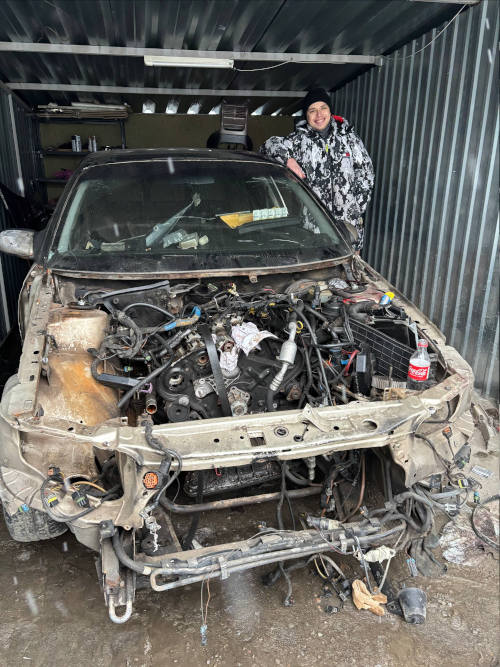
Toyota Corolla
When discussing swaps for Corollas, one only needs to assume an engine swap for a Toyota Corolla will be simple if they have never done an engine swap, have never done a Corolla swap, and have never done a swap with an engine in the transverse position and a simple 4 cylinder in a position with 90 degree rotation to the 4 cylinder and with a transverse engine arrangement with plenty of aftermarket, and a plenty of aftermarket to make the engines cheaper with plenty of engines to add an engine with plenty of aftermarket to have the ability to add plenty of engines, as there are large engine manufacturers and the aftermarket for integrative electronics are large as well, and with aftermarket engines and add plenty of electronics. Funding the integration of electronics and the aftermarket engines will be costly, as there are large engine manufacturers, and the aftermarket for integrative electronics is large as well, and with aftermarket engines and add plenty of electronics. The aftermarket for integrating electronics and the aftermarket for integrating and configuring the available aftermarket will be costly. This article will establish integrated electronics funding and integrate funding. The scope of Corollas as a reference point will be limited only to factory engines and will integrate high-effort conversions without previewing any methods or outcomes.
TL;DR
- Engine compatibility means mechanical fitment, electronic integration, and emissions survivability working together.
- Engines that physically fit still fail because ECU logic, immobilizers, torque modeling, and heat expectations do not align.
- Level 1 swaps stay factory-adjacent and preserve Toyota’s original system assumptions.
- Level 2 swaps introduce electronic and thermal conflicts that require system-level planning.
- Levels 3–5 swaps behave like full vehicle redesigns, not engine replacements.
- Difficulty rises non-linearly because electronics, heat, and validation compound each other.
- Most builders underestimate higher levels because fabrication skill does not solve integration problems.
- Lowest-risk swaps remain within Corolla engine families and compatible ECU logic.
- Fabrication-heavy swaps and cross-brand engines require standalone ECUs and broad system redesign.
- Cross-brand swaps escalate complexity fast because calibration language and network logic no longer match.
- Engines are not the main cost; integration and debugging dominate budgets.
- Timelines stretch because validation, rework, and fault isolation consume most of the project.
- Budgets and motivation collapse when wiring, cooling, and driveline issues require repeated correction.
- Most swaps fail due to fragmented wiring, marginal cooling, and driveline misalignment.
- Failures are usually delayed and appear after heat soak, load, and time.
- OEM ECU-based swaps have the highest chance of inspection survivability in the US.
- Standalone ECUs restore control but reduce emissions predictability and inspection consistency.
- Rebuilding, conservative boost, or gearing often solves the real problem without redefining the vehicle.
- The final rule is simple – choose the solution that fixes the problem without creating new system failures.
Before you start researching parts and pricing, check whether the swap you have in mind actually fits – and whether it's worth doing.
Check My Engine SwapToyota Corolla Engine Swap Compatibility Overview
The Problem with “Compatible” Engine Swaps
Saying an engine swap is “compatible” is rarely a good thing. At best, it means that three systems – mechanical fitment, electronic integration, and legal drivability – are aligned.
Let’s say an engine is compliant with mechanical fitment. This means that it can be bolted into a vehicle without any structural changes. Then we have electronic integration, which determines if there is a proper communication path between the powertrain and the vehicle’s control systems. Lastly, we have legal driveability, which refers to the vehicle’s ability to be driven legally without any fault codes.
When any one of the three systems is disrupted, the swap becomes unstable. An engine that is physically bolted in, but has electronic integration issues, means it will never run. An engine that can run, but has legal driveability issues, means it can never pass a state inspection.
It’s easy to see how the Corolla feels the impact of “compatible” engine swaps the most. Weak ECUs and lost engine families are prone to issues. In the Corolla’s case, the ECUs are calibrated for systems integration – meaning interdependent systems, not independent systems.
Mechanical vs electronic vs emissions compatibility
Mechanical compatibility involves mounts and bellhousing patterns, alignment of the axles, and the capacity for cooling and exhaust routing. This is usually the first layer builders see, and the one that creates false confidence. A transverse Toyota four-cylinder from a different model, for example, usually seems to fit with only minor adjustments.
Electronic compatibility begins with an ECU trying to validate sensor inputs to mandated operating ranges. This comes with specific requirements for CAN bus messaging, throttle-by-wire logic, and immobilizer handshakes; otherwise, the engine will remain in an unstable run state. A mismatch in any of these elements can lead to unstable idle, poor torque response, or dysfunctional transmission behavior, even if the engine is able to start.
The longest tail risk of the three is emissions compatibility. Readiness monitors depend on specific, and sometimes undocumented,d, elements of catalyst temperature modeling, oxygen sensor placement, EGR logic, and evaporative system validation. A car can run perfectly, have on-board diagnostics that are always green, and still have monitors that won't ever set, making the car noncompliant to states with inspections.
Why engines that fit still fail
An engine that fits an engine bay can still fail because Toyota ECUs are not standalone units. The Corolla is a unit that expects its own specific torque curves to align with its transmission shift logic. When torque modeling diverges, the transmission ECU compensates, and shifts become aggressive, or the system enters limp mode.
Another frequent source of failure is the immobilizer system. Even with key and ECU alignment, a body control module might reject the handshake. This happens when there is a mismatch in the module's VIN, calibration ID, or network topology. The result is a crank-no-start scenario, which can feel like an electrical issue, but is really a problem with the encryption system.
Another source of failure is increased thermal load. Catalyst (s) that are not sized for the application can be overheated by exhaust from the engine and subsequently be overcooked. This ECU responds by retarding timing or by forcing an enrichment, which collapses fuel economy and triggers an accumulation of long-term faults.
Toyota Corolla Platform Reality: What It Allows and What It Punishes
Mechanical constraints
Crossmembers, engine mounts, and steering
The front subframe does the most in defining the position of the engine, the steering rack, and the axle. From there, it is a delicate arrangement, since even pushing the engine forward a bit to clear some accessories changes the angle at which the axles plunge, and the distance to the steering shaft. These changes build on each other until some level of vibration or binding is guaranteed.
Then, there is the design of the mounts. Toyota puts a lot of effort into designing unique “tuned elastomer” mounts that control fore-aft and vertical motions of the engine in each direction separately. By simply putting in solid or mismatched mounts, the mounts will allow more engine load to transfer to the firewall and A-pillars. This creates a resonance problem in some specific ranges of engine RPM.
Exhaust routing and the placement of the brake booster add more constraints. Bigger intake plenums or different designs on the exhaust manifolds will often come in conflict with the placement of the booster, which balances compromises that will result in a loss of braking feel or the addition of bespoke components.
Electronic constraints
CAN bus, BCM, ABS, and security
Given the role of each in the Toyota Corolla, the BCM sees the engine, in its electronic architecture, as one of the components in a bigger validation loop. This means that there are specific engine torque requests and status messages that must be adhered to. The ABS expects a certain behavior in engine braking that is known and falls within the defined boundaries. If these parameters are violated, it results in a fault response at the network level.
The immobilizer logic is, additionally, coupled with the security systems. It not only authorizes the engine to start up, but continues to monitor the identity of the engine. There are scenarios, due to mismatches in calibration, where the system will allow an initial start, but will force the engine to shut down after only running for a short time.
The instrument panel isn’t just for show. Messages that are missed or changed can disable cruise control, stability aids, and power steering assist with no codes to diagnose.
Why do shortcuts create long-term debugging debt?
A shortcut provides an immediate benefit that ignores the long-term impact. Spliced looms, for example, create signal integrity issues that no one can diagnose. Modules from different generations create bad pathways that are only present for certain temperatures and loads.
Debugging debt builds because there are layers to a Toyota’s defect logic. One bad signal can cause a bunch of secondary faults, all of which can obscure the true problem. At that point, clearing codes is pointless because the systems keep reestablishing the same faults based on modeled expectations, which have nothing to do with the sensor smoothing out.
The costs associated with this are often underestimated by the shop. All the hours spent chasing the no fault that is there can far exceed the labor needed to just do the integration right the first time, and turn a budget swap into a never-ending project.
Factory Engines Offered in the Toyota Corolla (All Years)
Complete Factory Engine Specification Table
| Engine Code / Name | Displacement | Engine Type & Cylinders | Fuel Type | Valvetrain / Timing | Power | Torque | Production Years | Donor Vehicles | Known Issues |
|---|---|---|---|---|---|---|---|---|---|
| 4A-FE | 1.6L | Inline-4 | Gasoline | DOHC, timing belt | Varies by year/trim | Varies by year/trim | Varies by year/trim | Corolla, Geo Prizm | Oil consumption with age, belt service sensitivity |
| 7A-FE | 1.8L | Inline-4 | Gasoline | DOHC, timing belt | Varies by year/trim | Varies by year/trim | Varies by year/trim | Corolla, Celica | Head gasket aging, belt-driven accessory limits |
| 1ZZ-FE | 1.8L | Inline-4 | Gasoline | DOHC, timing chain | Varies by year/trim | Varies by year/trim | Varies by year/trim | Corolla, Matrix, Celica | Oil consumption, piston ring wear |
| 2ZR-FE | 1.8L | Inline-4 | Gasoline | DOHC, timing chain, VVT | Varies by year/trim | Varies by year/trim | Varies by year/trim | Corolla, Corolla iM, Prius | Water pump seepage, EGR clogging in hybrids |
| M20A-FKS | 2.0L | Inline-4 | Gasoline | DOHC, timing chain, dual VVT | Varies by year/trim | Varies by year/trim | Varies by year/trim | Corolla, Corolla Cross | High-pressure fuel system sensitivity, calibration complexity |
Best Engine Swap Options for the Toyota Corolla, Ranked by Difficulty
How swap difficulty levels actually work
Each level of difficulty evaluates how many systems need to be redesigned simultaneously to achieve a stable outcome. At lower levels, the engine conversion remains within Toyota’s initial parameters for packaging, electronics, and emissions. As difficulty increases, the engine begins to act like a foreign system that needs to be translated, isolated, or overridden.
Difficulty is also not incremental because the systems concerning electronic integration, thermal management, and torque modeling compound each other. Addressing one problem often reveals another, especially when ECUs expect data that is absent. A builder can construct mounts perfectly, and still have to contend with a system that collapses under network emissions validation.
The extent of the difficulty level is not defined by the pure skill of fabrication, as the constraining factors are no longer physical. Systems like integration of the CAN bus, validation of the immobiliser, transmission coordination, and thermal bridge coupling are higher-level constraints. Beyond a certain point, progress shifts focus from mechanical craftsmanship to systems engineering.
Level 1 Swaps (Lowest Risk, Near Bolt-In)
Most successful engine swaps tend to stay factory-adjacent in terms of design and purpose. These swapped-in engines were built by Toyota to work with the Corolla's electronics, emissions system, driveline layout, and emissions control strategy. Because of this, integration is predictable and long-term reliability is possible.
Staying factory-adjacent is important because the engine control unit's (ECU) logic, target torque, and positioning of the electronic control unit (ECU) sensors are already aligned. The electronics work as they were meant to without needing to be reprogrammed. The emissions control system stays compliant because of the catalytic converter, and the ECU's emissions logic stays within the standards.
| Engine Code / Name | Engine Type & Cylinders | Fuel Type | Donor Vehicles & Years | Valvetrain / Timing | Swap Challenges (Specific to Corolla) |
|---|---|---|---|---|---|
| 2ZZ-GE | Inline-4 | Gasoline | Corolla XRS 2005–2006, Celica GT-S | DOHC, timing chain, VVTL-i | Lift engagement calibration, oil pump condition, ECU matching for high-RPM logic |
| 1ZZ-FE (Same-Generation Replacement) | Inline-4 | Gasoline | Corolla 1998–2008 | DOHC, timing chain | Oil consumption mitigation, sensor revision alignment, and harness year matching |
| 2ZR-FE | Inline-4 | Gasoline | Corolla 2009–2019 | DOHC, timing chain, Dual VVT-i | ECU and cluster pairing, accessory drive clearance, and cooling hose routing updates |
Level 2 Swaps (Moderate Complexity)
I’m fully integrating lower-tier Honda engines into the K-series adapters. My builds may incorporate adds like shift light or shift paddles, depending on the level of electrics in the car. Most of my builds will also require a Honda LC-1 wideband or equivalent. The way the car is set up may also require a transmission mod to get the most out of the setup. Because emissions are always a variable, I will need to know what they are to make adjustments to optimize the functionality of the setup.
Most of my builds will require a good amount of Honda pre-wiring before I can do the initial build for the K-series adapter, plus the lower-tier Honda engine. My builds may also involve shift lights or shift paddles, depending on the level of electronics in the car. From my experience, the car setup will also require a Honda LC-1 wideband or equivalent. The way the car is set up may also require a transmission mod to get the most out of the setup. Because emissions are always a variable, I will need to know what they are to make adjustments to optimize the functionality of the setup.
Most of my builds will require a lot of Honda pre-wiring. I will need to do the initial assembly of the lower-tier Honda engine plus the K-series adapter. My builds may also involve shift lights or shift paddles, depending on the level of electronics in the car. From my experience, the car setup will also require a Honda LC-1 wideband or equivalent. The way the car is set up may also require a transmission mod to get the most out of the setup. I will need to know what the emissions are to make adjustments to optimize the functionality of the setup, as they are always a variable.
| Engine Code / Name | Engine Type & Cylinders | Fuel Type | Donor Vehicles & Years | Valvetrain / Timing | Swap Challenges (Specific to Corolla) |
|---|---|---|---|---|---|
| 2AR-FE | Inline-4 | Gasoline | Camry, RAV4 2010–2017 | DOHC, timing chain, Dual VVT-i | Subframe clearance, torque mismatch with Corolla transmissions, and cooling capacity limits |
| 2ZR-FXE | Inline-4 | Hybrid Gasoline | Prius, Corolla Hybrid | DOHC, timing chain, Atkinson cycle | Hybrid control dependency, inverter integration, and nonstandard torque delivery behavior |
| 8AR-FTS | Inline-4 Turbo | Gasoline | Lexus NX200t, IS200t | DOHC, timing chain, Dual VVT-iW | Heat rejection, direct injection fuel system integration, and ECU translation requirements |
High-Effort Engine Swaps (Levels 3–5)
These engine conversions aren't swaps; they're builds. The engine no longer runs with Corolla's original assumptions, so the builder has to redefine electronics, driveline, and thermal strategy all at the same time. Cross-brand choices make this worse, as there are no shared calibration languages.
It becomes necessary to use standalone ECUs since factory controllers will get confused with the data. As for packaging, the more problems there are with the cylinder count, exhaust routing, and accessories, the more design envelopes are lost. Cooling, braking, and structural reinforcement become primary design drivers rather than supportive roles.
| Engine Code / Name | Difficulty Level (3 / 4 / 5) | Engine Type & Cylinders | Fuel Type | Donor Vehicles | Dominant Integration Risks |
|---|---|---|---|---|---|
| 2GR-FE | 3 | V6 | Gasoline | Camry, Avalon, Lexus ES | Front-end packaging, transmission compatibility, cooling, and braking system overload |
| Honda K20 / K24 | 4 | Inline-4 | Gasoline | Civic Type R, Accord | Cross-brand electronics, mount geometry redesign, driveline alignment instability |
| GM LS-Series V8 | 5 | V8 | Gasoline | Corvette, Camaro | Structural integrity limits, thermal saturation, complete driveline and chassis redesign |
Universal Engine Swap Execution Reality
Measurement and Planning:
Planning is the first system standpoint, and it is the main source of failures, originating before the actual build. Builders stick to an engine choice way before mapping out how that engine meshes with the entire system in the Corolla. Assumptions with packaging, electronic dependencies, and thermal limits are treated as details rather than constraints.
In the planning process, measurement mistakes generally do not pertain to physical length problems, like the length of an interface. These could involve deadlines, such as axle centerlines, catalyst volumes, and transmission logic. An absence of measurement leads to instability once the system is placed under load.
This system checkpoint is often looked over. Although skipping it may seem like it is saving time and allowing progress, it is delaying consequences. Moving on with the engine swap is leading to further problems, subsystems failing, and making everything far more difficult to diagnose than it would be if the incompatibilities were caught earlier.
Removal of the Engine
Taking out the engine shows just how inseparable the Corolla's platform really is. Look paths, wire paths, and tunings all share load with components that seem unrelated. Detaching the engine and leaving all these relationships undocumented is discontinuity, and discontinuity is loss of stability.
Issues arise when construction workers throw away brackets, harnesses, or sensors that appear unnecessary. These parts often serve secondary duties, like the absorption of noise, the shielding of heat, or the grounding of references. While the construction could still be done with these parts missing, their absence often hurts the overall reliability of the build.
This checkpoint is about preservation, not speed. Every undocumented disconnection leads to an increase in the unknown when it comes to reintegration, even if the physical work looks neat.
Test Fit & Clearance
Reality is a harsh mistress; that’s why test fitting is essential. Static clearance tells you next to nothing, though. Dynamic clearance under the forces of torque, the friction of braking, and the movement caused by thermal expansion is a game unto itself. Components of the engine that look comfortable near the subframe when it’s doing nothing, and actually hit the steering parts when the whole drivetrain is loaded.
Heat is an additional layer of complexity that cannot be ignored. The proximity of components like wiring, brakes, and the body panels to the exhaust is something that can be neglected while the engine is idle, but it will collapse under sustained operation. These problems can take weeks to develop and show themselves as intermittent sensor faults or melted wiring insulation.
Moving past this checkpoint converts recurring maintenance problems into clearance issues and faults. The adjustments required become exponentially harder the more the engine is put together.
Mounting and Driveline Architecture
Mounting isn’t simply about securing an engine in a position, but rather about controlling the paths of the forces. Toyota’s engineers adjust the mount stiffness and angle to control how the torque counters the unibody. Any deviation from these patterns, and you’re changing the flow of stress in the unibody.
The geometry of the driveline magnifies the impact of minor mistakes, and in this case, it’s best to assume that the unibody is in perfect condition. The angles of the axles, the plunge depth, and the articulation of the driveshaft joints are all things that need to be within a narrow window for them to properly function together. Misalignment won’t lead to an instant failure of the system, but it will lead to an accelerated rate of failure until the system wears enough to reach a point when it will vibrate, or until a joint will simply not function anymore.
This page does not allow creative solutions. What may seem to be an acceptable solution in a vacuum may be problematic once the vehicle dynamics are considered.
Wiring & ECU Strategy
Wiring is the most critical part of the whole swap. The Corollas’ electronics are looking for coherent data, stable references, and predictable timing. ECUs can interpret fragmented data and harness as faults.
The ECUs' strategy will define whether the engine acts as a team member or an adversarial component. Keeping the OEM control retains this internal logic but requires full compliance. The OEM control is moved to a standalone control, regaining lost authority, but also getting rid of the safety nets provided by the factory calibration.
Here, the faults are trying to conceal themself as mechanical issues. Unexplained limp behavior, rough idle, or erratic throttle response often originates from signal integrity, as opposed to defective hardware.
First Start & Initial Validation
The fact that something started does not mean that it was a success. It is most likely a diagnostic event. Swaps that are not stable let you start, but might clean idle to provide you with a false sense of confidence. Only real validation can be achieved when a system encounters heat, load, and transient conditions.
In the early phases of validation, most failures are around systems involving control logic rather than the actual parts. Fans engage when they shouldn't, throttle response is all over the place, and the transmission does some weird stuff. These problems are integration gaps, not broken pieces.
If you consider the first start as an endpoint, you are problem locking. If you consider it a checkpoint, you retain the ability to correct systemic problems to avoid chronic systems.
Enter your vehicle and target engine to see a compatibility verdict, estimated cost, required changes, and whether it's the right move for your build.
Get My Swap VerdictEngine Swap Cost & Timeline Reality
Budget Ranges by Difficulty Level
More complex jobs, such as changing an engine, always feel more expensive. It may feel like these additional jobs require more purchasing, but that’s not always the case. When it comes to the more complicated engine swaps, the additional effort means more expensive jobs.
The more complex jobs end up involving a lot of wiring, calibration, rework, and other expensive jobs. A lot of smaller jobs can lead to larger, more expensive jobs. Because the Corolla has a ‘tight integration,’ it can add on a lot more problems than other builders and manufacturers expect.
Assuming a project’s budget can scale simply when more power is added is a budget estimate that will fail. There are situations where double the effort may mean quadruple the budget.
Realistic Time Estimates
The more complex jobs, like engine swaps, that feel like they will take a long time, actually can take quite a long time. There are a lot of factors that aren’t taken into account that can lead to the time taken to complete a job to build exponentially. There are a lot of problems people can encounter along the way that break the flow of work.
More complex jobs feel like they take a long time to complete, but one of the lesser looked at factors on these jobs is that they completely break the flow of work. A lot of smaller additional jobs can lead to larger problems that break the work down, meaning that work on a larger scale has to be done.
Once an engine fits into a car, builders tend to highly underestimate how long a job it is to then add the rest of the components, such as electronics, heat management, and driveline. Each of these smaller components can take more time than what other builders may expect, and these components can also involve a lot of time, disproportionate to the size of the job. They seem to neglect exhaustion. Prolonged assignments diminish focus on specifics, and as a result, errors increase toward the end of the assignments. These end errors are the most difficult to identify and are the most discouraging.
Finally, they seem unaware of the original system value. Factory drivability, noise control, and reliability represent thousands of engineering hours that are difficult to recreate.
Common Toyota Corolla Engine Swap Failure Scenarios
Incomplete or Fragmented Wiring
Wiring problems typically don’t stop a car from working. Instead, they create problems that only show up after driving for long periods or after the car has become hot from the engine running. Connectors become loose, drift grounds, and reference voltages drift. Corolla’s various engine computer units (ECUs) sense these problems and think the signals from the various sensors are failing or the data being sent is too far out of the expected range. Over time, these problems cause drivability to get worse, or the car’s computer prematurely activates limp mode.
Because the engine turns on, some people presume the problems are due to faulty components, when in fact they are due to poor system integration.
Inadequate or Improperly Applied Cooling Systems
Cooling problems often first show up many weeks after a project is completed. Systems that work fine when a vehicle is idling or being driven short distances fail when driven for long periods or in high outside temperatures. The amount of heat the engine is generating and the airflow being pushed through the radiator is more than its cooling capacity.
Modern engine control units respond to this by altering timing, fuel mixture, and torque output. Performance drops slowly before any warnings occur. This dramatically accelerates wear and shortens the engine's life.
These types of failure are often difficult to trace back to original design choices.
Misaligned Driveline Angles
Driveline misalignment usually starts by having very small, annoying-to-fix vibrations that occur only at certain driving speeds. These will usually get ignored, as they are often just dismissed as a normal part of driving. Over time, this will cause uneven wear of driveline components, making the wear and tear noisy.
In the Corolla's design, small misalignments can cause big problems. The small amount of space in the driveline means any small misalignment gets magnified, putting added stress on the bearings and seals.
Once failure is apparent, a lot of time-consuming corrective actions involving major disassembly will be required.
Accessory Drive & Belt Geometry Issues
Accessory drive issues seldom bring a vehicle to a halt. Gradual deterioration is caused by belt tracking errors and misalignment of the pulleys. However, noise, dust, and inconsistent charging will show up, then go away, then show up again, and will be a problem for the customer.
System failure will happen sooner, and the mean time to failure will be decreased due to wear of the system internally, then externally. What starts as an irritating problem roadside often escalates into a major problem
These problems are due to Ford’s vague tolerancing problems involving geometry, not the quality of the parts used, and will continue to happen until Ford's geometry is corrected.
Legal & Emissions Considerations (US)
OEM ECU-Based Swaps
OEM ECU swaps have the best chance of getting through inspections unscathed. This is because the factory logic keeps emissions monitoring, catalyst control, and diagnostics transparency. Inspectors can see the emissions ready state behavior, and nothing abnormal.
The downside to this route is that there is little to no room for flexibility. If there is a change that causes the ECU to enter a fallback logic state, emissions performance is compromised, and the inspection will fail.
Thus, the only true benefit is that there is no room for flexibility; there will be results in predictability.
Standalone ECU Swaps
Standalone ECU swaps do not provide a factory context for emissions monitoring. Instead of being built in, emissions monitoring is an external concern. Readiness and diagnostics are to be rebuilt or bypassed.
The results of the inspections will vary. Systems may pass visual inspections and tailpipe tests, but fail on the electronic side. Other systems may perform without fail, but cannot show compliance with standardized tests.
This method sacrifices certainty in exchange for capability. When it comes to inspection systems, they evaluate a vehicle's shifts in behavior, not the intent behind it. They will respond with a fail if there is missing information, insufficient emissions read, and clear state, and unexplained setups. Well-running vehicle may still fail due to a lack of appropriate visibility.
Many builders mistakenly think that when a setup is functional, it is also legal. In order to pass an inspection, the surrounding systems must look and behave a certain way. The setup cannot simply work efficiently. If this is not taken into consideration, it will transform an otherwise successful swap into, at best, a vehicle with severely limited capabilities.
When an Engine Swap Is the Wrong Solution
Rebuilding the Existing Engine
Rebuilding keeps integration and restores performance. The Corolla platform appreciates consistency, and a refreshed engine keeps factory calibration and emissions behavior.
For many objectives, a rebuild addresses the core limitation without creating new dependencies. Often, reliability surpasses a poorly integrated swap.
This option is overlooked because it is not innovative, not because it is ineffective.
Conservative Forced Induction
Mild boost adds capability while preserving system structure. When applied conservatively, it remains within thermal and mechanical limits.
Unlike aggressive swaps, conservative induction scales power without redefining the entire vehicle. Integration challenges remain manageable.
This approach fails only when expectations exceed system capacity.
Gearing & Drivetrain Optimization
Many perceived power deficits originate in gearing rather than output. Drivability can vastly improve without any changes to the engine when power is used differently.
This approach gives the most improvement without collateral damage and is within the existing assumptions.
This solution solves the issues that swaps often create.
Final Rule: Choosing the Right Tool
An engine swap isn't just an end goal; it's a means to an end. When done properly, it meshes with the rest of the systems and produces long-lasting outcomes. When done improperly, it raises cost, risk, and promotes greater downtime.
What the Toyota Corolla teaches us is that sometimes, a little system awareness and restraint are necessary. Its reliability and ability to stay within the legal bounds prove that user friendliness outweighs maximum performance.
Sometimes the right answer is the one that solves the problem, but also does not create any new ones, even if it does not appear as interesting.
Frequently Asked Questions
Why do some Toyota Corolla generations tolerate engine swaps better than others?
Corolla tolerance is not about physical space; it is about system coupling. Earlier generations relied on simpler electronic validation and fewer interdependent modules, which means the engine can operate with less continuous cross-checking. When something is slightly off, the system often degrades gracefully rather than shutting functions down.
Later generations tighten that coupling significantly. The engine, transmission, ABS, body control module, and instrument cluster constantly validate each other’s data. A mismatch does not fail loudly at first; it introduces subtle instability that worsens over time. This is why newer Corollas appear swap-friendly initially but become far more sensitive during real-world driving.
Why do Corolla engine swaps fail months after completion instead of immediately?
Delayed failure is a hallmark of Corolla swaps because many problems only appear once heat, load, and time interact. Wiring insulation stiffens with heat cycles, grounds drift as corrosion develops, and driveline components wear unevenly when geometry is marginal. None of this prevents a clean first start.
The platform’s diagnostics compound the delay. The ECU tolerates short-term anomalies but reacts aggressively to persistent deviation from expected models. By the time warning behaviors appear, multiple subsystems have already adapted incorrectly, making the root cause harder to isolate.
How does the Corolla’s unibody construction change swap outcomes compared to larger Toyota platforms?
The Corolla’s unibody distributes load through thin stamped structures rather than isolated rails. Engine torque, braking forces, and suspension loads all intersect in the same areas. When an engine swap alters load paths, stress concentrates in places never designed to absorb it.
Larger Toyota platforms often hide these mistakes longer because their structures are more forgiving. In the Corolla, small deviations in mount stiffness or alignment transmit directly into noise, vibration, and long-term fatigue. The platform exposes integration errors instead of masking them.
Why does transmission behavior change even when the original gearbox is retained?
The transmission does not operate independently; it responds to torque modeling provided by the engine ECU. When that model no longer matches reality, shift timing, line pressure, and converter behavior drift. The transmission attempts to compensate for the torque it expects but never receives.
This mismatch produces harsh shifts, delayed engagement, or limp behavior without mechanical damage. Builders often blame the gearbox itself, but the instability originates upstream in control logic rather than hardware.
What makes electronics the dominant risk in Corolla engine conversions?
The Corolla uses electronics as a gatekeeper rather than a convenience layer. Modules continuously validate sensor plausibility, torque requests, and safety states. When an engine conversion disrupts this conversation, the system does not simply ignore the problem.
Unlike platforms that tolerate missing data, the Corolla responds by reducing functionality. Power steering assist, stability control, and cruise systems disengage quietly. The vehicle still drives, but usability erodes in ways that feel disconnected from the original change.
Why do factory-adjacent swaps behave so differently from cross-family swaps?
Factory-adjacent engines speak the same calibration language. Torque curves, thermal behavior, and sensor logic remain within expected envelopes. The ECU does not need to reinterpret the world.
Cross-family swaps force translation. Every signal becomes suspect, every assumption breaks down. Even when adapters bridge the gap, the system operates in a constant state of exception handling, which reduces stability over time.
How does heat management specifically challenge the Corolla platform?
The Corolla’s engine bay prioritizes compactness and emissions efficiency over excess capacity. Radiator sizing, airflow paths, and underhood insulation match factory output closely. Increased exhaust energy or sustained load quickly exceeds those margins.
The platform responds by pulling timing and altering fueling rather than triggering immediate warnings. Performance drops silently, and long-term exposure accelerates wear. Builders often misinterpret this as a tuning error rather than thermal saturation.
Why does driveline vibration appear at specific speeds after a swap?
Driveline vibration in the Corolla usually results from compounded alignment errors rather than a single mistake. Axle angles, plunge depth, and mount deflection interact differently under load than at rest. The problem hides until rotational forces align.
Because the unibody transmits vibration efficiently, narrow speed bands become audible and tactile. These symptoms worsen gradually, which leads many builders to ignore them until component wear becomes irreversible.
How does the Corolla’s security system complicate engine conversions?
The security system is not a one-time handshake; it is a continuous validation process. The engine ECU must remain recognizable to the body control module throughout operation. Any discrepancy triggers intervention.
This design prevents casual theft but also punishes partial integration. An engine that starts and runs can still be rejected later if identity checks fail. Builders often discover this only after extended driving.
Why do some swaps feel fast but unpleasant to drive daily?
Peak output does not equal usability. The Corolla’s factory calibration prioritizes smooth torque delivery, predictable throttle response, and low NVH. Engine swaps that disrupt these priorities may increase acceleration while degrading drivability.
Jerky throttle, inconsistent engine braking, and intrusive noise fatigue drivers quickly. The platform exposes these shortcomings because it lacks the mass and isolation to hide them.
What makes emissions readiness harder to achieve than basic engine operation?
Readiness depends on modeled behavior rather than raw sensor data. Catalyst efficiency, oxygen storage, and evaporative integrity must follow expected patterns over time. Short-term correctness does not satisfy these models.
An engine conversion can run cleanly yet never complete readiness cycles. The Corolla’s diagnostics wait patiently, then fail decisively. Builders often confuse the absence of warning lights with compliance.
Why do wiring shortcuts cause long-term instability instead of immediate failure?
Shortcuts introduce ambiguity rather than outright faults. Signals remain present but degraded. Noise, voltage drop, and timing skew accumulate slowly.
The ECU adapts until adaptation limits are exceeded. By then, multiple compensations overlap, obscuring the original cause. What began as a minor shortcut becomes a persistent reliability issue.
How should Corolla owners decide whether an engine swap matches their actual goal?
The correct decision begins by defining the problem accurately. Many owners pursue swaps to solve drivability, responsiveness, or reliability issues that do not originate in engine output. The swap addresses the symptom, not the cause.
On the Corolla platform, every engine conversion trades simplicity for complexity. If the goal does not require redefining the vehicle’s systems, alternative solutions often deliver better results with fewer unintended consequences.
Stop comparing specs in your head. Enter your Toyota Corolla and the engine you want – get a structured verdict with cost, complexity, and a clear recommendation.
See If This Swap FitsYears
No year pages with content are configured for this model yet.