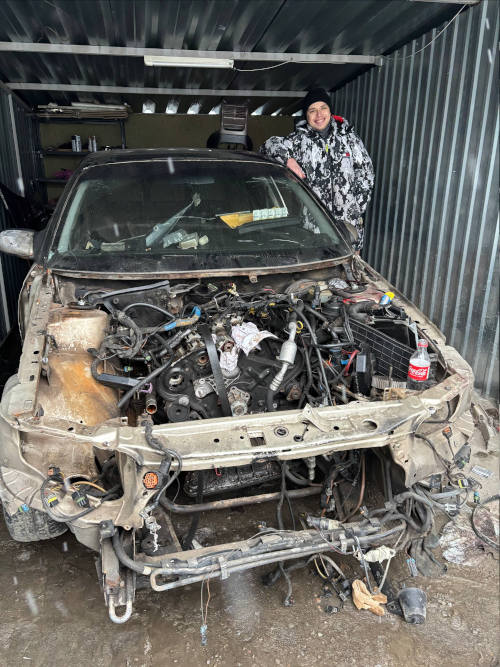
Acura MDX
Honda's transverse front-wheel-drive architecture defines the MDX's place in the U.S. crossover market. Each generation's MDX uses unibody construction comparable to unibody passenger vehicles, employing a front subframe, transverse V6 engines, and front-bias all-wheel drive or later torque-vectoring AWD systems. In contrast to typical body-on-frame SUVs, these factors limit the realistic possibility of particular engine substitutions and must be considered when determining the scope of changes required to accommodate an engine swap. Modifications to the selection, configuration, or calibration of the engine or the control systems as the vehicle progresses in generation can shift an engine swap from an integration project to an ongoing engineering challenge.
Due to these factors, MDX engine compatibility extends beyond the vehicle's engine bay and toward the integration of engine control, transmission control, vehicle stability control, emissions, and vehicle security systems via multiplexed control modules. The MDX contains a vehicle control network that expects certain torque, immobilizer, and emissions state signals, while an engine swap will not provide these. As a result, swaps must be carefully considered as they must balance mechanical fitment and the appropriate electronic and regulatory complexities to be successful.
TL;DR
- Engine compatibility in the Acura MDX means mechanical fitment, electronic communication, and emissions readiness all function together as a system.
- Engines that physically fit can still fail when torque modeling, immobilizer communication, or CAN network expectations do not match the vehicle architecture.
- Level 1 swaps stay within the same engine ecosystem and typically preserve mounting geometry, drivetrain alignment, and predictable electronics behavior.
- Level 2 swaps introduce moderate integration challenges where cooling, ECU communication, and accessory packaging begin to dominate complexity.
- Levels 3–5 represent full system builds where drivetrain layout, electronic architecture, and thermal management must be redesigned together.
- Difficulty rises non-linearly because small mechanical deviations cascade into electronic conflicts, driveline geometry issues, and cooling limits.
- Swaps within the Honda J-series family carry the lowest risk because the MDX drivetrain and electronics already understand their behavior.
- Moderate swaps often succeed mechanically but stall during wiring integration or transmission torque coordination.
- Cross-brand swaps escalate complexity rapidly because drivetrain orientation, ECU logic, and communication protocols no longer match the MDX platform.
- The engine itself rarely drives project cost; wiring integration, fabrication corrections, and repeated debugging dominate budgets.
- Project timelines stretch because real issues appear during integration cycles, not during initial installation.
- Many builds stall when builders underestimate electronic integration and the time required to stabilize network communication.
- Most failures appear weeks or months later due to wiring instability, heat accumulation, driveline misalignment, or accessory drive stress.
- Cooling limitations and torque-related transmission behavior often emerge only under sustained load rather than during early test drives.
- Swaps that retain OEM-style engine management have the best chance of maintaining normal diagnostic behavior during U.S. emissions inspections.
- Standalone ECU setups often run well mechanically but complicate inspection readiness because diagnostic systems no longer match factory expectations.
- Rebuilding the original engine often solves reliability or performance concerns while preserving factory drivetrain integration.
- Mild performance upgrades or drivetrain ratio changes sometimes address the real limitation without disrupting the vehicle’s electronic ecosystem.
- The decisive rule is simple: the closer the replacement engine behaves like the factory system, the more reliable the finished vehicle will be.
Engine Replacement Possibilities for an Acura MDX
Understanding Compatibility
For an MDX, an engine swap means all the vehicle’s mechanical, electrical, and legal systems. Mechanically, the engine, mounts, and surrounding accessories must fit. All control modules, engine and transmission, plus the vehicle’s computer system,s must communicate and electrically integrate with the new engine. Lastly, the engine must meet the legal emissions and data reporting requirements, along with passing inspections.
An engine swap candidate must have some combination of the four dimensions of compatibility. Many Honda family V6 engines can be interchanged because they can be bolted to the same engine mounts. This is not the case with MDXs. Newer generations have additional requirements to be integrated into the engine. The vehicle control computer actively monitors the engine because it also controls the vehicle's traction control and transmission. If the control unit of the replacement engine does not provide the signals required, the drivetrain will enter limp mode and/or trigger fault codes.
The compatibility of the swap must be evaluated from a system level rather than a singular mechanical viewpoint. Builders must also understand how the engine integrates with the vehicle’s electronic control system and driveline strategy. For example, MDX platforms utilize engine torque information for the control of traction, distribution of torque to the AWD, and transmission shifting. If those control systems lose confidence in the engine data, it can result in erratic or complete failure to function.
Mechanical, electronic, and emissions compatibility
Mechanical compatibility is the most apparent dimension of a swap, and it accounts for the engine’s occupancy of the physical space, alignment with the transmission’s bellhousing, and the ability to connect to and integrate with accessory systems, including but not limited to cooling, intake, and exhaust. The MDX incorporates transverse layouts for the powertrains; therefore, the length of the engine is limited by the front subframe and firewall. Longitudinal or taller engine blocks rapidly exceed this length restriction.
In further generations of MDX, electronic integration issues become most prominent. Their vehicles' engine control modules are integrated through CAN networks with body control modules, stability control modules, and instrument cluster modules. The coupled ECU provides torque calculations that determine the interventions of traction control, the logic of transmission shifts, and the strategies of torque distribution to the differentials of the AWD. If the engine control module is unable to send certain signals, then multiple modules will register communication errors.
Another continuing concern is emissions control standards. The MDX sold in the United States is subject to the almost universal and comprehensive OBD-II readiness, which means the engine control module has to provide information on the efficiency of the catalytic converter, the status of the evaporative emissions control system, the operation of the oxygen sensor, and other diagnostic tests. An engine control module swap that is missing or bypasses any of these components is likely to be an immediate fail on an emissions test. If the engine controls correctly, the vehicle may still be unusable in regulated states because the readiness tests were not completed.
Why engines that fit still fail
Failing engine swaps are often the result of incomplete integration. For example, most MDX models require an electronic immobilizer authentication process. If the vehicle is not programmed correctly, ly then it may be the case that the vehicle will turn over but not start.
Another failure point is with modeling torque. Modern transmissions wait for precise estimates of engine torque, and then make decisions about when to shift and at what pressure to engage the clutch. If a swapped engine produces torque signals that don’t match what it was designed to expect, then it could interpret that difference as a fault condition. This can cause the shifted torque to be erratic, and the engine could default to a protective state, or it can reduce the amount of available power.
Failures resulting from cooling and from driveline geometry also happen with engine swaps. The MDX’s packaging is especially tight around the engine and transmission assembly. Larger engines can create a thermal load that exceeds the original powertrain’s radiator and airflow. Also, when you swap an engine, the angle of the driveshaft can change,nge which can create a position for the driveshaft that will cause excessive vibration or premature failure of the components. These conditions can be present for a long time before they are noticed.
Short Differences Between Generations
Over the years of production, the Acura MDX gained multiple iterations of engineering refinements. The refinements vary in the amount of electronic components and chassis control systems. From the mid-2000s, the older vehicles have a more simplistic approach to CAN and simpler traction systems. Swapping engines in these vehicles runs into far less dependence on the network. However, the integration of the immobilizer and the emissions readiness system still has to be considered.
Control architectures keep improving in later generations. More detailed communication between engine and chassis modules is needed with torque vectoring all-wheel drive systems, integrated stability control strategies, and advanced transmission management. The control engine unit is now integrated in the vehicle dynamic systems, and therefore, powertrain mismatches can affect multiple subsystems.
The fourth-generation MDX will be the first with these capabilities. The vehicle is electronically integrated at the system level. Engine control, transmission management, and chassis stability systems utilize high-bandwidth communication. In these conditions, system compatibility is determined more by the ability to replicate or emulate the communication patterns of the original powertrain than by simply fitting an engine of the same size.
Before you start researching parts and pricing, check whether the swap you have in mind actually fits – and whether it's worth doing.
Check My Engine SwapAcura MDX Platform Reality: What It Allows and What It Punishes
Structural Architecture and Chassis Response
For each of the MDX’s generations, the vehicle’s structural architecture builds from a unibody design, avoiding a ladder frame construction. The vehicle’s engine and transmission assemblies connect to a front subframe, which is integrated into the vehicle’s monocoque structure. This design helps increase the overall rigidity of the vehicle and enhances the overall ride. However, this construction technique limits the flexibility required for future developmental modification of the engine and transmission assemblies. Although a unibody design is better for torsional rigidity and ride quality, it also limits developers’ flexibility for employing large modifications to the powertrain.
In monocoque designs, the unibody structure functions as the structural frame of the vehicle, instead of the frame rails. The placement of the engine and transmission assemblies sets limits based on the mass and torque of the assembly. This is because the subframe engine mounts create a load distribution design, which, if unbalanced, can cause surrounding structural elements to become fatigued or injured due to vibration caused by the load.
The design of the subframe determines the arrangements of the steering rack, suspension arms, and drivetrain elements. Given that the MDX incorporates all of these elements tightly, varying the position of the engine can create collisions with the steering components. Additionally, small modifications to the position of the engine can skew the alignment of the axles and the angles of the drive shafts, leading to excessive vibration or premature wear on the constant velocity joints.
Another consideration is NVH behavior. The use of tuned engine mounts and subframe bushings is designed to isolate vibrations from entering the passenger compartment. However, an engine's varying firing frequencies and torque pulse can produce vibrations that the original isolation system wasn't made to absorb. This is especially true when the engine is idle or at low speeds.
Mechanical constraints (mounts, crossmembers, steering)
Mechanical constraints in the MDX engine bay are predominantly determined by the transverse configuration of the drivetrain. The engine is sideways in relation to the vehicle's direction, a nd the transmission is next to the engine rather than behind it. This configuration shortens the overall length of the powertrain, but creates a more compact space from the radiator support to the firewall.
The locations of the engine mounts are designed around a specific block geometry. The V6 engines of Honda and Acura are often architecturally similar to one another, and this helps to keep mount compatibility within certain engine families. However, block height and accessory positioning can affect subframe clearances. Builders often face interference from power steering, intake, and exhaust routing.
The placement of the steering rack also adds new constraints. In the MDX, the steering system is located behind the front subframe, next to the engine block and oil pan. Engines that have a deeper oil pan or a different exhaust configuration would come into contact with the steering system during suspension movement. Such conflicts could occur depending on the load applied to the system or during aggressive steering, which makes it difficult to identify during post-installation testing.
The layout of the cooling system also impacts the feasibility of the design. The placement of the radiator, the position of the fan, and the design of the airflow are optimized for the original engine cooling system design. An increase in engine displacement or power output for the engine will increase the cooling requirements. If the cooling system is not designed to handle the increased heat, the engine will overheat in operation.
The MDX platform also has some electronically based limitations that are related to the CAN bus and the BCM, ABS, and security systems.
Electronic systems in the MDX platform rely heavily on the CAN (Controller Area Network) for communication between modules. The engine control unit (ECU) communicates in real-time with the body control module (BCM), anti-lock braking system (ABS), dashboard, and transmission control modules. Each of these modules has certain expectations with regard to the content and frequency of messages sent by the engine ECU.
Torque data is one of the most vital pieces of information conveyed through the CAN bus. Stability control and AWD systems use these data to estimate the engine power sent to each wheel. If the engine’s ECU fails to send this data, the vehicle will deactivate some of the traction control functionalities and/or activate warning lights. Additionally, some modules will lower the engine’s power as protection.
The integration of security is yet another significant limitation. Many MDX models have immobilizer systems, where the ECU must do an authentication verification with the vehicle's security module to enable fuel delivery and ignition. In the case of fitting an ECU from another vehicle, the immobilizer handshake will most likely fail unless the modules are set to each other. If the authentication is not done, the engine will start for a few seconds and then turn off.
There are also some steering management interactions with the anti-lock braking system. During stability control incidents, the ABS module may compel the engine ECU to reduce torque. If the engine ECU is not able to perceive or respond to these commands, the stability control system may record faults or deactivate itself. Particularly in the more recent MDX models, these interactions are constant as the vehicle is being driven.
Why do shortcuts create long-term debugging debt?
During an engine swap, shortcuts made in the beginning can create problems that only appear long after the engine was installed. The vehicle might run smoothly in the beginning, but later on develop intermittent problems as the different subsystems try to communicate with the new powertrain. These problems are usually the cause of bad partial integration.
An example of this is the bypassing of an engine immobilizer or diagnostic systems. These can, for the time being, allow an engine to start and run. However, other control units still expect communication from the ECU in the original vehicle. This results in network errors, warning lights, strange vehicle behavior, and loss of functionality.
Transmission behavior can also degrade when an Automatic Transmission Control (ATC) unit is fed with the wrong torque data. The ATCs adjust the clutch pressure and shift timing based on predicted engine torque. If the prediction is wrong, the shift will be harsh and will be delayed. This will also cause an early degradation of the transmission.
For long-term reliability, the engine swap should be treated as a system integration problem, not just a mechanical installation. The closer the replacement engine comes to mimicking the original powertrain in terms of communication, the more stable the vehicle will be in the long run. Integration details are often ignored, resulting in continued troubleshooting instead of a stable final build.
Factory Engines Offered in the Acura MDX (All Years)
Complete Factory Engine Specification Table
| Engine Code / Name | Displacement | Engine Type & Cylinders | Fuel Type | Valvetrain / Timing | Power | Torque | Production Years | Donor Vehicles | Known Issues |
|---|---|---|---|---|---|---|---|---|---|
| J35A3 | 3.5 L | V6 SOHC | Gasoline | SOHC VTEC | 240 hp | 245 lb-ft | 2001–2002 | Acura MDX, Honda Odyssey | Transmission pairing failures in early MDX models |
| J35A5 | 3.5 L | V6 SOHC | Gasoline | SOHC VTEC | 265 hp | 253 lb-ft | 2003–2006 | Acura MDX, Honda Pilot | EGR port clogging, automatic transmission wear |
| J37A1 | 3.7 L | V6 SOHC | Gasoline | SOHC VTEC | 300 hp | 270 lb-ft | 2007–2009 | Acura MDX | High oil consumption in some engines |
| J37A4 | 3.7 L | V6 SOHC | Gasoline | SOHC VTEC | 300 hp | 270 lb-ft | 2010–2013 | Acura MDX, Acura ZDX | Oil consumption and piston ring wear |
| J35Y5 | 3.5 L | V6 SOHC | Gasoline | SOHC VTEC with direct injection | 290 hp | 267 lb-ft | 2014–2016 | Acura MDX | Carbon buildup on intake valves |
| J35Y6 | 3.5 L | V6 SOHC | Gasoline | SOHC VTEC with direct injection | 290 hp | 267 lb-ft | 2017–2020 | Acura MDX | High-pressure fuel pump noise, injector deposits |
| J35Y8 | 3.5 L | V6 SOHC | Gasoline | SOHC VTEC with direct injection | 290 hp | 267 lb-ft | 2022–present | Acura MDX | Typical direct-injection carbon accumulation |
| J30AC | 3.0 L | V6 Turbo | Gasoline | DOHC with VTEC and twin-scroll turbo | 355 hp | 354 lb-ft | 2022–present | Acura MDX Type S | Higher thermal load and a complex turbo cooling system |
Best Engine Swap Options for the Acura MDX, Ranked by Difficulty
How do levels of difficulty on engine swaps work?
The levels of difficulty on engine swaps measure how different an engine replacement powertrain is from the vehicle's mechanical, electronic, and regulatory expectations. System integration is required on a per-subsystem basis on the engine, transmission, control modules, emission systems, and chassis. Lower levels of difficulty involve engines that are already part of the same engineering ecosystem as the host vehicle. Higher levels of difficulty involve engines that force the host vehicle to behave like a different platform entirely.
Difficulty levels on engine swaps increase complexity in a non-linear fashion as integration complexity compounds. Systems that diverge require more integration to work. For example, a small change in engine architecture may require moderate mount adaptation. As changes increase, they can cause transmission compatibility issues, changes to driveline geometry, the need to redesign the cooling system, and conflicts with the ECUs. Additionally, once the engine management system is unable to communicate with the vehicle network, the project changes from a simple mechanical swap to a more complex system reconstruction.
Modern engineering vehicles can be especially complex. For example, steering engine control modules expect input for specific torque models, security authentication, emissions monitoring, and CAN network messages. When a replacement engine cannot provide these, the builder has to either emulate these functionalities or remove those systems. This alteration may lead to the loss of traction control, transmission, stability, and control, or even the loss of the entire dashboard.
Simply having the fabrication skills to perform the swap is not enough to lower the level of difficulty. The custom mounts, modified exhaust, or fabricated intakes just solve the mechanical portion of the integration. More advanced swaps involve planning for the electronic architecture, a redesign of thermal management, and analysis of drive line compatibility. Even the most capable fabricators will encounter stalled projects when the replacement powertrain is not compatible with the network communication, torque modeling, or emissions logic.
Level 1 Swaps (Lowest Risk, Near Bolt-In)
Level 1 swaps are most successful because the vehicles and engines come from the same family of electronics and operate in the same electronic ecosystem as the original vehicle. This is because the engine control modules, engine positioning, and design of the accessories are nearly identical. The control units even use the same communication protocols for the vehicle network.
Engines adjacent to the factory minimize unknowns. When the engine is from the same manufacturer, most sensors, actuators, and control strategies are the same as those of the vehicle’s existing systems. This familiarity also applies to emissions systems and diagnostic monitoring, thereby increasing the chances that the vehicle will continue to exhibit normal inspection readiness behavior.
| Engine Code / Name | Engine Type & Cylinders | Fuel Type | Donor Vehicles & Years | Valvetrain / Timing | Swap Challenges (Specific to MDX) |
|---|---|---|---|---|---|
| J35A5 | V6 SOHC | Gasoline | Acura MDX 2003–2006, Honda Pilot 2003–2008 | SOHC VTEC | Transmission compatibility with early MDX automatic units requires matching control logic and proper immobilizer synchronization. |
| J37A1 | V6 SOHC | Gasoline | Acura MDX 2007–2009 | SOHC VTEC | Later MDX stability systems expect specific torque data from the ECU, which must align with the vehicle’s traction and AWD modules. |
| J35Y5 | V6 SOHC | Gasoline | Acura MDX 2014–2016 | SOHC VTEC Direct Injection | Direct injection fuel system integration requires matching high-pressure fuel pump control and compatible ECU programming. |
| J35Y6 | V6 SOHC | Gasoline | Acura MDX 2017–2020 | SOHC VTEC Direct Injection | Updated emissions monitoring logic can conflict with earlier vehicle diagnostic expectations if ECU calibration is mismatched. |
Level 2 Swaps (Moderate Complexity)
Level 2 swaps start to begin the limits of platform compatibility. These engines usually come from the same manufacturer ecosystem but vary in displacement, updated electronics, or different configurations for intake and exhaust. Mechanical installation remains feasible in the MDX engine bay, but the electronic integration is unpredictable.
At this point, more than fabrication, the plans are the important piece. Builders have to account for how the engine’s ECU sends torque information, throttle position, and emissions control. When engines produce more heat than the original platform the vehicle was designed to handle, this is when cooling and airflow management affect reliability.
At this level of projects, underestimating the electronic side of things usually leads to a standstill. Transmission modules, stability control, and instrument cluster systems operate based on engine data. If the new engine cannot communicate appropriately, the vehicle will be limited to the “protection mode” defaults.
| Engine Code / Name | Engine Type & Cylinders | Fuel Type | Donor Vehicles & Years | Valvetrain / Timing | Swap Challenges (Specific to MDX) |
|---|---|---|---|---|---|
| J35Z8 | V6 SOHC | Gasoline | Honda Pilot 2009–2015 | SOHC i-VTEC | Different intake manifold layout and accessory mounting interfere with MDX engine bay packaging and subframe clearances. |
| J35Y8 | V6 SOHC | Gasoline | Acura MDX 2022–Present | SOHC VTEC Direct Injection | Integration with newer CAN network architecture requires communication compatibility with earlier MDX electronic modules. |
| J30AC | V6 Twin-Turbo | Gasoline | Acura MDX Type S 2022–Present | DOHC VTEC Turbocharged | Turbo cooling demands and intercooler packaging exceed the airflow and radiator capacity of earlier MDX chassis. |
High-Effort Engine Swaps (Levels 3–5)
High effort swaps are a system redesign rather than just an adaptation. At this stage, the engine is likely from an entirely different drivetrain orientation, manufacturing ecosystem, or even varied electronic architecture. It is not just about mechanical installation. Builders are required to reconfigure drivelines, cooling systems, electronic communication systems, and often all of the above in conjunction with a new engine management system.
Adding cross-brand swaps further complicates the situation as the new engine is likely to use a different control system altogether. Transmission controllers, stability control, and instrument clusters look for torque and diagnostic messages in a specific format. Without an ECU strategy that meets the requirements, the systems won’t respond to the new engine as intended.
Standalone engine management is common in these situations. When the factory ECU is not able to communicate with the electronic systems of the vehicle, the builder has to substitute or replicate large portions of the control network, which typically results in the removal of factory traction control, emissions, and a host of other advanced control systems.
Greater difficulty levels are mostly about the packaging and management of heat. Engines that are intended for longitudinal layouts or larger vehicles never simply drop into the MDX’s transverse powertrain envelope. To maintain reliability and safe operating temperatures, the MDX with longitudinal or larger vehicle engines requires custom subframes, different driveshaft angles, and larger radiators.
| Engine Code / Name | Difficulty Level | Engine Type & Cylinders | Fuel Type | Donor Vehicles | Dominant Integration Risks |
|---|---|---|---|---|---|
| K24A | 3 | Inline-4 DOHC | Gasoline | Honda Accord, Acura TSX | Reduced torque output disrupts transmission shift calibration and AWD torque distribution expectations. |
| J32A2 | 3 | V6 SOHC | Gasoline | Acura TL Type-S | Different ECU communication protocols conflict with MDX stability and transmission modules. |
| LS3 | 4 | V8 OHV | Gasoline | Chevrolet Corvette, Camaro | Longitudinal drivetrain architecture incompatible with transverse MDX layout and factory transmission geometry. |
| 2JZ-GTE | 5 | Inline-6 DOHC Turbo | Gasoline | Toyota Supra, Toyota Aristo | Complete redesign required for drivetrain orientation, electronic control architecture, and cooling system capacity. |
| Cummins 4BT | 5 | Inline-4 Diesel | Diesel | Dodge industrial and commercial platforms | Excessive engine mass and vibration loads are ncompatible with MDX unibody structural and NVH characteristics. |
Universal Engine Swap Execution Reality
Planning & Measurement
Before the first bolt is taken out, an engine swap requires a lot of planning. Planning is what accommodates a controlled measure of engineering, versus a prolonged series of snap decisions. The builders will have to look at the host vehicle powertrain replacement as an integrated mechanical and electronic system. Before any activity within the engine bay, the dimensions, clearances, electronic layout, and driveline alignment all have to be determined.
Engine height, intake geometry, firewall clearance, the steering rack, and the subframe all have non-intuitive interdependences. Measurement errors create a cascade of problems. Many projects stall out because the paperwork for the replacement engine looked good,d but once the engine is in, it clashes with steering components, subframe bracing, or hood support.
The Acura MDX has a transverse powertrain layout, but thereforee it has additional engine packaging in multiple directions. The MDX furthermore has intrinsically limited space from the radiator support to the firewall (engine bay). Steering parts and subframe cross members come along and take up space in the areas of critical structure. Failure in planning abounds to create a legacy of system-wide compromise in the later stages of the build.
Engine Removal
The removal of the original engine from the vehicle is often regarded as the final mechanical operation of the removal process. In reality, it is more of an informational milestone. Once the engine is removed from the chassis, the builder can gain invaluable insight into the wiring, the location and routing of all of the various sensors, where harnesses branch or split, and the relative position of various components in the drivetrain and other structures of the chassis. It is during this milestone that many swap decisions are actually corrected, as many previously hidden constraints are now visible.
The complexity surrounding the engine is often more of a challenge than the engine itself. Complications from the interfaces of the transmission, the steering, the cooling, and the accessory drive systems can add additional layers of complexity to the design and integration of a new engine. If these challenges are discovered late in the process, the timeline to complete the project can be extended significantly as multiple subsystems must be redesigned, sometimes all at the same time.
This is true for the MDX as well, where the removal of the engine also reveals important information regarding the relationship of the drivetrain to the front subframe. The front subframe is not only the mounting point for the engine and its mounts, but it also contains the mounting points for the suspension and steering. Therefore, any changes in the location of the engine from its factory installation will also impact these other structures, and therefore, this stage of the engine swap is more of an information-gathering activity than an actual mechanical task.
Test Fit & Clearance
Test fit clearance defines if the ideas of compatibility will survive the test of reality. This checkpoint verifies the clearance of steering components, the firewall, the placement of the radiator, and the envelope of the hood. Minor interferences sometimes pop up in the strangest areas, like where the intakes and accessory drives extend past the engine block.
Heat management is another factor that needs to be addressed. Turbo engines, bigger displacement blocks, and modified exhaust routing will cause thermal loads to be concentrated near the wiring and brake components. The MDX engine bay is designed for a certain thermal profile, and if that is changed, it can create reliability issues that only show up after a long time.
Serviceability is another important factor. An engine that technically fits may also create maintenance barriers if there are unreachable sensors, belts, or cooling connections. Hence, Test fitting goes beyond confirming physical clearance. It also looks to see if the vehicle can actually be serviced after the swap.
Mounting & Driveline Geometry
How engine mounts and driveline positioning work determines how the forces are channeled within the chassis. The MDX unibody structure distributes the loads of the drivetrain through the subframe and the rest of the body structure instead of through separate frame rails. If there is a change in engine mass or torque characteristics, then that also alters the load paths.
Incorrect driveline geometry causes vibrations and premature wear of components. Driveshaft angles, the position of the axle, and even the position of the transmission have to be toleranced so the moving parts of the constant velocity joints and bearings work correctly. Even minor imperfections will cause vibrations during acceleration or prolonged loads, and these circumstances will not be apparent during early testing.
The mounting systems must control the torque reaction as well. Engines produce a rotational force that has to be absorbed by the engine mounts and subframes. If the mounting system does not control those forces, the entire drive train will shift under load and cause excessive stress to the mounts, exhaust, and cooling hose connections. Over time, these stresses will accumulate to cause reliability issues that appear not to be related to the original swap due to the original design.
Wiring and ECU Strategy
The vehicle will either operate as a factory vehicle or an experimental prototype based on the design of the wiring. The Acura MDX is based on control communications between engine control units, body control units, transmission control units, and stability control units. These units communicate torque estimates, diagnostics, and security authentication.
As the new replacement engine involves a new control architecture, the integration of the new engine control unit becomes more of an engineering project rather than just a wiring job. Signals will need to be wired to specifications, for instance, considering how existing modules expect these signals. With such guidelines in place, if torque calculations or relevant sensor data seem wrong, other systems may interpret such data as faults, resulting in a loss of functionality as the fault protection systems will be engaged.
The most common mistake the builders make when carrying out such integration work is underestimating the degree of engine management integration with the rest of the vehicle. In operation, the engine control unit will also control the operation of the transmission, the engagement of the traction control, and the monitoring of emissions. The vehicle will run in an uncoordinated manner in a way that will run in an uncoordinated manner, contrary to the integration the chassis control systems are expecting, when those integrations with the chassis systems are broken.
First Start & initial Validation
The first engine start demonstrates that the most rudimentary systems of combustion, fuel, and ignition systems work as they should. It is just the start of the project, and it demonstrates that man, more serious issues can only be revealed when the vehicle is under actual driving conditions. That is, when, for instance, electrical loads, heat cycles, and strains of the entire drivetrain are functioning together.
Thus, initial validation will focus primarily on the stability of the systems and, therefore, the operation of the engine is only a part of it. The integration of all systems should be such that it will be possible to observe the stability of the cooling system, the stability of the electronic communication system, and the stability of the driveline for vibration. This needs to be done for prolonged periods of operation. Once the vehicle is subjected to real road loads, the engine may have to be integrated with existing road loads.
With the MDX platform, the first few sustained drives typically show the relationship between engine torque output and the logic of the transmission. The latest generation of automatic transmissions relies on estimated torque values. When these estimates are incorrect, the shifting of the transmission can be altered, even after multiple driving cycles, and the changes can be quite severe.
Enter your vehicle and target engine to see a compatibility verdict, estimated cost, required changes, and whether it's the right move for your build.
Get My Swap VerdictEngine Swap Cost & Timeline Reality
Budget Projection Based on Difficulty
With the level of difficulty of an engine swap, the predicted budget will change. For lower-level engine swaps, the budget stays in the lower-end four digits, provided the engine family is similar to the rest of the components of the platform. These types of projects have the same mounting points, share similar transmissions, and the electronics behave the same.
Swaps in the mid to upper four-figure range will have an increased level of difficulty due to the fact that they have changed some of the integrating systems. There is a redesign of the cooling system, you will have to troubleshoot the electronics, and you may have to make and remake some fabrications. These causes that were not included in the initial budget planning are what drive these costs to compound over the course of the project.
It is not uncommon for the most complex engine swaps to reach the range of low five-figure budgets. When you reach that point in the budget, you are no longer just doing an engine swap; you are doing an entire drivetrain integration project. Custom electronics, new cooling systems, and new structural modifications extend the budget way beyond what most people thought going into the project.
Realistic Time Estimates
As the cost of a project goes up, the time to complete it will also increase, and usually at a very similar rate. With simple engine swaps, assuming the engine family is the same, it can leave an operational-ready engine in only a few weeks. It is easier to make the mechanical integrations, and the electronic systems are easier to work with.
Moderate swaps generally take many months. The primary reason for this isn't the time taken to manufacture anything, but the time taken for iteration. Each step of a swap combines previously independent systems, resulting in new issues. These issues must be resolved through multiple iterations of the same series of tests, which ends up taking a long time.
High complexity swaps, on the other hand, can take entire years of on-and-off work. This happens because each iteration requires a different approach to the design. Only after the electrical orientation of the system, as well as the thermal positioning, and the mechanical driveline, can be pinpointed, can the next phase of the design be approached. In other words, each design phase is highly iterative, and each iteration can take a long time.
What Builders Consistently Underestimate
The most underestimated part of swaps is the complexity of the wiring systems. Modern vehicles use densely packed wiring harnesses that contain hundreds of lines for each control signal, and a communications channel to each sensor, actuator, and control module. And even after the engine is running, the communication issues that arise may result in warning lights, and can even turn off some functions.
Builders are often surprised, and sometimes even frustrated with, the time it takes to debug systems. Once the engine is running, problems begin to emerge that weren’t present in a stationary test. Once the setup was functioning, the conditions of heat, vibration, and a sustained load caused the previously simulated conditions and functional systems to reveal issues involving the cooling, electronics, and stressed driveline.
Another hidden factor is opportunity cost. During the length of the swap project, the vehicle remains unusable. While the vehicle is being integrated, it detracts from being an asset for transport and instead starts being perceived as more of a long-term workshop project.
Common Acura MDX Engine Swap Failure Scenarios
Incomplete or Fragmented Wiring
Electrical systems may seem to function right after a replacement, but they may develop problems a few weeks later. When wiring harnesses have integrated splices in poor locations or where signal paths are mismatched, communication may fail intermittently. As the vehicle endures multiple bouts of vibration and heat, the connectivity of the electrical marginal connections deteriorates,s and inconsistent communication occurs between modules.
Multiple modules integrated in the MDX electronic architecture need stable and reliable network communication. If the communication network has gaps, or if the signals go out of order and come back out of order, the network will see this as a fault, and the network may lose communication. Faults may appear as a result of normal system operation and protection modes.
Under-sized or Inappropriately Applied Cooling Systems
Problems regarding cooling systems are generally noticed after prolonged driving. It can be especially worrying in the case of a swapped engine, as it may appear to idle fine and be able to go for a short drive, but it will begin working as designed, and prolonged load conditions will become apparent. These conditions will show if the cooling system can keep up with the thermal output of the engine in this case.
The engine in the MDX has specific designs in the engine bay for the flow in the engine bay, across the radiator, and for the rates at which the radiator can transfer heat to the coolant. When the engine in the MDX is upgraded to one with a higher thermal load, it can overwhelm these designs. Eventually,y during operation, the coolant will heat up, and the cooling system will be at its maximum limit,imit and the temperature will progressively rise to disturbing levels.
Misalignment of the vehicle's driveline can cause certain issues that, while appearing minor at first, can and will worsen with time. Vibration during acceleration that is minor can be the first symptom, and grinding of the constant velocity joints and driveshaft bearings will be the subsequent symptom. Symptoms of this kind develop over a long time and are often confused with issues that are mechanical in nature and unrelated to the driveline.
For the MDX, the transverse drivetrain has to be built with the axles arranged perfectly. Small positional changes in the engine will therefore change the angle at which the axles work. These changes will cause issues that will lead to the breakdown of the drivetrain, rendering other components of it useless despite themselves.
This sort of damage is often irreversible or will take a long time to heal.
Damage to the accessory drive and the engine's belt drive systems is often a byproduct of the engine swap, and it is damage that is often overlooked. Three main components are subject to misalignment of the drive systems of the engine, and they are the alternator, the compressor,r and the pump.
It is not uncommon for this issue to develop at the first startup. It will, however, develop after repeated engine runs that heat up the vehicle's engine and subject it to running at sustained speeds. It will be ignored while it develops, after which time the damage will be irreversible. The drives of the components will stretch unevenly, and the drives of the components will be misaligned.
Legal & Emissions Considerations (US)
OEM ECU-Based Swaps
Swaps that keep original equipment manufacturer engine control units (OEM ECUs) have the highest likelihood of keeping emissions compliance, due to diagnostic behavior. The OEM ECUs have the logic to monitor catalysts, evaluate oxygen sensors, and test evaporative emissions control systems. When these systems function properly, the vehicle is able to report readiness states that indicate the vehicle will be ready for emissions testing.
However, the OEM ECU's ability to be emissions compliant is still dependent on the OEM ECU’s ability to communicate with the vehicle’s other modules. If the vehicle’s immobilizer authentication or vehicle-to-ECU (V2ECU) communication fails, the vehicle will not enter a stable state of diagnostics. This means that while the engine of the vehicle meets the emissions compliance, the vehicle’s emissions compliance system will not,t and therefore the vehicle will fail emissions testing.
Standalone ECU Swaps
Standalone engine control units (ECUs) provide a lot of flexibility, but also make compliance with applicable laws/regulations/emissions testing significantly more complicated. This is because these systems are designed to monitor engine operation and not emissions. Therefore, it is common for standalone ECUs not to have the diagnostic logic to support the required standards for emissions testing compliance.
Because of this, a lot of standalone ECUs frustrate vehicle inspectors because, even though the engine may run efficiently and burn a clean fuel (i.e., no or low emissions), the vehicle fails to pass emissions testing because the emissions testing equipment is not able to confirm that the vehicle is compliant with the vehicle emissions standards. The frustrations stem from the fact that it is not a technical/mechanical issue. It is simply a regulatory issue.
The Reality of Inspections
The emissions inspection process usually involves standardized diagnostic processes instead of just measuring physical emissions. Vehicles need to show that their onboard systems are working, including engine control systems that monitor test completion. Engine control module swaps disrupt this process if control modules are not communicating in the anticipated ways.
With respect to the MDX platform, the necessary inspections are usually achievable by maintaining OEM-style diagnostic behavior. The closer the swap is to the OEM electronic architecture, the more likely the vehicle will operate in an expected manner during emissions testing.
When an Engine Swap Is the Wrong Solution
Rebuilding the Original Engine
The engine that the vehicle originally had likely has the capabilities that the vehicle needs. Performance loss is often due to wear of the components and is not due to the design being inadequate. Rebuilding the engine improves reliability, restores compression, and helps retain the vehicle’s electronic architecture’s design.
Since the MDX design has a tightly coupled engine management integration with the other systems that make up the drivetrain, rebuilding the engine sidesteps a lot of integration issues that would come from an engine swap. The vehicle keeps its original factory behavior in torque modeling, transmission coordination, and emissions monitoring.
Conservative Forced Induction
Light forced induction can sometimes mitigate a desire for better performance without an engine replacement. When done correctly, these approaches increase the vehicle's performance while keeping its original design and components, whiincludedes the balance of the original drive-train, the original electronic systems, and the original communications.
While these options require engineering, they tend not to create a lot of system-wide problems that come from replacing an entire engine. In these vehicles, where the design is centered around specific engines, adding a little more power along with the engineering is often better than replacing the entire powertrain.
Tuning the Gearing and Drivetrain
Sometimes the source of underperformance can be the drive ratios in the drivetrain rather than the performance of the engine. Changes done to gearing and/or transmission tuning can modify the way power flows to the wheels without changing the engine. This positively addresses the performance issues without assuming the engine is underperforming.
This is done without changing anything in the engine management system, helping to maintain reliability and legal compliance. The car will also drive like a factory-tuned vehicle while providing a completely different driving experience.
Final Rule: Selecting The Right Tool
An engine swap is more than just a mechanical step. It is a systems engineering decision that fundamentally alters how the vehicle's mechanical system, electronics, cooling system, and emissions compliance integrate. This is especially true with the MDX crossbar, where the integrated electronic systems and cross-drive layout maximize these systems.
When projects succeed, it is typically because the selected engine matched closely with the vehicle's original engineering assumptions. This changes the overall complexity and reliability of a project. The overall complexity and reliability of a project are affected by the alignment between the engine team and the rest of the project.
The guiding principle to follow is to solve the real problem while maintaining the integrity of the overall system. If the goal can be achieved without an engine swap, the change is more than likely the wrong step.
Frequently Asked Questions
Why do some Acura MDX engine swaps interfere with the front subframe even when the replacement engine appears dimensionally similar?
The MDX platform uses a tightly packaged transverse drivetrain mounted to a structural front subframe that also carries suspension loads and steering components. Even engines with similar displacement or block architecture may place accessory drives, intake plenums, or oil pans in slightly different locations. Those differences often intersect with the steering rack, subframe crossmembers, or firewall contours once the engine is physically positioned.
Because the subframe is a load-bearing structural element rather than a removable cradle designed for multiple engine families, its geometry does not tolerate large deviations. Builders sometimes discover conflicts only after the engine is lowered into place. At that point,t the problem is no longer engine fit but structural packaging, which can force redesign of mounts, exhaust routing, or accessory positioning.
Why does the second-generation MDX (2007–2013) react differently to swaps than the earlier 2001–2006 models?
The second generation introduced significantly tighter integration between the engine management system, stability control logic, and the vehicle’s Super Handling All-Wheel Drive system. Earlier MDX models operated with simpler electronic coordination between modules. As a result, they tolerate deviations in engine communication more easily.
In later vehicles, the ECU becomes a central participant in torque distribution strategies. The drivetrain expects precise torque modeling signals in order to coordinate gear changes and rear differential torque allocation. When a swapped engine produces torque signals that differ from those expectations, the vehicle may interpret the discrepancy as a control fault rather than simply adapting to the new powertrain.
How does the transverse drivetrain layout of the Acura MDX influence realistic engine swap choices?
The transverse layout compresses the engine and transmission assembly sideways between the front wheels. This packaging strategy limits engine length and places strict boundaries on accessory placement. Engines designed for longitudinal platforms often exceed the available length or create conflicts with steering and suspension structures.
More importantly, the transverse configuration aligns the drivetrain with front differential components and half shafts. When the engine architecture deviates too far from the original design, driveline geometry changes as well. Those changes introduce vibration and mechanical stress that may not appear during initial testing but develop over extended operation.
Why do some MDX swaps appear to run correctly but later develop transmission behavior problems?
Automatic transmissions in modern MDX generations rely on predicted torque output from the engine control module. Shift timing, clutch pressure, and torque converter behavior depend on those predictions. When a swapped engine produces torque curves that differ from the original calibration, the transmission’s control logic may react unpredictably.
These issues rarely appear immediately because the transmission initially adapts within its calibration limits. Over time,e the mismatch between expected and actual torque forces the transmission controller to compensate more aggressively. The result can be delayed shifts, harsh engagement, or protective operating modes designed to prevent drivetrain damage.
Why do cooling issues often appear weeks after an Acura MDX engine swap rather than during the first drives?
Early test drives rarely expose the full thermal load placed on the cooling system. Engines generate significantly more heat under sustained highway speeds, climbing grades, or repeated acceleration events. During these conditions,s the cooling system must dissipate continuous thermal energy rather than short bursts.
The MDX engine bay relies on specific airflow paths and radiator capacity tailored to the original engine. When a replacement engine produces greater heat or alters exhaust routing, the thermal balance of the engine bay changes. Heat accumulation often appears gradually, revealing itself only after extended driving cycles.
Why do some builders favor swaps within the Honda J-series engine family when working with the MDX?
Engines within the same family often share block architecture, mounting patterns, and sensor layouts. This common foundation reduces uncertainty when integrating the engine with the vehicle’s existing drivetrain and electronic systems. The closer the replacement engine remains to the original engineering architecture, the fewer unknown interactions arise during the build.
Beyond physical fitment, these engines often operate with similar engine management philosophies. Torque reporting, throttle control logic, and emissions monitoring behave in ways the MDX platform already understands. That familiarity helps maintain stable communication between engine control modules and the rest of the vehicle network.
Why do Acura MDX engine swaps frequently stall during the wiring integration stage?
Wiring complexity in modern vehicles extends far beyond simple sensor connections. The engine control module communicates continuously with multiple vehicle systems, including traction control, stability control, transmission management, and the instrument cluster. Each system expects specific message formats and timing behavior.
When a swap introduces an engine with different communication logic, these systems may still receive signals but interpret them incorrectly. The resulting faults appear intermittent or unrelated to the engine itself. Resolving them requires aligning communication behavior across the entire vehicle network rather than simply connecting wires.
How does the MDX unibody structure influence engine swap reliability over time?
Unlike body-on-frame SUVs, the MDX distributes drivetrain forces through a unibody structure and integrated subframes. Engine torque, suspension loads, and road forces all travel through interconnected structural paths. When a swapped engine introduces different torque characteristics or weight distribution, those forces shift within the chassis.
Structural systems respond gradually to these changes. Vibrations, mount stress, or drivetrain misalignment may take months to reveal themselves. Because the vehicle structure was designed around specific powertrain loads, large deviations can produce fatigue or noise issues long after the swap appears complete.
Why do some Acura MDX swaps trigger persistent stability control or traction warnings?
Stability control systems rely on cooperation between multiple modules, including the engine ECU, ABS controller, and transmission management system. These systems share torque and throttle information so the vehicle can reduce engine output when wheel slip occurs. If the engine controller cannot supply the expected torque data, the stability system loses a critical input.
When this happens, the vehicle often disables advanced traction features to prevent unpredictable behavior. The warning indicator,s therefore, represents a communication problem rather than a mechanical failure. Without consistent engine torque data, the stability system cannot coordinate braking and engine intervention effectively.
Why do engine swaps in later MDX generations require more planning than earlier models?
Later MDX vehicles operate as integrated electronic platforms where drivetrain behavior depends on continuous communication between modules. Features such as torque-vectoring all-wheel drive and adaptive transmission control rely on accurate engine torque modeling. This architecture assumes the engine behaves exactly as the factory designed.
When a swap introduces a different engine management strategy, that assumption disappears. The builder must then reconcile how each subsystem interprets engine data. As electronic integration increases across generations, planning the communication strategy becomes as important as selecting the engine itself.
Why do some Acura MDX swaps run well in the workshop but reveal driveline vibration on the road?
Driveline vibration often emerges only when torque loads travel through the drivetrain under real driving conditions. In a stationary environment,t the engine operates without the dynamic forces generated by acceleration, wheel load, and suspension movement. Once the vehicle moves, those forces interact with engine mounts and axle geometry.
The MDX transverse drivetrain relies on precise axle alignment to maintain smooth rotation under load. If the engine position shifts slightly relative to the transmission or differential, the resulting angle changes introduce cyclic stress into the driveline. These stresses appear first as vibration and later as accelerated component wear.
Why does preserving the original electronic architecture often determine whether an MDX swap becomes reliable?
The MDX vehicle network expects the engine to behave as a predictable source of torque and diagnostic information. When the replacement engine communicates using the same control logic, other modules continue to operate as designed. Transmission shifts remain coordinated, stability control maintains proper intervention, and diagnostic systems report normal behavior.
Once that communication pattern breaks, the vehicle must compensate for missing or inconsistent data. These compensations often appear as warning lights, reduced functionality, or protective operating modes. Reliability, ty theref,o re depends less on the engine’s mechanical capability and more on whether the vehicle’s electronic ecosystem continues to function as an integrated system.
Stop comparing specs in your head. Enter your Acura MDX and the engine you want – get a structured verdict with cost, complexity, and a clear recommendation.
See If This Swap FitsYears
No year pages with content are configured for this model yet.