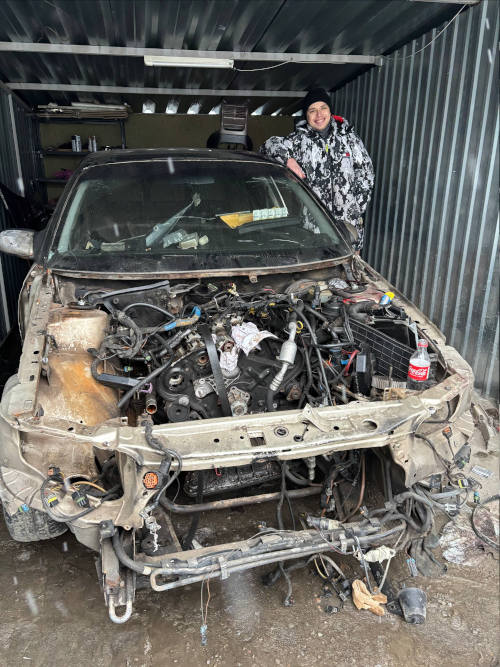
Chevrolet Equinox
The Chevrolet Equinox attempts to maximize packaging efficiency, emissions compliance, and electronic integration inside its various engineering platforms. First sold in 2005, each generation of the Chevy Equinox has utilized unibody crossover construction, designed with specific parameters around passenger comfort, crash safety, and modularity of the driveline. These construction parameters impact the realities and options of engine changes more than the volume of the engine compartment. Equinox builders, therefore, have to treat the Equinox platform more as a series of edited mental constructs and packaging, electronic, and emissions control systems than unaddressed mechanical systems. The emissions system alone has been radically altered during the Equinox's production history.
Within the Equinox generation, construction features and changes incorporated a more refined control and operational systems than in prior generation platforms, such as a truck-based system where an engine swap would have minimal electronic impact and controlled features. The powertrain and control body modules of the generation are integrated with body control modules, traction control modules, electronic throttle control, and vehicle security systems. Equinox platforms have been designed with integrated systems, electronic control, and compliance to regulatory systems in addition to an unexploited physical capacity available to accommodate an engine swap.
The generations of the Equinox platform have also varied between the different crossover architectures by General Motors. The initial models have shared some structural components with the Pontiac Torrent and the Saturn Vue. The subsequent models have moved to the more recent global GM crossover architectures with greater torsional rigidity and more advanced electronic integration. With each increment of this evolution, the sophistication of the vehicle’s powertrain control environment increases. Thus, what may seem like an uncomplicated swap from an engine bay dimension perspective often becomes far more involved when considering the integration of the drivetrain electronics, cooling load management, and alignment of the drivetrains.
TL;DR
- Engine compatibility in the Chevrolet Equinox means mechanical fitment, electronic integration, and emissions survivability, not just whether the engine fits in the bay.
- Engines that physically fit still fail when the Equinox cannot reconcile immobilizer logic, torque modeling, cooling load, or driveline geometry.
- First-, second-, and third-generation Equinox swaps do not follow the same rules because platform behavior and electronic integration change across generations.
- Level 1 swaps stay closest to the original drivetrain ecosystem, which is why they carry the lowest risk and the most predictable outcomes.
- Level 2 swaps usually remain within a GM-adjacent path, but electronics, transmission behavior, and cooling demands start to dominate the project.
- Levels 3 through 5 are system builds, not engine changes, because the vehicle must absorb a different drivetrain identity.
- Most builders underestimate higher levels because fabrication does not solve module communication, thermal balance, diagnostic credibility, or transmission strategy.
- The lowest-risk Equinox swaps are same-code or same-family replacements that preserve the factory-adjacent engine, transmission, and control path.
- Four-cylinder-to-V6 conversions escalate quickly because they recreate a different factory package rather than simply adding more engine.
- Cross-brand swaps become difficult fast because the engine, transmission logic, security system, and module ecosystem stop speaking the same language.
- High-effort swaps often require standalone control because the factory electronic path no longer supports the new drivetrain coherently.
- The engine itself is rarely the main cost driver, because wiring, debugging, rework, and integration consume more time and money than the long-block.
- Timelines stretch because swaps progress in dependency chains, and one unresolved issue in cooling, wiring, or geometry delays everything downstream.
- Budgets and motivation usually collapse because the project reaches visible near-completion long before it reaches stable system-level completion.
- Most swap failures are caused by fragmented wiring, weak cooling strategy, poor driveline angles, or unstable accessory-drive geometry.
- Equinox swap failures are often delayed rather than immediate, because heat soak, load, vibration, and repeated operating cycles expose weak integration later.
- OEM ECU-based swaps have the best chance of remaining inspection-friendly because they preserve a believable diagnostic and emissions structure.
- Standalone ECU swaps increase control freedom but usually reduce inspection realism because they separate the engine from the Equinox’s original road-use ecosystem.
- Rebuilding the original engine, using conservative boost, or optimizing the drivetrain is often smarter when the real problem is reliability, moderate performance, or drivability rather than engine identity.
- The core rule is simple: choose the solution that preserves system integrity, because in a Chevrolet Equinox, coherence matters more than the engine itself.
Before you start researching parts and pricing, check whether the swap you have in mind actually fits – and whether it's worth doing.
Check My Engine SwapChevrolet Equinox Engine Swap Compatibility Overview
What “compatible” actually means
In relation to the Chevrolet Equinox, the term ‘compatible’ does not simply mean that an engine fits inside the engine bay. There are multiple layers of meaning to this term, including mechanical configuration, expectations regarding the electronic systems, and adherence to applicable regulations. An engine that physically fits between the strut towers may not function properly due to the inability of its control logic to interface with the vehicle’s electronic control modules, and/or if the torque behavior of the engine conflicts with the vehicle’s drivetrain management systems.
Mechanical compatibility represents the first and most evident dimension. Considerations in this dimension include the geometry of the engine mounts, the space that the oil pan occupies in relation to the front subframe, the location of the steering rack, and the physical relationship between the engine and the transmission bellhousing pattern. The Equinox Platform has front subframe-mounted drivetrains, which means the engine and transmission components are housed in a particular shell that is designed to handle crash impacts and integrates the suspension geometry. Therefore, any engine that is placed in this space needs to interact with the defined points of the mounting system, or the defined control of the vehicle's structure will become unpredictable.
The second dimension is electronic compatibility. The Equinox uses a series of powertrain control modules which, through CAN (Controller Area Network) communication, interact with other components of the vehicle. These components have particular expectations in terms of certain sensor readings and the amount of torque generated. If an engine control unit does not provide the requisite signals for the body control module, traction control module, and ABS (anti-lock braking system) control module, the vehicle will be in a failure state and will not operate normally. In a lot of situations, during this failure state, the vehicle immobilizer will also prevent the engine from starting, even if the vehicle is running.
The third dimension is emissions compliance. In order to be street legal, the engine must not have any modifications that violate the emissions laws in the US, as the Equinox Platform has integrated emissions compliance systems that include catalytic converter efficiency, oxygen sensors, exuded vapor capture, and combustion efficiency. An engine swap that disconnects emissions control systems will result in an unending series of diagnostic trouble codes. These codes will prevent the vehicle from being street legal.
Mechanical vs electronic vs emissions compatibility
Mechanical compatibility tends to be the most straightforward aspect to assess during preliminary planning for swaps, as it pertains to Geometry and measurements. Builders can assess engine length, height, and accessory drive spacing in order to determine whether a candidate engine will fit in the volume available in the Equinox engine bay. Still, these measurements can often be too simplified and do not accommodate the remaining, often significant, mechanical details of the platform. Drive train longevity will be influenced by the alignment of the transmission output shaft, the angle of the driveshafts going to the front hubs, and the clearance of the oil pan to the subframe.
The data from the engine control unit will be fed to the traction control and stability control systems, and it will determine if the system will in fact be active, in which case the vehicle will operate in a reduced-power mode. The engine control unit will determine The electronic compatibility of a vehicle will narrow down the options more than the physical realism of an engine fit suggesting that electronic limitations will inhibit more than the physical limitations of a system. The first models of the Equinox included a powertrain control module that described its functions to a body control module, transition control, and traction control, and security modules. These control modules expected a consistent engine speed signal, transmission torque, throttle position, and engine speed.
The compliance of emissions adds further sophistication. The Equinox platform merges catalytic converter processing, oxygen sensor feedback loops, and evaporative emissions diagnostics alongside the powertrain control architecture. These systems depend on predictable combustion and exhaust gas behaviors. An engine swap that modifies any of these factors without the appropriate calibrations will almost always set off a diagnostic trouble code. In states where emissions inspections are done, this may hinder the renewal of registration, even if the vehicle operates mechanically.
The three dimensions of compatibility rely on one another. An engine that mechanically fits but needs a standalone engine control unit may resolve the electronic integration problem but still fail emissions compliance. On the other hand, an engine within the same engine family may electronically integrate but require significant subframe alteration to fit. The best swaps are those where the design constraints of the platform allow all three compatibility layers to be aligned.
Why engines that fit still fail
Engine swaps on Equinox vehicles may appear possible but often fail to deliver desired results because Equinox handles engine/s transmission pairs and ECU integration with precision, and components require placement with precision. The system controlling the drivetrain analyzes and models engine torque output in order to manage, adjust, and modulate traction control, shift points, and throttle control. If the torque output differs from the model input to the ECU as anticipated, the ECU may flag the system for abnormal behavior and operate outside normal parameters.
Failure points due to immobilizer communication issues are frequent and problematic. The Equinox includes an engine start authorization security system which includes an authenticated communication sequence involving the key transponder, body control module, and powertrain control module. Any engine swap where a control module has not authenticated will cause a no start due to an anti-theft mechanism preventing fuel injection or ignition. Even engines that are mechanically compatible with the vehicle may have no effect on the Antitheft system, regardless of how compatible the engines may appear.
Almost all engine swaps will fail to give Equinox owners the results they expect. The cause of the most engine swaps that fail to deliver as expected is due to issues with the vehicles thermal design and the heat rejection characteristics of the engine that is used. Repeated high load conditions may cause overheating which may appear to be intermittent and be difficult to diagnose.
Swap failures also relate to driveline geometry. The Equinox has front wheel as well as all wheel drive layouts. These layouts need the transmission output shafts and front differential assemblies to be aligned at certain points. If an engine swap raises or lowers the entirety of the drivetrain, then the CV axles may be operating at angles greater than those intended. This can cause premature failure of the joint or cause accentuation of vibration while the shafts are under load.
Short generational differences
The Chevrolet Equinox has had three significant generational changes since its inception, with each successive generation altering the context of which engine swaps are analyzed. These changes include notable differences in design and structural systems. Noticing the differences is critical to accurately provide an analysis of the feasibility of an engine swap.
Between 2005 and 2009, the first generation of the Equinox was built on a crossover platform that was part of General Motors' Theta family. These vehicles began to employ CAN-based communications, but the integration of the body modules and powertrain was still at a relatively low level. The first generation of Equinox vehicles was equipped with one of two crossfire 6 engines: 3.4 or 3.6 Liters V6, which are naturally aspirated engines that are paired with an automatic transmission. The electronic complications are present but are still not enough to deter highly complicated swap projects.
The second generation of the Equinox ran from 2010 to 2017. The 2010 Equinox shows a significant change in vehicle architecture, as the unibody crossover vehicle architecture is still in use, now added with greater electronic vehicle system integration as well as a greater variety of engine options, that include the inline-four Ecotec engines and the V6 engines that have also been updated. The V6 engines added later in 2010 are turbocharged engines. More of the vehicle system components and systems use a Controller Area Network (CAN) to communicate with each other, and the vehicle system as a whole begins to rely on integrated torque management systems.
For the 2018 model year, the Chevy Equinox launched its third generation. The Equinox now also has a greater variety and more advanced integrated electronic architecture. The Equinox uses a turbocharged four-cylinder engine, and swapping engines in this vehicle is very difficult, or close to impossible, because the engine and transmission are tightly coupled, and it is also tightly coupled to the behavior of the vehicle's safety system.
Chevrolet Equinox Platform Reality: What It Allows and What It Punishes
Structural architecture and chassis behavior
For all of the Chevrolet Equinox generations, the vehicle uses a unibody chassis structure and not a body-on-frame structure. A unibody design means that the structural integrity of the vehicle comes from the integrated design of the body shell, and not from a separate frame that is added. The engine and transmission will mount to a front subframe that can also connect to the body structure through some reinforced structural member mounts. The design improves safety in a crash and also reduces the final vehicle's weight. A unibody structure will also limit the design flexibility that can be applied to the vehicle's drivetrain.
The chassis’s torsional rigidity is critical in how the Equinox manages drivetrain load. The body shell absorbs the mechanical forces produced by the engine and suspension and then distributes them to various structural members. Should a different engine be installed, particularly one with an increased torque rating, the load path within these structural members can change. If the engine mounts do not line up with the envisioned load distribution on the subframe, the result can be increased vibrations and localized stress.
The subframe mounting points also limit engine positioning. The front subframe of an Equinox Ford contains the engine mounts, the lower control arms of the suspension, and the rack and pinion steering assembly. These components are located where they are to ensure that suspension geometry and steering kinematics are optimal. Any engine that conflicts with these positions can change the relationships between suspension components and thereby limit steering. Within suspension components, even small movements longitudinally, laterally, or vertically in the positions of the drivetrain can create durability issues.
The unibody construction also influences the NVH behavior of the vehicle. The Equinox chassis is engineered to control the vibrations and noise generated by the baseline engines. The engine mounts, subframe bushings, and chassis stiffening are intentionally designed to control the energy of these vibrations so that they are not felt in the passenger compartment. An engine swap also brings a different set of torque and an atypical firing sequence, which can create a different NVH that the chassis is not designed to control.
Mechanical constraints (mounts, crossmembers, steering)
Within the Equinox engine bay, mechanical packaging is highly restricted. For factory engines, the front sub frame is equipped with predetermined mount locations for the specific weight and torque reaction support of the engines. These locations also facilitate the alignment of the engine with the transmission’s input shaft. Moving engine locations requires subframe and mounting methods that mimic the original load distribution, which is extensive.
The position of crossmembers places other limits on the engines that can be installed. The front crossmember is incorporated into the subframe assembly and provides rigidity for the steering and suspension supports. The engine oil pan, along with the geometry of the engine block, need to clear this crossmember and the vehicle’s ground clearance, which limits the engine’s oil pan depth and the position of the oil sump.
The position of the steering rack also sets additional constraints. Within the Equinox design, the steering rack is positioned behind the engine and within the subframe assembly. The clearance to the engine block and the exhaust within this sub-assembly are tight to the steering rack.
The arrangement of the engine accessories also sets limits on packaging. The placement of the engine’s alternator, air conditioning compressor, and power steering pump is fixed relative to the engine block. The redesign of accessory brackets is done when there is interference to the strut towers or the inner fender. The equally dimensioned engines is illustrate the Equinox engine bay’s challenges the most.
Electronic Constraints (CAN Bus, BCM, ABS, Security)
For the Chevrolet Equinox, multiple control modules, connected through CAN (Controller Area Network) architecture, perform various electronic functions. These modules are for the powertrain, body control, ABS (anti-lock braking system), transmission control, and immobilizer systems.
For the Chevrolet Equinox, torque modeling is the most useful in terms of the Equinox communication network. This is because of the way the Equinox traction control system works. The system involuntarily controls wheel slip by performing commands that require a torque decrease via the engine control module. For this reason, the engine control module needs to have a grasp of the command and respond to it on the spot. Consider a swapped engine that has an inoperative control unit to the described torque management communication. This would mean that the traction control system would not function properly and that stability control system faults might be triggered.
Why shortcuts create long-term debugging debt
Many engine swap projects initially bypass electronic integration challenges through temporary solutions such as standalone engine management systems or partial wiring harness modifications. While these approaches may allow the engine to start and run, they often create long-term diagnostic challenges within the vehicle’s electronic environment. Modules that cannot communicate correctly will continuously log diagnostic trouble codes, making it difficult to identify genuine faults in the future.
Sensor discrepancies represent a common source of these issues. The Equinox control modules expect specific sensor readings related to coolant temperature, throttle position, and airflow. If the swapped engine uses sensors with different calibration ranges or signal formats, the receiving modules may interpret these readings incorrectly. Over time this can lead to unpredictable behavior in systems such as traction control or transmission shifting.
Transmission integration also contributes to debugging complexity. Automatic transmissions rely on torque estimates from the engine control module to determine shift timing and clutch pressure. If these estimates are inaccurate due to incompatible engine control strategies, the transmission may experience harsh shifting or premature wear. Diagnosing these issues becomes difficult because the root cause lies in communication mismatches rather than mechanical failure.
These cumulative issues create what engineers sometimes describe as debugging debt. Each workaround introduced during the swap process solves a short-term problem while introducing additional complexity into the vehicle’s electronic ecosystem. Over time, this complexity makes the vehicle increasingly difficult to maintain or troubleshoot. For this reason, swaps that maintain compatibility with the vehicle’s original electronic architecture generally produce more reliable long-term results.
Factory Engines Offered in the Chevrolet Equinox (All Years)
Complete Factory Engine Specification Table
| Engine Code / Name | Displacement | Engine Type & Cylinders | Fuel Type | Valvetrain / Timing | Power | Torque | Production Years | Donor Vehicles | Known Issues |
|---|---|---|---|---|---|---|---|---|---|
| GM LA1 3400 V6 | 3.4 L | V6 | Gasoline | OHV | 185 hp | 210 lb-ft | 2005–2006 | Chevrolet Equinox, Pontiac Torrent | Intake manifold gasket leaks, coolant seepage |
| GM LY7 3.6 V6 | 3.6 L | V6 | Gasoline | DOHC | 264 hp | 250 lb-ft | 2007–2009 | Equinox, Cadillac CTS, GMC Acadia | Timing chain stretch in early production |
| Ecotec LAF | 2.4 L | Inline-4 | Gasoline | DOHC, VVT | 182 hp | 172 lb-ft | 2010–2017 | Equinox, GMC Terrain | Oil consumption issues in early models |
| Ecotec LEA | 2.4 L | Inline-4 | Gasoline | DOHC, VVT, E85 capable | 182 hp | 172 lb-ft | 2012–2017 | Equinox, GMC Terrain | Timing chain wear and oil consumption |
| GM LFX 3.6 V6 | 3.6 L | V6 | Gasoline | DOHC, VVT | 301 hp | 272 lb-ft | 2013–2017 | Equinox, Chevrolet Camaro | High-pressure fuel pump wear in some units |
| Ecotec LYX | 1.5 L | Inline-4 Turbo | Gasoline | DOHC, VVT | 170 hp | 203 lb-ft | 2018–present | Equinox, Chevrolet Malibu | Turbocharger heat management sensitivity |
| Ecotec LTG | 2.0 L | Inline-4 Turbo | Gasoline | DOHC, VVT | 252 hp | 260 lb-ft | 2018–2020 | Equinox, Cadillac ATS | Carbon buildup on intake valves |
| Ecotec L3T | 1.5 L | Inline-4 Turbo | Gasoline | DOHC, VVT | 175 hp | 203 lb-ft | 2022–present | Equinox | Limited long-term reliability data |
Best Engine Swap Options for the Chevrolet Equinox, Ranked by Difficulty
How swap difficulty levels actually work
The swap difficulty levels are primarily a function of integration depth rather than just fabrication effort. Low-level swaps stay more or less with the same original drivetrain family, transmission logic, emissions hardware, and modules. High-level swaps make the vehicle behave like a completely different machine, and the problem is no longer “will the engine fit” but rather “can the whole vehicle still function as a system.”
The problem complexity increases on a non-linear scale because each additional mismatch increases the number of interlinked systems to be addressed. A mount issue is normally confined to a particular area but a torque-model mismatch could simultaneously impact shifting, traction control, reduced power behavior, and even the immobilizer logic. The same is true for heat rejection; if the engine’s thermal load exceeds what the stock radiator, fan strategy, and airflow paths expect, the swap begins to stress the rest of the package rather than just the engine bay.
The upper levels are largely dominated by electronics because the Equinox is more than an engine cradle with a body shell on it. The powertrain is in constant communication with the BCM, ABS, security, transmission control, and engine control modules. Once the swap goes beyond the original engine family or factory calibration, maintaining those inter-module communications becomes significantly more challenging and is an issue fabrication alone will not resolve.
This is why welding, bracket work, and bespoke mounts do not, by themselves, render a swap “easy.” A tidy installation can ususally still be a highly involved build if it requires a lot of adjustment work, a custom standalone, bespoke cooling, or re-architecting the driveline. In practice, the easiest swaps are the ones that stay closest to the engine, transmission, and control set the Equinox comes with. The forums on the Equinox and its Terrain twin show that exact pattern, with same-family swaps being the literal path of least resistance, 2.4-to-3.6 conversions seen as a significant step, and LS-style ideas way more over the line than obvious. :contentReference[oaicite:0]{index=0}
Level 1 Swaps (Lowest Risk, Near Bolt-In)
Most successful swaps happen because they are nearest to the original factory position. The engine family, mounting logic, transmission pattern, accessory packaging, and module behavior are close enough that the rest of the vehicle still recognizes the powertrain. The electronics and even the emissions are more predictable, which is why this level is almost always the only optional route with any sort of certainty for a road-driven Equinox that needs to be reliable and not experimental.
| Engine Code / Name | Engine Type & Cylinders | Fuel Type | Donor Vehicles & Years | Valvetrain / Timing | Swap Challenges (Specific to Equinox) |
|---|---|---|---|---|---|
| GM LA1 3400 V6 | 60-degree V6 | Gasoline | 2005–2006 Chevrolet Equinox, 2006 Pontiac Torrent | OHV | Best only in 2005–2006 Equinox applications, later first-generation changes reduce plug-and-play confidence, AWD accessory and exhaust routing still need close donor matching |
| GM LY7 3.6 V6 | DOHC V6 | Gasoline | 2007–2009 Chevrolet Equinox, 2007–2009 Pontiac Torrent, related GM Lambda applications | DOHC, VVT, timing chains | Requires donor-year fidelity for front accessory layout, exhaust crossover packaging, and module pairing, first-generation 3.4 hardware does not simplify this swap |
| Ecotec LAF 2.4 | Inline-4 | Gasoline | 2010–2011 Chevrolet Equinox, 2010–2011 GMC Terrain | DOHC, VVT, timing chain | Needs correct direct-injection hardware, intake and sensor package matching, emissions family differences across early second-generation years can create readiness and calibration friction |
| Ecotec LEA 2.4 | Inline-4 | Gasoline / flex-fuel depending on donor | 2012–2017 Chevrolet Equinox, 2012–2017 GMC Terrain | DOHC, VVT, timing chain | Usually the cleanest non-identical second-generation replacement path, but flex-fuel content logic, sensor carryover, and emissions configuration must stay aligned with the recipient chassis |
| GM LFX 3.6 V6 | DOHC V6 | Gasoline | 2013–2017 Chevrolet Equinox, 2013–2017 GMC Terrain, related GM FWD/AWD V6 applications | DOHC, VVT, timing chain | Works best as a same-generation V6-for-V6 replacement, AWD exhaust clearance, catalytic packaging, and donor-year electronic pairing still matter more than raw engine fit |
| Ecotec LYX 1.5 Turbo | Turbocharged inline-4 | Gasoline | 2018–2024 Chevrolet Equinox, 2018–2024 GMC Terrain | DOHC, VVT, timing chain | Third-generation compatibility depends heavily on matching transmission strategy, charge-air plumbing, and turbo cooling provisions, not just long-block interchange |
| Ecotec LTG 2.0 Turbo | Turbocharged inline-4 | Gasoline | 2018–2020 Chevrolet Equinox, 2018–2020 GMC Terrain | DOHC, VVT, timing chain | Low-risk only when replacing another factory 2.0T vehicle, because transmission calibration, cooling package, and axle load assumptions are already built around this output level |
Level 2 Swaps (Moderate Complexity)
At this point, electronics and thermal management start to take over the decision. While the engine could still belong to a factory-supported family or a sibling GM configuration, the Equinox no longer considers the combo a simple replacement. These swaps stall when builders miscalculate the dependency of calibrations, the differences in cooling packages, the expectations of the transmission, or the amount of donor-specific hardware to return the vehicle to a normal operating state after the engine is installed.
| Engine Code / Name | Engine Type & Cylinders | Fuel Type | Donor Vehicles & Years | Valvetrain / Timing | Swap Challenges (Specific to Equinox) |
|---|---|---|---|---|---|
| Ecotec LEA into early LAF-equipped Equinox | Inline-4 | Gasoline / flex-fuel depending on donor | 2012–2016 Chevrolet Equinox, 2012–2016 GMC Terrain into 2010–2011 Equinox/Terrain | DOHC, VVT, timing chain | Usually feasible, but fuel-content logic, induction-side component carryover, and recipient-side calibration expectations make this more than a drop-in unless the donor is chosen very carefully |
| Ecotec LAF into later LEA-equipped Equinox | Inline-4 | Gasoline | 2010–2011 Chevrolet Equinox, 2010–2011 GMC Terrain into later second-generation vehicles | DOHC, VVT, timing chain | Moves in the less desirable direction electronically, because later vehicles expect later-engine emissions and fuel-system behavior, so readiness logic becomes the main risk rather than mount alignment |
| GM LFX 3.6 into second-generation 2.4 Equinox | DOHC V6 | Gasoline | 2013–2017 Chevrolet Equinox, 2013–2017 GMC Terrain V6 donors | DOHC, VVT, timing chain | Requires the Equinox to move from four-cylinder cooling, exhaust, wiring, front-end accessory assumptions, and likely transmission strategy to the full factory V6 ecosystem |
| GM LY7 3.6 into 2005–2006 3.4-equipped Equinox | DOHC V6 | Gasoline | 2007–2009 Chevrolet Equinox, 2007–2009 Pontiac Torrent | DOHC, VVT, timing chain | Stays inside the first-generation shell, but it is not a simple generational upgrade because transmission control, exhaust routing, accessory packaging, and module expectations all move with the later drivetrain |
| Ecotec LTG 2.0 Turbo into third-generation 1.5T Equinox | Turbocharged inline-4 | Gasoline | 2018–2020 Chevrolet Equinox, 2018–2020 GMC Terrain 2.0T donors | DOHC, VVT, timing chain | Looks attractive because the platform is shared, but the swap usually escalates around transmission pairing, charge-air cooling, radiator capacity, axle and calibration expectations rather than hard-block fit |
High-Effort Engine Swaps (Levels 3–5)
The swap should be categorized as a system build, as opposed to simply an engine change. The engine is merely one piece of the puzzle as the Equinox will also require a new transmission, new coolant system, new adjustable torque communication, new driveline setup, and a new control system to interface with or meet the requirements of the factory control ecosystem. That is the reason these types of projects take a significant amount of time, even after the engine has been mated to the Equinox.
Cross brand swaps further increase the complexity because they break floorpan and factory design assumptions at many levels, simultaneously. The Equinox's bellhousing design, accessory drive locations and interfaces, crank and cam signal logic, pedal position sensing and immobilizer control strategies will be incompatible with the Equinox. Once that becomes true, the use of a standalone engine control unit becomes almost a given, and that decision typically takes the project out of the realm of true factory style integration.
With the addition of taller and wider engines, as well as higher output models, all of the previously mentioned characteristics of the engine increase the need for additional modifications. Levels 3 through 5 should be viewed as completely custom builds that may retain the Equinox shell, but something much more involved is happening behind the curtain.
| Engine Code / Name | Difficulty Level (3 / 4 / 5) | Engine Type & Cylinders | Fuel Type | Donor Vehicles | Dominant Integration Risks |
|---|---|---|---|---|---|
| GM LGX 3.6 V6 | 3 | DOHC V6 | Gasoline | Chevrolet Camaro, Cadillac CTS, GMC Acadia, other later GM V6 applications | Later-generation direct-injection V6 logic conflicts with older Equinox network expectations, forcing major calibration, harness, and module-authentication reconciliation |
| Honda J35A / J35Z V6 | 4 | SOHC V6 | Gasoline | Honda Pilot, Odyssey, Accord V6, Saturn Vue V6 | Cross-brand engine management, transmission strategy divergence, and security-system incompatibility turn the build into a hybrid architecture problem rather than a mechanical swap |
| GM LS4 5.3 V8 | 5 | Pushrod V8 | Gasoline | Chevrolet Impala SS, Pontiac Grand Prix GXP, Buick LaCrosse Super | Front-drive V8 packaging still overwhelms Equinox subframe, exhaust, cooling, torque-management, and transmission durability assumptions, so the project becomes a full drivetrain-system redesign |
| GM LS-family longitudinal V8 | 5 | Pushrod V8 | Gasoline | Silverado, Camaro, Corvette, Tahoe, Express, aftermarket crate engines | Requires abandoning the stock transverse Equinox logic entirely, with dominant risks centered on driveline architecture conversion, firewall and subframe packaging, and total control-system replacement |
| Ecotec LTG 2.0 Turbo into second-generation Equinox | 4 | Turbocharged inline-4 | Gasoline | Chevrolet Malibu, Camaro, Cadillac ATS, third-generation Equinox/Terrain | Shared GM branding does not solve the mismatch in transmission ecosystem, boosted-engine thermal management, and torque-model communication across different platform generations |
| GM HFV6 family outside recipient generation calibration path | 3 | DOHC V6 | Gasoline | Chevrolet Traverse, GMC Acadia, Cadillac SRX, Buick Enclave, other GM FWD/AWD V6 donors | Even when the block family is familiar, donor-to-recipient differences in accessory layout, fuel-system strategy, exhaust packaging, and module coding can force the swap out of factory-style integration |
The practical ranking is unequivocal. The cleanest Equinox swaps can stay within the same engine family or even the same factory-adjacent family for that generation. The moment a project moves from “replacement with adapter” to “new drivetrain paradigm,” the difficulty increases significantly, and that increase is far more a function of system integration than whether a competent fabricator can get the engine mounted. That pattern is also evident in owner conversations: early second gen LAF-to-LEA replacement paths are considered feasible, 2.4-to-3.6 are considered major donor-driven projects, first gen 3.4-to-later V6 are not considered simple upgrades, and LS-family is widely considered highly invasive builds.
Universal Engine Swap Execution Reality
Planning & Measurement
Before each engine swap turns into fabrication problems, they stem from measurement problems. The first check point isn't whether the target engine looks small enough to fit. The first check point is whether the full system package can fit in the same space without having to make unthinkable compromises in regards to cooling, accessory drive routing, axle position, and service access. On the Chevrolet Equinox, that checkpoint is more important in comparison to older, less integrated vehicles like older model Equinoxes as the engine bay, front subframe, steering rack, radiator package and transmission position are all tighter and more integrated compared to the older model equinoxes.
Planning most often fails when builders take a measurement of the long-block and then stop measuring. The space that is in front of the long-block is not the only space to plan for. The space that is actually occupied includes the exhaust routing, the plumbing for the charge system on turbo applications, the need to insulate the engine from the cabin with heat shielding, the space needed for the engine to move under load, the area needed for wiring transitions and the area needed for fluid hose paths. When the surrounding systems no longer fit neatly around the engine, this is the most common way to stop a project early on. This will often create a delayed constraint.
Time sequencing is essential when each early assumption in a project is to be taken into account each time. The steering rack clearance may affect axle geometry changes. The drivetrain shifts may not be protective but may tighten radiator clearance or hood clearance. Thus, a good planning phase helps provide a structure system checkpoint. It examines in advance if the engine, transmission, cooling path, and electronic systems can coexist before fabrication work is started to lock a direction that is costly to change or reverse.
Removing the Engine
While it may appear like a mechanical stage, engine removal is more like an information retention stage. When the original drivetrain is removed, they lose the factory point of reference for hose routing, the length of harness branches, mount orientations, the position of the engine, transmission, and subframe. That's why removal acts as a checkpoint for whether the builders comprehends the original systems and is able to recreate the important relationships later on.
The difficulties and problems found at this level stem from the underestimation of how much the original framework of the assembly affects the vehicle's behavior. The Equinox does not treat the powertrain as a stand-alone module. It integrates engine placement with steering, front suspension, cooling airflow, and electronic connector position. Any of the original components that are removed, and without a complete reference of the relationships, it becomes guesswork during reinstallation and test fitting.
Another typical miscalculation is believing that successful removal indicates that the project is progressing in a clean manner. In reality, removal is where the hidden scope begins. Damage to connectors, old hoses, brittle interfaces, and previously borderline components become evident. These problems are important because the swap will now rely on a new drivetrain being added to a system whose adjacent components may already be at the end of their usable lifetime.
Test Fit & Clearance
Test fitting, also called a “reality check,” helps determine if the selected engine is a usable system or just an abstract fitting into the Equinox. This check is more than just closing the hood once. It looks to assess if there is flexibility in the heat engine movements, the pathway of exhaust, service access, and positioning of all other systems support systems under the working condition.
What clearance is often taken for granted is static clearance. An engine that sits clear of the firewall or subframe could contact them under a torque reaction, thermal expansion or body movement over rough pavements. Turbo, catalytic, and rear exhaust space of V-type engines amplify this problem as the closest clearances often sit next to the steering rack, brake lines, or near a bulkhead and those elements apply heat and movement.
When an engine centres the test fit without future serviceability, this will also be a failure point. A wish package that technically fits but hinders access to ignition elements, to the coolant cross, service belts, or pivotal connectors, creates long term maintenance debt. This form of debt is hugely critical, as difficult access to service will turn an engine out repair into an engine out task. This is a strong clear indicator that the swap did not achieve a stable packaging solution.
Mounting & Driveline Geometry
Mounting the engine isn't about just holding it in place; it's about whether the swap maintains or ruins the geometric logic of the drivetrain. In the Equinox, this means that engine height, fore-aft position, side-to-side offset, and transmission position all affect axle angle, inner joint plunge, torque reaction, and load absorption by the subframe.
Many projects fail at this stage. Custom mounts may solve the static placement problem, but what about the dynamic side of things? A drivetrain might be centered and level, but it can still be poor from a driveline geometry perspective if the output points do not align with the front hub and differential that the chassis was designed around. This may not be evident during shop testing, but it often appears later as load-induced vibrations, premature wear of the CV joints, uneven articulation of the axles, or irregular traction when cornering.
Mount stiffness introduces another systems problem. If they are too soft, the engine moves so much that it could damage hoses, downpipes, or accessories. If they are too stiff, the unibody receives vibrations it wasn't designed to absorb, and the vehicle develops a level of harshness that feels structural rather than mechanical. Consequently, this stage serves as a checkpoint to ensure that the swap respects driveline geometry and the NVH characteristics of the chassis type.
Wiring and ECU Strategy
The way wiring and ECU strategy integrations are done will ultimately determine whether a finished vehicle acts like a fully functioning integrated machine or acts like a half-baked rolling chassis. This is larger than just harness adaptation. It also covers the logic wiring for the throttle, torque management, transmission, immobilizer, cooling fan, diagnostic readiness and communictation to BCM and ABS modules. For Equinox, this is often the focal point of the entire project, even when the swap initially seems to be the most dominant mechanically.
The classic mistake is that wiring is treated as a finishing touch, rather than being seen as a core architectural decision. Once this happens, the project is virtually physically complete long before the electrical framework is fully designed. Builders are then left with a very clean engine install but still several unfinished or open-ended issues around security handshake, pedal interpretation, gauge behavior, cooling control, diagnostic communication, and the dreaded reduced power triggers.
A second problem arises with mixed control strategies. This occurs when part of the vehicle still relies on the factory logic and then the engine is on a different control strategy that doesn’t fully integrate or cooperate with the rest of the vehicle. That mixed strategy, almost always, will start the engine, but, in the long run, will very rarely form a properly functioning vehicle. The vehicle ends up being operational, but fully suffers from hidden integration problems that show up later as intermittent drivability issues, fault codes, or undesirable transmission characteristics.
Enter your vehicle and target engine to see a compatibility verdict, estimated cost, required changes, and whether it's the right move for your build.
Get My Swap VerdictEngine Swap Cost & Timeline Reality
Budget Ranges by Difficulty Level
The overall scope of engine swap budgets expands in broad bands, not neat estimates. For low risk, factory adjacent swaps, if the donor is complete, the original vehicle in good condition, and the electronic path stays stock adjacent the budget stays in the lower four figures. Moderate complexity swaps start in the mid four figures to low five figures due to the beginnings of custom adaptations, calibration work, and rework that is not immediately visible. High effort builds grow quickly into the five figures due to the engine becoming the least expensive component.
That non-linearity matters. Costs do not increase in a lineal fashion based on engine size or fabrication difficulty. They increase as the project begins to lose factory assumptions and starts paying repeatedly for integration, corrections, and revalidations. Once a swap demands control system rework, cooling system rework, driveline rework, or repeated fitment alterations, every resolved problem creates one or two new ones in close proximity.
The hidden cost is not just the dollars spent on the build. It is also dollars lost on lost momentum, rendered shop time, duplicated effort, and components procured prior to the architecture being fully understood. Opportunity cost becomes tangible when the vehicle occupies space for months, while, stably, it is not reaching a running condition. At that time, the project is consuming value in greater amounts than it is creating value.
Realistic Time Estimates
Realistic time estimates can be made based on previous patterns for time estimates for each individual project type. Similar family, low-elevation swaps can potentially be completed in the “shorter project window” if the donor is closed and the scope remains disciplined. Most moderate projects take longer than they should because they do not spend time on the actual construction and they spend more time waiting, diagnosing, and revising their assumptions. High difficulty swaps tend to move from a a open closed window on a time line to a completely open cycle for development.
What affects a project’s time line usually is not one big cataclysmic issue. It’s an accumulation of several issues that are all interdependent and must be solved in a specific series. For example. cooling cannot be finalized before all the stabilizing work is done on the pack. The same is true for wiring and the ECU strategy. Validation of the ECU is untrustworthy until the driveline is fully repeated on the regulator, heat, and module intercommunication.
Equinox crosses also amplify the issues because they are packaged crossovers instead of overbuilt engine bays with generous spare volume. Small changes in one system tend to ripple into another. This is also why it may appear that many builds do appear to be complete but they are still functionally unfinished. The project goes to 90 percent of visible completion and then spends a tremendous amount of time working on that last 10 percent where a majority of the real integration work is done.
What Builders Consistently Underestimate
Builders tend to underestimate the complexity of wiring looms, vehicle thermal dynamics, and the amount of rework needed following the first convincing test fit. They also underestimate the amount of disruption that donor completeness brings. Small missing brackets, sensors, plugs, control modules, or original supporting hardware tend to create big problems. They tend to force substitutions that move the project further from a stable architecture.
Another blind spot is the time it takes to calibrate. Mechanical completion creates the false impression that the project has entered final assembly when in fact it has entered it's most fragile phase. The engine may run, but the vehicle has to also run correctly through start-up, idle control, throttle transitions, gear changes, fan-on engagement, and heat-soaked restart conditions. Each of those behaviours has the potential to expose mismatches that were not able to be seen in the previous static assembly phase.
Many builders also underestimate the rework on surrounding systems. The engine becomes the focal point, but the swap often requires multiple changes to the exhaust layout, accessory clearance, hoses, intake routing, stiffness of the mounts, and electrical layout. Rework is time-consuming because every modification has to be looked at again and again, which is why projects run longer, even when individual components are not particularly costly.
Common Chevrolet Equinox Engine Swap Failure Scenarios
Incomplete or Fragmented Wiring
Often times, the Equinox wiring fault may show up later and present problems that seem erratic. The issues may arise after the car has gone through several rounds of heating and cooling cycles, and after the car has gone through real world driving conditions. Harness strategies that seem acceptable and provide wire integrity during initial test stages may present issues when the connectors have warmed up, the ground develops a sustained load, and the modules go through data exchanging cycles more than once like they would in typical driving conditions.
Most wiring fault issues show a delayed failure pattern that tends to consist of irregular or inconsistent vehicle communication, not complete electrical failure. Even though the vehicle may still be driveable and startable, it may begin to show signs of issues like a random power deficit, a lack of proper control of the cooling fans, occurrence of throttle plausibility faults, or issues with the transmission. In most cases, these issues are symptoms of fragmented architecture where the engine, BCM, and other devices fail to share or communicate the same logical information.
Over time, that fragmentation turns diagnostics into noise. real faults hide inside a background of expected-but-unresolved codes, intermittent warnings, and improvised signal conversions. The communication weak spots in a vehicle are hard to trace as an automotive vehicles may appear to operate acceptably, however, it the vehicle is susceptible to show weak points due to heat, vibrations, or a sequence restart that would expose the vehicle communication weaknesses.
Under-Sized or Misapplied Cooling Systems
Cooling system failures after the initial success of the coolant systems is where issues begin to arise. The engine may appear to be stable during testing, survive short drives, and have idle stability during shop testing. The issues that arise are mainly as a result of an increase in load and heat under the engine. The vehicle then experiences a hot restart condition and repeated stop and go conditions and has under hood heat that has not been dissipated.
Considerations for cooling performance in the Equinox extend beyond the individual's radiator. Other influences include; design of the flow path, integrated condenser stacking, the fan's control logic, the behavior of the engine bay in regard to pressure, and the heat shield. The misapplication of a cooling package may control a peak temperature threshold once. However, with heat soaked the package loses control because fan strategies and flow path do not match the thermal profile of the integrated drive components at that specific cooling system.
The secondary cooling impact extends to the neighboring systems. Increased ambient temperature on the transmission, and higher under hood intake temperatures, lead to accelerated aging of electrical connectors and increased hysteresis rubber components. The result is thermal performance that is subpar and is not balanced.
Driveline Angle Misalignment
The symptoms of driveline angle misalignment seldom announce themselves immediately. Over time, rotation under real functional torque, will introduce, vibration, accelerated wear of CV joints, and stress on the axle seals. Alignments may show acceptable static placement while in reality, the alignment has shifted once the system is under torque, and the driveline has not followed the intended path.
The Equinox exhibits unique behavior due to the close coupling of the components in the subframe, transverse engine and the axles. Minor adjustments to engine height or lateral position may cause detrimental changes to joint operating angles; not immediately but over time. This behavior leads to misdirected blame towards the individual components rather than the overall detrimental geometry.
As for this kind of failure, once it begins, the symptoms will be widespread. Mounts, seals, and adjacent equipment will be adversely affected by vibrations. Repeated driveline roughness affects the driving feel structurally, giving the crossover a coarse, unsettled feel, even if the engine operates fine. In practical terms, that is a geometry issue that is showing up as a problem of durability. \s
Accessory Drive & Belt Geometry Issues
Because the belt system can operate for a period of time even when the alignment and wraps aren’t fully optimized, accessory drive issues can “survive” early testing. Problems show up later as belt walking, noise, increased slip due to heat, and shortened bearing life, after the engine has gone through cycles and experienced real vibration. In custom fitted engine bays with tight spaces, these failures are commonplace.
On the Equinox, the accessory drive is located within a limited space between the chassis, cooling package, and body structure. An engine swap that shifts it a little or a different configuration of front accessories is likely to leave the belt path theoretically operational, but dynamically unstable. Instability becomes apparent when the belt is subjected to heat, transient load, and slight mount movement.
The delayed failure is significant as it obscures design flaws and is misinterpreted as wear part replacement. While replacing belts, tensioners, or accessories may quiet the concerns temporarily, the core geometry issue remains. The system continues to fail repeatedly, as the issue at hand is structural, not consumable items.
Legal & Emissions Considerations (USA)
Swaps with OEM ECUs
Swaps with OEM ECUs tend to be the most likely to still be inspection passable because they keep some version of the diagnostics click system. Internally, the control logic, engine, and adaptive emissions hardware, remain in a believable factory environmental system. This allows the system as a whole to be accepted by the inspections, and stay in a good working order; though it may still be a complicated swap, it provides a coherent identity to the electronics of the car.
Not just any control unit being used is an advantage; it is a good thing because the OEM control unit, OEM sensors, OEM catalytic logic, OEM evaporative diagnostics, and OEM support modules work together in systems architecture that is designed for permanent, actual road use instead of use for a temporary purpose. That is why for an Equinox, the more modern crossovers, that is an important distinction because often, the inspection reality depends on the car still looking electronically complete, and not just making sure it doesn't check engine light for no reason.
Standalone ECUs
Standalone ECUs remove the safety net of inspection realism and often result in greater design freedom. Integrating emissions monitoring, torque communication, and factory-style readiness behavior, that separation becomes a serious limitation concerning street ready functionality and long-term usability.
The issue at hand is the credibility of the systems. A system that is separate still may demonstrate that the engine is running, but may still fail to show the vehicle as a fully-fledged emissions compliant road car. The further away the swap gets from OEM control logic, the more difficult it is for the completed vehicle to comply with the vehicle's built in assumptions regarding the inspection, fault monitoring, and the behavior of the supporting modules. That is why standalone control often marks the point where a swap stops being inspection-friendly transportation and starts becoming a custom vehicle project.
Reality of inspections in the USA is less of a theoretical and more of a tactile issue. If the vehicle does not provide a coherent emissions and diagnostics package, the vehicle does not permit a theoretical functionality and vehicle inspection permit a tactile functionality, thus failing.
For the Equinox, that means that factory-adjacent swaps will remain the only configurations that will preserve broad road usability with minimal legal friction. Once the project starts to include custom control pathways or gaps in diagnostic integration, it stops being an ordinary road vehicle and the experience matters even before any inspection comes into play.
An Engine Swap Mistake
Keeping the Original Engine
Choosing to do an engine swap has the emotional appeal of it being more transformative than just rebuilding the existing engine. More often than not, this instinct misidentifies the need of the situation. Rebuilding the original engine is often a necessary repair, but it also keeps the same control architecture, cooling system, and driveline geometry the Equinox was designed to work with. That makes it a better long term lower risk option, even if it doesn't feel as ambitious as an engine swap.
Rebuilding also keeps system coherence. The same thoughts put into the original engine's calibration, attachment layout, and servicing logic still exist thanks to rebuilding. This is the more mechanical option for users who want to avoid creating an over-engineered long integration project simply.
Conservative Forced Induction
When someone is considering an engine swap to get a moderate increase in performance, the engine swap is really more of a power goal than a performance goal. A good example of this is the existing engine along with conservative forced induction, which can be more aligned with the goal than an engine swap, as long as the performance increase isn't enough to make the supporting systems collapse. The best part of this solution is that the overall vehicle architecture is not replaced.
This path isn't easy but it usually addresses a different issue than a full swap. If the owner prefers a slight increase in output as opposed to a completely different drivetrain identity, it might be more logical to stay with the existing engine family than to export a new control, packaging, and emissions ecosystem. The critical difference is whether the issue is just insufficient output, or complete dissatisfaction with the entire engine platform.
Gearing & Drivetrain Optimization
Some owners embark on an engine swap because the vehicle is underwhelming, unbalanced, or mismatched to the intended purpose. This sensation does not always stem from an engine limitation. In a crossover like the Equinox, the gearing and behavior of the transmission, along with the entire response of the drivetrain, can heavily skew the perceived performance. If the report is focused on response, towing sensation, cruising and steady-state behavior, or general drivability, the engine may not be the actual bottleneck.
Drivetrain optimization is typically more in line with the way the vehicle functions as a system. Where the use case does not justify an entirely different engine architecture, resolving the ratio and response can provide the outcome needed without the vehicle undergoing a full reintegration. That makes it the more reasonable path when the principal issue is behavior and not engine identity.
Final Rule: Selecting the Correct Engine Swap for the Chevrolet Equinox
The best engine swap for a Chevrolet Equinox isn't based on the most sophisticated donor engine, the highest hypothetical numbers, or the most fabrication enthusiasm. The best engine swap is the one that keeps the vehicle mechanically aligned, electronically coherent, thermally balanced, legally defensible, and serviceable after the novelty of the swap has worn off. If a project doesn't satisfy all of these, it is a poor engine swap choice, regardless of how the engine specs appear on paper.
Those parameters eliminate most of the bad options. If the goal is reliable transport, do a rebuild. If the goal is moderate improvement, fix the specific bottleneck. If the goal does require a swap, then the best option is to stay as close as possible to the same engine family, control strategy, and emissions pathway that the Equinox is equipped with. The most important rule is to preserve overall system integrity. In a modern crossover, system integrity is more important than the engine itself.
Frequently Asked Questions
Why do 2005–2009 Equinox swaps behave differently from 2010–2017 and 2018+ builds?
The first-generation Equinox behaves like an earlier GM crossover project, not just an older version of the same swap environment. Its engine choices, transmission pairing, packaging logic, and module expectations sit in a different era of GM integration, so the project usually centers on making the drivetrain physically and electronically coherent inside that older architecture rather than upgrading it toward later-generation behavior. That is why first-generation ideas that sound simple on paper often fail once the builder assumes later GM compatibility rules apply backward.
The second and third generations punish that assumption even harder because the platform becomes more dependent on engine-specific control logic, transmission behavior, and thermal management. In practical terms, a swap that stays inside the original generation usually behaves like a repair-plus-integration project, while a swap that crosses generations behaves like a partial vehicle redesign. That distinction matters more on the Equinox than on older, less networked GM platforms because the vehicle stops tolerating approximation once it expects a more complete powertrain identity.
Why does AWD change the donor decision more than most Equinox owners expect?
AWD changes the donor decision because it turns the swap from an engine problem into a front driveline packaging problem. The transfer case, axle geometry, exhaust path, and subframe relationships all become less forgiving once the drivetrain has to feed both the front wheels and the rear driveline. A front-wheel-drive donor may provide a workable long-block, but it often does not provide a full solution for the packaging and load-path assumptions built into an AWD Equinox.
This is why AWD projects tend to punish incomplete donor strategy. A builder may solve the engine side and still end up with awkward axle angles, tighter exhaust routing, or transfer-case-related fitment compromises that never existed on the front-wheel-drive version. On the Equinox, AWD does not just add parts, it narrows the acceptable range of drivetrain position and surrounding hardware, which is why donor selection has to start with the chassis configuration and not just the engine code.
Can a 2010–2017 Equinox 2.4 use donor engines from other GM 2.4 direct-injection cars without turning into a mismatch project?
Sometimes it can, but only when the builder treats the donor as an engine core plus a set of Equinox-specific decisions rather than a complete plug-in replacement. Owner reports around 2.4 donor swaps show that engines from nearby GM applications can physically substitute, yet the success of the job depends on small but important details such as exhaust-manifold configuration, bolt differences, heat-shield alignment, phaser-era differences, and which original Equinox components have to move over. That means the engine family helps, but donor compatibility is still defined by the recipient Equinox’s surrounding hardware and control expectations.
The tradeoff is clear. Using another GM 2.4 donor can save a project that would otherwise stall, but it works best when the goal is disciplined substitution, not improvisation. Once the builder starts mixing years, emissions-era parts, or induction-side hardware without a plan, the project stops being a clean donor swap and becomes a rolling fitment and calibration exercise. On this platform, that boundary arrives earlier than many people expect because the Equinox is sensitive to the details around the engine, not only the long-block itself.
Why do 2010–2017 2.4-to-3.6 conversions escalate so quickly even though GM sold both engines in this generation?
They escalate because “same generation” does not mean “same supporting vehicle.” The four-cylinder and V6 versions do not simply differ at the engine; owner discussions repeatedly frame the conversion as a package-level change involving transmission, wiring, exhaust, and potentially the subframe and mounts. That is a strong sign that the Equinox treats those drivetrains as distinct factory ecosystems rather than interchangeable trim-level variations.
The practical consequence is that the project becomes donor-led very quickly. Once the swap has to carry over the V6 cooling logic, transmission expectations, exhaust layout, and front-end packaging, the builder is no longer “adding two cylinders” to a 2.4 Equinox. The builder is recreating the V6 version of the vehicle inside a shell that did not start that way. That is why these conversions stall when the plan is engine-first instead of whole-drivetrain-first.
Does a 2018–2020 1.5T-to-2.0T Equinox swap stay factory-like if the donor is complete?
It stays more factory-like than most cross-platform ideas, but it is still not automatically simple. Chevrolet offered both turbo engines in the early third-generation Equinox, and the 2.0T was the stronger factory option before GM dropped it for 2021, which means the concept has a real factory baseline rather than a purely hypothetical one. That gives the project more logic than an out-of-family swap, especially if the donor and recipient stay inside the same generation window.
Even so, “factory-like” depends on whether the swap follows the full 2.0T ecosystem and not just the engine assembly. The reason is that the third-generation Equinox ties turbo behavior, transmission strategy, cooling capacity, and control logic closely together. A complete donor improves the odds because it gives the project a coherent target state, but the swap only stays civilized if the finished vehicle ends up behaving like a 2.0T Equinox, not like a 1.5T shell with a more powerful engine installed inside it.
Why are first-generation 3.4-to-3.6 upgrades not just a smarter version of the same Equinox?
Because the later first-generation 3.6 setup is not simply a higher-output continuation of the 3.4 package. It brings a different engine architecture, different packaging demands, and different drivetrain expectations into a vehicle that began life with an older V6 solution. Forum discussions around first-generation engine changes make it clear that owners do not treat the early and late V6 arrangements as casually interchangeable, and that hesitation is rooted in the surrounding systems rather than the raw physical size of the engine.
The real issue is project identity. If the goal is to keep a first-generation Equinox on the road, preserving the original drivetrain family usually protects more of the vehicle’s logic. If the goal is to turn the vehicle into the later V6 version, then the swap should be approached as a package conversion, not as an engine-only improvement. That is the dividing line between a repair-minded project and a conversion-minded project on the early Equinox.
Should donor completeness matter more than donor mileage on an Equinox swap?
In many Equinox projects, yes. Donor completeness determines whether the builder can preserve the engine’s original supporting logic, and that usually matters more than a modest mileage difference between candidates. Missing brackets, connectors, exhaust-side hardware, sensor sets, or drivetrain-specific support parts force substitutions, and those substitutions tend to push the project away from a stable factory-like outcome.
Mileage still matters for reliability, but incomplete donors create a different kind of risk: architecture drift. Once a swap starts borrowing partial solutions from multiple years or models, the builder spends more time reconciling differences than installing the engine. On the Equinox, that tradeoff is especially important because many “small” missing items are actually the pieces that keep the recipient vehicle from turning into a wiring, heat-shield, or fitment puzzle after assembly.
Is the transmission often the hidden reason otherwise sensible Equinox swaps stall?
Very often, yes. The Equinox powertrain does not treat the engine and transmission as loosely coupled components, and owner discussions around transmission interchange show that even year-to-year changes inside the same transmission family can complicate compatibility. Once that is true inside the stock drivetrain family, it should already be clear that swap difficulty is not driven by engine mounts alone.
That is why some swap ideas look mechanically reasonable but still collapse during planning. The engine may physically belong, yet the transmission strategy, control module expectations, and driveline outputs no longer align well enough to create a stable finished vehicle. On the Equinox, the transmission is often the part that reveals whether the project is a realistic factory-adjacent conversion or an uncontrolled escalation into full-system redesign.
Why do Equinox swaps that idle cleanly and drive around the block still fail a few weeks later?
Because early success validates only the most superficial layer of the build. It proves the engine can run, the basic harness can function, and the drivetrain can move the vehicle briefly. It does not prove that the cooling system can survive heat soak, that the driveline geometry stays stable under repeated load, or that the module ecosystem remains coherent across hot restarts, fan cycles, and normal daily operation. Owner reports about post-swap issues often point to overlooked grounds and connection faults for exactly this reason: the first start happens before the system has been truly stressed.
The Equinox is especially prone to delayed disappointment because it is a tightly packaged crossover. Small compromises in cooling, wiring quality, exhaust clearance, or axle position may not show themselves during short initial runs. They usually appear after temperature, vibration, and repeated operating cycles expose the weak point. On this platform, durability is the real test of integration, not the first clean idle.
When does a replacement engine stop being a repair and become a re-engineering job on the Equinox?
The line is crossed when the vehicle can no longer keep its original powertrain identity without major reinterpretation. If the replacement needs a different transmission strategy, different module pairing, different subframe or mount logic, or a different thermal package, the project has already moved beyond repair. At that point, the builder is not restoring the Equinox to service. The builder is defining a new configuration and trying to make the rest of the vehicle accept it.
This matters because repairs and re-engineering jobs deserve different decision standards. A repair can justify itself through restoration of normal use. A re-engineering job has to justify itself through system coherence after the change. On the Equinox, many stalled swaps come from mislabeling a donor-driven conversion as a simple repair and only discovering the true scope after the original drivetrain is already out.
How should you choose between rebuilding your original Equinox engine and chasing a donor from another GM vehicle?
The right question is not which option sounds more interesting, but which option preserves more of the vehicle’s working logic. Rebuilding keeps the known transmission pairing, electronics path, emissions behavior, and physical packaging intact. A donor swap only makes more sense when it preserves those same relationships well enough to avoid turning the project into a system-conversion exercise. On the Equinox, that threshold arrives quickly because donor interchange is real, but rarely as clean as casual engine-family talk suggests.
That is why many builders are better served by being conservative. If the original engine can be restored without changing the vehicle’s identity, that usually protects reliability and usability. A donor becomes compelling only when it stays close enough to the recipient Equinox that it behaves like a corrected version of the same vehicle rather than a partial hybrid assembled from compatible-looking GM parts.
Can a Chevrolet Equinox be made meaningfully quicker without abandoning its original engine family?
In many cases, yes, and that is an important decision filter. The factory 2.0T third-generation Equinox already shows that GM achieved a clear step up in performance while keeping the vehicle inside its native platform logic, and period testing confirms the difference was substantial compared with the 1.5T version. That matters because it proves that meaningful performance change on the Equinox does not automatically require a radical swap concept.
The broader lesson is strategic. If the performance goal can be met while staying inside the same engine family, the vehicle keeps more of its original drivability, serviceability, and diagnostic integrity. On the Equinox, that usually produces a better finished machine than jumping immediately to a dramatic donor that forces the whole chassis to adapt around it. The platform rewards coherence more than it rewards bravado.
Can you swap a V8 into a Chevrolet Equinox and still end up with a usable street vehicle?
It is possible to imagine, but very hard to justify as a street-focused Equinox project. Owner discussions around LS4 and LS-style ideas consistently frame them as saw-blade, package-redesign territory rather than practical crossover upgrades, and that reaction is telling. The issue is not just whether a V8 can be mounted. The issue is whether the finished vehicle still behaves like something that can be cooled, controlled, serviced, and driven without constant compromise.
On this platform, a V8 concept usually breaks too many native assumptions at once. Packaging, driveline layout, transmission logic, exhaust routing, and module integration all move outside the Equinox’s natural operating envelope. That pushes the build out of the realm of rational street conversion and into custom-vehicle territory, where the shell happens to be an Equinox but the engineering task is no longer “swap an engine.” It is “invent a different vehicle using an Equinox body.”
Stop comparing specs in your head. Enter your Chevrolet Equinox and the engine you want – get a structured verdict with cost, complexity, and a clear recommendation.
See If This Swap FitsYears
No year pages with content are configured for this model yet.