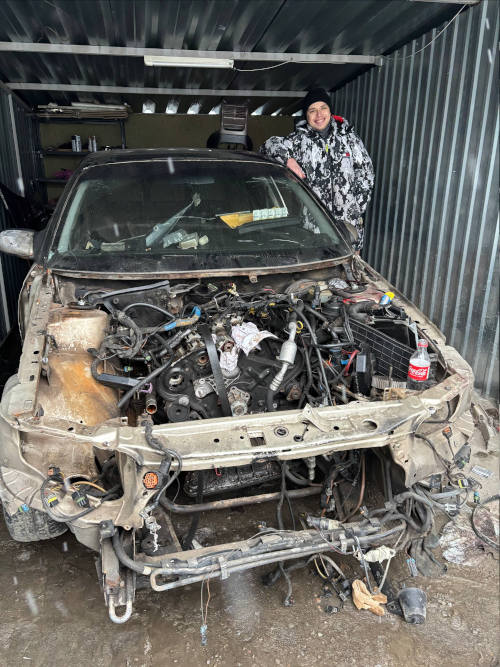
Chevrolet Traverse
The Chevrolet Traverse is a full-size unibody crossover SUV sold in multiple generations and built around front-wheel-drive-based architecture with optional all-wheel drive. Across generations, the vehicle has remained focused on packaging efficiency, passenger space, emissions compliance, and integrated electronic control rather than modular performance-oriented drivetrain interchangeability.
That distinction matters for engine swaps.

A Chevrolet Traverse engine swap is usually not limited by whether an engine physically enters the engine bay. Real compatibility depends on whether the engine, transmission, control modules, cooling system, emissions equipment, and drivetrain can continue operating as one coordinated system. A project that appears mechanically possible may still become impractical because of transmission control logic, immobilizer communication, emissions readiness requirements, packaging conflicts, or unavailable calibration support.
For this vehicle family, compatibility should be evaluated across six dimensions:
- Mechanical compatibility
- Electronic compatibility
- Transmission compatibility
- Emissions compatibility
- Cooling compatibility
- Driveline compatibility
Generation differences also matter. Early Traverse models and later Traverse models differ in platform architecture, engine families, transmission strategies, network complexity, and powertrain integration. A solution that is realistic for one generation should not automatically be assumed to transfer to another.
This guide focuses on whether an engine swap is realistic before sourcing a donor engine or disassembling the vehicle. Later sections will examine factory engine baselines, realistic swap candidates, difficulty levels, execution risks, cost realities, and legal considerations.
| Field | Summary |
|---|---|
| Vehicle | Chevrolet Traverse |
| Generations covered | All generations |
| Production years | 2009–present |
| Body/platform type | Full-size unibody crossover SUV; platform varies by generation |
| Factory drivetrain layout | Front-wheel drive with available all-wheel drive |
| Engine orientation | Transverse front-engine layout |
| Main factory engine families | Primarily GM High Feature V6 family; later generations may vary by model year |
| Transmission types | Automatic transmissions only; exact transmission family varies by generation |
| Main swap difficulty range | Moderate to extreme, depending on engine family and electronics |
| Primary compatibility bottleneck | Electronics integration combined with transverse packaging |
| Best-suited swap category | Same-generation OEM-family replacement |
| Highest-risk swap category | Cross-brand, V8, diesel, or full custom drivetrain conversion |
Where exact configuration details differ, verification by model year, drivetrain, trim, emissions package, and market remains necessary.
Quick verdict
| Decision area | Practical verdict |
|---|---|
| Easiest swap type | Same engine family replacement |
| Best OEM-style swap | Same-generation factory-family engine with matching electronics |
| Best performance-oriented swap | Same-manufacturer upgrade with minimal architecture changes |
| Most difficult swap category | Cross-brand or major custom conversion |
| Biggest mechanical constraint | Transverse engine bay and subframe packaging |
| Biggest electronic/ECU constraint | ECU, BCM, immobilizer, CAN communication |
| Biggest transmission constraint | Automatic transaxle integration and control logic |
| Biggest emissions/legal risk | OBD readiness and emissions system compatibility |
| Best recommendation | Treat Traverse swaps as full-system integration projects |
For most owners, the Chevrolet Traverse is usually better suited to factory-family engine replacement than radical performance conversion. Same-generation swaps generally preserve the highest probability of maintaining drivability, transmission behavior, diagnostics, and emissions functionality.
Same-manufacturer swaps may become realistic in selected cases, but they commonly require additional work beyond mounts and wiring. Once the project moves outside the original platform logic–especially toward large displacement, custom, or cross-brand combinations–the complexity increases quickly.
If the goal is reliability, daily usability, and predictable ownership cost, staying close to the original engine family is usually the strongest starting point.
What “compatible” actually means

Engine swap compatibility is not a single yes/no answer.
An engine can physically fit and still fail as a usable swap. For the Chevrolet Traverse, compatibility should be treated as a layered decision process rather than a simple engine-selection problem.
1. Mechanical compatibility
Mechanical compatibility is the starting point, but not the finish line.
This includes engine bay dimensions, mount locations, engine orientation, accessory placement, oil pan shape, steering clearance, firewall proximity, exhaust routing, and subframe or crossmember interference.
Because the Traverse uses a transverse front-engine layout inside a crossover platform, available space behaves differently than longitudinal truck or rear-wheel-drive platforms. Engine width, intake location, transmission packaging, and front driveline geometry become major constraints.
A mechanically installed engine may still require custom mounts, modified exhaust paths, revised cooling layouts, or changes to service access.
2. Electronic compatibility
Electronic compatibility is often the factor that separates realistic swaps from abandoned projects.
Modern Traverse generations rely on communication between the engine control module, transmission controller, body control module, security systems, sensors, throttle control, and network architecture.
Immobilizer logic, CAN communication, sensor validation, torque requests, and module synchronization may determine whether the vehicle starts, shifts correctly, displays faults, or enters reduced-power operation.
Older generations may offer somewhat simpler integration paths, while newer generations tend to depend more heavily on networked control strategies.
3. Transmission compatibility
Transmission compatibility goes beyond bolt patterns.
Bellhousing compatibility, flexplate design, torque converter geometry, transmission calibration, torque capacity, shift behavior, and automatic transmission control all influence whether a swap can function reliably.
Because the Traverse platform uses automatic transaxle layouts, the engine and transmission are strongly coupled. Incorrect pairing can affect shifting quality, axle alignment, drivetrain stress, and long-term durability.
All-wheel-drive configurations may introduce additional requirements for transfer components and driveline geometry.
4. Emissions and inspection compatibility
A running engine is not automatically a legal or complete swap.
Modern inspection systems often evaluate readiness monitors, catalyst behavior, oxygen sensor operation, EVAP systems, misfire detection, and diagnostic reporting.
If emissions equipment no longer communicates correctly–or if required monitoring never completes–the vehicle may fail inspection even if it drives normally.
Inspection rules vary by jurisdiction and should be verified before planning a donor combination.
5. Cooling and driveline compatibility
Cooling and driveline compatibility determine whether the swap survives daily use.
Engine output changes may exceed radiator capacity, alter fan requirements, increase heat load, or introduce packaging problems around airflow and heat extraction.
At the same time, higher torque can affect axle loading, drivetrain angles, differential stress, and long-term reliability.
A swap that works during initial startup may still fail under sustained load if heat management and driveline durability were not considered.
The next section should establish the Chevrolet Traverse platform reality and factory engine baseline before evaluating which swap paths are actually realistic.
Chevrolet Traverse platform reality and factory engine baseline
Before evaluating which engine swaps are realistic, the original Chevrolet Traverse architecture needs to be treated as the baseline system rather than a collection of independent parts. Engine swaps succeed or fail largely because of the assumptions built into the factory platform. The original engine family, transmission layout, electronics, emissions strategy, and packaging dimensions define what the vehicle can accept mechanically, electronically, and legally.
For the Traverse, that baseline is especially important because this vehicle was developed as a front-wheel-drive-based crossover platform with tightly integrated automatic transaxles and electronically managed powertrain systems. Unlike platforms designed for broad drivetrain interchangeability, the Traverse generally rewards staying close to factory architecture.
Platform and chassis reality
The Chevrolet Traverse has been built as a unibody crossover throughout its production history rather than a body-on-frame SUV. That decision affects almost every engine swap variable.
Across generations, the vehicle uses a front-engine, transverse powertrain layout with front-wheel drive as the base configuration and optional all-wheel drive depending on model year and trim. In practical swap terms, this means the engine and transmission operate as one packaged unit mounted inside a relatively constrained front subframe structure.
The engine bay is shaped with a width greater than its length. This creates different constraints compared with longitudinal truck or performance platforms. Engine height, intake placement, exhaust routing, transmission case dimensions, and accessory positioning become more restrictive than simple hood clearance.
Several packaging realities influence swap feasibility:
- The front subframe acts as both structural support and drivetrain mounting reference.
- Engine mount geometry is designed around factory engine families and transaxle alignment.
- Steering components occupy space close to the rear of the powertrain package and may limit oil pan and exhaust configurations.
- Firewall clearance becomes increasingly important as engine length or rear-bank packaging changes.
- Radiator and cooling stack depth leave limited room for major accessory relocation.
- AWD models introduce additional packaging requirements through the front transfer arrangement and rear driveline routing.
Oil pan geometry should not be treated as a minor detail. On crossover platforms, oil pan depth and shape frequently interact with subframe position and axle geometry. Even engines that share displacement or manufacturer origin may require different lower-end packaging.
Exhaust routing is another commonly underestimated limitation. Factory exhaust systems are packaged around catalyst placement, thermal management, emissions monitoring, and service access. Larger engines or different cylinder bank geometry may force redesign of heat shielding, catalytic converter placement, and downstream emissions components.
Accessory drive layout and cooling capacity also influence what can realistically remain OEM-like. Belt routing, compressor placement, fan depth, and airflow assumptions are often optimized for original engine output and thermal behavior.
Generation differences that affect swaps
Although all Traverse generations share the same broad vehicle concept, swap difficulty changes meaningfully by generation.
The first generation (2009–2017) uses earlier versions of GM's integrated crossover electronics and generally represents the simplest electronic baseline in the model family. These vehicles remain fully OBD-II managed but usually operate with less network complexity than later platforms.
The second generation (2018–2023, verification by market and model year recommended) introduced updated platform architecture, revised transmission strategies, and increased dependency between engine management and vehicle-wide control systems. CAN communication, security logic, and calibration consistency become more important.
The newest generation (2024+) moves further toward tightly integrated turbocharged powertrain management. Exact module relationships should be verified by year and drivetrain, but newer calibration dependency generally reduces tolerance for mixed-generation combinations.
Several trends affect later-generation swap planning:
- More extensive ECU and transmission coordination
- Stronger BCM and immobilizer dependency
- Greater reliance on drive-by-wire operation
- Expanded readiness monitor expectations
- More aggressive torque management logic
- Additional emissions integration between modules
OBD-II remains relevant across covered years, but emissions monitoring sophistication increases over time. Catalyst monitoring, EVAP behavior, misfire detection, and readiness completion become more sensitive to deviations from factory calibration.
This does not automatically make newer Traverse models impossible to modify. It means later generations usually require more electronic discipline and fewer assumptions about plug-and-play compatibility.
Factory engines offered
| Engine code/name | Displacement | Configuration | Fuel type | Valvetrain/timing | Power | Torque | Production years | Donor vehicles | Known issues |
|---|---|---|---|---|---|---|---|---|---|
| GM LLT | 3.6L | V6 | Gasoline | DOHC, VVT, direct injection | Approximately 281–288 hp | Approximately 266–270 lb-ft | 2009–2017 | Chevrolet Traverse, GMC Acadia, Buick Enclave, Saturn Outlook | Timing chain concerns have been reported in some applications |
| GM LFY | 3.6L | V6 | Gasoline | DOHC, VVT, direct injection | Approximately 310 hp | Approximately 266 lb-ft | 2018–2023 | Chevrolet Traverse and related GM crossover applications | Calibration and electronic dependency vary by application |
| GM LTG | 2.0L | Inline-4 turbo | Gasoline | DOHC, turbocharged, direct injection | Varies by application | Requires verification | Limited availability; verify by market/model year | Selected GM crossover applications | Turbo and thermal management should be verified |
| GM LK0 | 2.5L | Turbocharged inline-4 | Gasoline | DOHC, turbocharged | Approximately 328 hp | Approximately 326 lb-ft | 2024–present | Chevrolet Traverse | Long-term field history sis till developing |
The factory engine history shows that Chevrolet largely stayed inside a narrow architectural envelope rather than changing vehicle identity across generations. Engine families evolved, but the underlying assumptions remained similar: transverse packaging, automatic transaxles, integrated electronics, and emissions-managed operation.
That continuity matters because factory engines create the strongest compatibility baseline. Engines originally engineered for the same platform usually preserve mount geometry, transmission relationships, cooling expectations, and diagnostic behavior more effectively than custom alternatives.
Why the factory engine baseline matters
1. Mount geometry
Factory engine families establish where the powertrain sits inside the vehicle. Mount position affects engine angle, axle alignment, oil pan clearance, accessory placement, firewall space, and long-term serviceability. Even small changes in block architecture can alter multiple downstream systems.
2. Bellhousing and transmission patterns
Factory transmission pairings define more than bolt compatibility. They influence torque converter geometry, shift calibration, transmission cooling, and driveline alignment. Keeping the original transmission often becomes easier when staying inside related engine families.
3. ECU and wiring expectations
The original engine management system defines sensor strategy, throttle operation, immobilizer communication, diagnostic behavior, and module interaction. Factory ECU expectations frequently determine whether the vehicle behaves normally after startup.
4. Cooling and exhaust capacity
Radiator sizing, fan control, catalyst placement, and airflow assumptions are designed around factory output and heat generation. Significant power changes may exceed thermal margins even if the engine is physically installed
5. Emissions and inspection logic
Factory emissions systems establish readiness expectations and diagnostic pathways. OBD monitors, catalyst efficiency tracking, EVAP operation, and fault detection can determine whether a swap remains inspection-stable.
6. Transmission behavior and driveline durability
Original torque delivery influences transmission calibration, axle loading, differential stress, and long-term driveline behavior. Higher output does not automatically create incompatibility, but it changes the assumptions that factory systems were built around.
Once the factory platform and engine baseline are clear, the next step is to evaluate candidate engine swaps by difficulty level, integration requirements, and overall feasibility.
Before you start researching parts and pricing, check whether the swap you have in mind actually fits – and whether it's worth doing.
Check My Engine SwapEnter your vehicle and target engine to see a compatibility verdict, estimated cost, required changes, and whether it's the right move for your build.
Get My Swap VerdictBest engine swap options for the Chevrolet Traverse, ranked by difficulty
Once the original Chevrolet Traverse platform and factory engine baseline are understood, engine swap decisions become easier to evaluate objectively. The goal is not to identify the engine with the highest output. The goal is to identify the engine that creates the lowest integration burden relative to the intended use case.
For the Traverse, swap difficulty is driven more by integration depth than by physical installation. Mechanical fitment, transmission compatibility, ECU behavior, emissions monitoring, and driveline durability usually matter more than raw horsepower figures.
How swap difficulty levels actually work
For the Chevrolet Traverse, swap difficulty should be viewed as a progression from factory continuity toward complete system redesign.
Level 1 swaps remain inside the original platform logic. These usually keep the original engine family, preserve transmission relationships, and reduce uncertainty around wiring, cooling, and diagnostics.
Level 2 swaps remain inside the GM ecosystem but move outside the exact original configuration. These projects may still be practical, but commonly require additional planning for mounts, transmission calibration, accessory placement, exhaust routing, and ECU behavior.
Level 3–5 swaps move into custom-build territory. At this point, the engine control strategy becomes a project by itself. Standalone ECU solutions may simplify engine operation but can complicate factory gauges, transmission control, immobilizer behavior, traction systems, and inspection stability.
On the Traverse platform specifically, higher torque levels can create secondary problems outside the engine bay. Automatic transmissions, axle loading, AWD hardware, cooling capacity, and heat management become increasingly important as output rises.
Difficulty should therefore be interpreted as integration effort rather than fabrication hours alone.
Level 1 swaps – lowest risk, OEM-style compatibility

Level 1 swaps stay as close as possible to factory architecture. These swaps generally preserve mount geometry, transmission expectations, cooling assumptions, and emissions logic more effectively than alternative approaches.
| Engine code/name | Why it belongs in Level 1 | Main benefit | Main challenge | Best use case |
|---|---|---|---|---|
| GM LLT 3.6L V6 | Factory engine for first-generation Traverse | Highest probability of retaining OEM behavior | Year-specific wiring and calibration matching still mmatter | Daily-driver replacement (2009–2017) |
| GM LFY 3.6L V6 | Factory engine for second-generation Traverse | Strong compatibility with factory transmission and electronics | Requires generation-correct module integration | OEM-style replacement (2018–2023) |
| GM LTG 2.0L Turbo | Factory-associated configuration in selected applications | Maintains factory-style packaging | Cooling and calibration verification required | Replacement where originally equipped |
| GM LK0 2.5L Turbo | Factory baseline for the latest generation | Preserves the newest-generation integration logic | Limited documented long-term swap history | 2024+ replacement only |
Level 1 does not mean bolt-in simplicity. Matching engine code alone may not be enough. Harness revisions, emissions packages, drivetrain differences, and calibration variations can still affect compatibility.
For most Traverse owners, Level 1 remains the category with the highest probability of maintaining inspection stability, predictable drivability, and long-term serviceability.
Level 2 swaps – moderate complexity
Level 2 swaps stay inside the same manufacturer ecosystem but move outside direct factory pairing.
These projects can become worthwhile when donor availability, performance goals, or engine replacement economics justify additional complexity. However, they should not be treated as routine engine replacements.
| Engine code/name | Why it belongs in Level 2 | Main benefit | Main challenge | Best use case |
|---|---|---|---|---|
| GM LGX 3.6L V6 | Closely related GM V6 architecture | Potential to remain close to OEM packaging | ECU and calibration alignment require verification | Advanced OEM-plus replacement |
| GM LFX 3.6L V6 | Same broader engine family with different applications | Parts availability in some markets | Accessory layout and integration differences | Experienced Din IY or shop projects |
| Later-generation factory engine retrofit | Same manufacturer but different generation logic | Potential efficiency or performance gains | Electronics and transmission compatibility | Custom daily-driver build |
Level 2 swaps usually become successful when the builder treats the donor engine, ECU, wiring, transmission strategy, and supporting hardware as one package rather than sourcing components individually.
Documented examples suggest that retaining as much donor-system continuity as possible generally reduces troubleshooting time.
Level 3–5 swaps – high-effort custom builds
Level 3–5 swaps transform the Traverse from a factory-style vehicle into a custom project.
At this level, mechanical installation becomes only one layer of the challenge. Engine management, drivetrain adaptation, cooling redesign, and module integration often become larger tasks than engine placement itself.
| Engine code/name | Difficulty level | Main benefit | Dominant integration risk | Recommended only if… |
|---|---|---|---|---|
| GM LS-series V8 | 4–5 | Large aftermarket ecosystem and performance potential | Transverse packaging and transmission redesign | The vehicle is becoming a full custom build |
| GM LT-series V8 | 5 | Modern performance potential | Direct injection and electronics integration | Advanced fabrication and standalone strategies are acceptable |
| Cross-brand turbo gasoline engine | 5 | Unique custom build opportunities | CAN, ECU, transmission, and emissions conflicts | Factory integration is not a priority |
| Diesel conversion | 5 | Theoretical torque and efficiency benefits | Fuel system and emissions architecture mismatch | Regulatory and fabrication complexity is acceptable |
| Race-focused standalone build | 5 | Maximum flexibility | Loss of factory drivability and diagnostics | Street functionality is secondary |
For Traverse applications, major V8 conversions are usually not limited by engine dimensions alone. Transmission compatibility, axle loading, cooling stack packaging, and automatic control strategy frequently become the dominant constraints.
Standalone ECU approaches may simplify engine control, but should not be viewed as universal solutions because factory body functions and transmission behavior may still expect original communication patterns.
Engine swap option table
| Engine code/name | Difficulty level | Engine type | Fuel type | Donor vehicles | Main benefits | Main risks | Recommended only if… |
|---|---|---|---|---|---|---|---|
| LLT 3.6L | 1 | V6 | Gasoline | Traverse / related Lambda vehicles | Most predictable integration | Generation-specific calibration | Reliability is the priority |
| LFY 3.6L | 1 | V6 | Gasoline | Traverse and related GM applications | Strong OEM continuity | Module compatibility | Factory behavior should be retained |
| LTG 2.0T | 1–2 | Turbo I4 | Gasoline | Requires verification by the market | Factory-oriented packaging | Thermal and ECU complexity | Originally equipped or carefully planned |
| LK0 2.5T | 1–3 | Turbo I4 | Gasoline | 2024+ Traverse | Current-generation compatibility | Limited swap history | Working inside the newest generation |
| LGX 3.6L | 2 | V6 | Gasoline | GM crossover applications | Stays inside the GME ecosystem | Integration work | OEM-plus outcome is desired |
| LS-series V8 | 4–5 | V8 | Gasoline | GM performance platforms | Performance ceiling | Complete drivetrain redesign, Custom-built goals | s dominate |
| LT-series V8 | 5 | V8 | Gasoline | Requires verification | Modern V8 performance | Extreme integration complexity | Fabrication resources are available |
Best swap by use case
Best daily-driver swap:
Same-generation factory engine replacement. This option usually offers the strongest balance of reliability, diagnostics compatibility, serviceability, and drivability. The tradeoff is limited performance gain.
Best budget swap:
Used OEM-family replacement with matching drivetrain configuration. Cost efficiency typically comes from minimizing adaptation work rather than reducing engine purchase price.
Best OEM-style swap:
Factory-family engine with matching ECU and transmission strategy. This preserves the highest probability of retaining original vehicle behavior.
Best performance swap:
A carefully planned same-manufacturer upgrade rather than a radical engine conversion. Moderate performance improvements usually preserve more of the vehicle than complete architecture changes.
Best off-road/towing swap:
Factory-family replacement remains the safest answer. The Traverse platform was not originally designed around heavy-duty drivetrain conversion strategies.
Best race/custom swap:
LS or LT custom projects only if the goal is experimentation or a showcase build rather than OEM-level refinement. These projects should be approached as complete vehicle engineering exercises.
Swap to avoid for most users:
Cross-brand or diesel conversions. The combination of electronics integration, transmission adaptation, emissions uncertainty, and fabrication effort usually outweighs the benefit for typical owners.
Choosing an engine is only the beginning. The next section should evaluate execution reality, common failure points, cost considerations, legality, alternatives, and the practical reasons why some theoretically possible swaps never become successful finished projects.
Engine swap execution reality for the Chevrolet Traverse

Choosing a Chevrolet Traverse engine swap is only the first decision. The finished result depends on planning quality, measurement accuracy, wiring discipline, calibration strategy, validation, and local emissions requirements. A swap that looks reasonable on paper can still become unreliable or unusable if the engine, transmission, ECU, cooling system, emissions equipment, and driveline do not continue working as one system.
Planning and measurement before removal
A Traverse swap should begin as a measurement and systems-planning problem, not as a parts-shopping exercise. Before removing the original engine, the builder should document engine bay dimensions, mount locations, oil pan clearance, steering and subframe clearance, firewall space, accessory drive location, radiator and fan depth, exhaust routing, transmission position, axle geometry, wiring layout, and emissions equipment placement.
Small measurement errors can create major problems later. A mount that places the engine slightly too high may affect hood clearance, axle angle, exhaust routing, or vibration. A transmission that sits slightly off-center may cause axle stress or driveline noise. A cooling package that appears acceptable during mockup may become inadequate during traffic, towing, or heat soak.
For the Traverse, AWD versions require additional attention because the front power transfer arrangement and rear driveline geometry depend on the original transaxle position. Any engine plan that changes transmission placement must be checked before fabrication begins.
Test fitting, mounting, and driveline alignment
Test fitting should confirm the engine and transmission as a complete powertrain package. The goal is not simply to lower the engine into the bay. The goal is to verify mount angle, bellhousing alignment, flexplate and torque converter compatibility, axle position, exhaust clearance, accessory access, and serviceability.
Mount design or mount kit selection should be verified against the exact generation, drivetrain, and engine configuration. A mount solution that works on one Traverse generation or related GM crossover should not automatically be assumed to fit another.
Driveline alignment is especially important on a transverse automatic platform. If the engine physically fits but the transmission position is wrong, the swap can still fail through vibration, axle wear, shift problems, or differential stress. A usable swap must maintain both mechanical placement and driveline geometry.
Wiring, ECU strategy, and first start validation
Wiring and ECU strategy often decide whether a Traverse swap becomes a usable vehicle or a permanent project. The safest strategy is usually retaining an OEM-style control path: correct ECU, compatible transmission control, matching sensors, proper immobilizer communication, and module behavior that the body control system can recognize.
Using a donor ECU may help if the engine and transmission are moved as a matched package, but it can still create issues with BCM expectations, CAN messages, throttle control, gauges, security, and diagnostic readiness. A standalone ECU may simplify engine operation in custom builds, but it can complicate automatic transmission control, emissions inspection, stability systems, and factory diagnostics.
First start is not the finish line. After initial startup, the swap still needs validation for oil pressure, charging voltage, idle stability, throttle response, coolant circulation, fan control, transmission engagement, sensor data, grounding, heat soak, repeated drive cycles, and stored fault codes. A swap that starts once but cannot complete road-test validation is not finished.
Common failure scenarios
| Failure scenario | Why it happens | Symptoms | Prevention |
|---|---|---|---|
| Incomplete wiring documentation | Harness changes are made without pinout tracking | No-start, random faults, sensor errors | Map every circuit before cutting or splicing |
| ECU or immobilizer mismatch | ECU, BCM, key, or security logic do not agree | Crank-no-start, security light, reduced power | Plan module compatibility before buying parts |
| CAN communication errors | Factory modules do not receive expected messages | Warning lights, limp mode, no gauge data | Keep compatible modules or verify network strategy |
| Incorrect transmission pairing. The engine and | nd automattransmission areare not calibrated together | Harsh shifts, no shift, overheating, fault codes | Use matched powertrain components when possible |
| Bad axle or driveline angles | Powertrain position changes during mounting | Vibration, axle wear, noise under load | Mock up drivetrain geometry before final welding |
| Undersized cooling system | Heat output exceeds radiator, fan, or airflow capacity | Overheating, heat soak, coolant temperature spikes | Verify cooling capacity under real driving conditions |
| Exhaust heat management problems | Custom routing places heat near wiring or body components | Melted wiring, cabin heat, cand atalyst faults | Use proper shielding and retain the mission's layout where possible |
| Emissions readiness failure | OBD monitors do not complete after the swap | Inspection failure despite normal driving | Match ECU strategy with catalyst, EVAP, O2, and sensor systems |
| Poor serviceability | The engine fitsbu t blocks access to basic components | High repair labor, impossible maintenance access | Check spark plugs, belts, sensors, and exhaust access during mockup |
Engine swap cost and timeline reality
The Chevrolet Traverse swap cost is driven more by integration depth than by the purchase price of the engine. The lowest-cost category is usually a same-generation factory-family replacement because it minimizes fabrication, wiring uncertainty, calibration work, and inspection risk.
Moderate same-manufacturer swaps can become significantly more expensive because they may require additional donor parts, wiring changes, cooling adjustments, exhaust work, ECU planning, and transmission validation. High-effort custom swaps can move into custom build territory quickly, especially when mounts, exhaust, transmission control, driveline geometry, and emissions strategy all require separate solutions.
Costs also grow non-linearly because one change often creates another. A different engine may require a different transmission strategy. A different transmission position may require axle changes. A custom exhaust may create heat management issues. Rework, diagnosis, and downtime can become larger expenses than the engine itself.
Legal and emissions considerations
A swapped Traverse can run well and still fail inspection. Street legality depends on local rules, model year, emissions equipment, ECU strategy, and whether OBD readiness monitors care completedcorrectly.
Key inspection risks include catalyst monitoring, EVAP operation, oxygen sensor function, misfire detection, readiness status, and stored diagnostic trouble codes. If the ECU expects emissions equipment that is missing, relocated incorrectly, or not communicating properly, the vehicle may fail even if it drives normally.
Standalone ECU strategies are especially sensitive for street use because they may not preserve factory OBD behavior. Local, state, and country regulations must be verified before starting the project. This section is not legal advice; it is a reminder that emissions planning should happen before the swap, not after the first start.
When an engine swap is the wrong solution
An engine swap is not always the best answer to a Traverse reliability or performance problem. In many cases, rebuilding the existing engine or replacing it with the same factory engine is more practical than adapting a different powertrain.
Other alternatives may include cooling system restoration, transmission repair, maintenance catch-up, conservative factory-compatible upgrades, or choosing a different vehicle platform if the goal is major performance. Buying a vehicle already designed around higher output is often cheaper and more reliable than forcing the Traverse into a role it was not designed to fill.
Avoiding an unnecessary swap can save money, downtime, and long-term troubleshooting. The best decision is the one the owner can verify, maintain, and legally operate.
Frequently asked questions
What is the easiest engine swap for the Chevrolet Traverse?
The easiest swap is usually a same-generation factory engine replacement. It keeps the project closest to the original mounts, transmission, electronics, cooling, and emissions strategy.
What is the cheapest engine swap for the Chevrolet Traverse?
The cheapest successful swap is usually not the cheapest engine. It is the swap that requires the least custom wiring, fabrication, calibration, and rework.
Is a same-family swap better than a cross-brand swap?
For most Traverse owners, yes. Same-family swaps usually preserve more factory compatibility and reduce electronics, transmission, and emissions risk.
Can the factory transmission be reused?
It may be possible with factory-family engines, but compatibility must be verified by engine, generation, drivetrain, and control logic. Non-native engines often create transmission control and alignment problems.
Do I need a standalone ECU?
Most OEM-style swaps should avoid standalone control if street drivability and inspection stability matter. Standalone ECUs are more common in custom or race-focused builds.
Why do engine swaps fail inspection?
They often fail because OBD readiness monitors do not complete or emissions systems do not match ECU expectations. A running engine is not the same as an inspection-ready vehicle.
Can a swapped Chevrolet Traverse be reliable?
Yes, if the swap stays close to factory architecture and is validated properly. Reliability decreases as custom mounts, custom wiring, non-native transmissions, and emissions compromises increase.
What usually causes swap projects to go over budget?
Wiring diagnosis, fabrication changes, cooling revisions, exhaust rework, transmission issues, and unexpected module conflicts commonly increase cost.
Is a performance swap better than rebuilding the factory engine?
Usually not for a daily-driven Traverse. Rebuilding or replacing the factory engine is often more predictable unless the owner is prepared for a custom integration project.
Which swap should most owners avoid?
Most owners should avoid cross-brand, diesel, and V8 conversions. These usually require extensive fabrication, electronics work, transmission adaptation, and legal verification.
Final rule for choosing the right swap
A Chevrolet Traverse engine swap should be treated as a system redesign, not a simple engine replacement. The best swap is not the most powerful engine; it is the engine that preserves compatibility across mounts, transmission, ECU, cooling, emissions, and driveline durability.
If the required custom work cannot be measured, verified, budgeted, and maintained, the better solution is usually a factory-family replacement, rebuild, or a different vehicle platform.
Stop comparing specs in your head. Enter your Chevrolet Traverse and the engine you want – get a structured verdict with cost, complexity, and a clear recommendation.
See If This Swap FitsYears
No year pages with content are configured for this model yet.