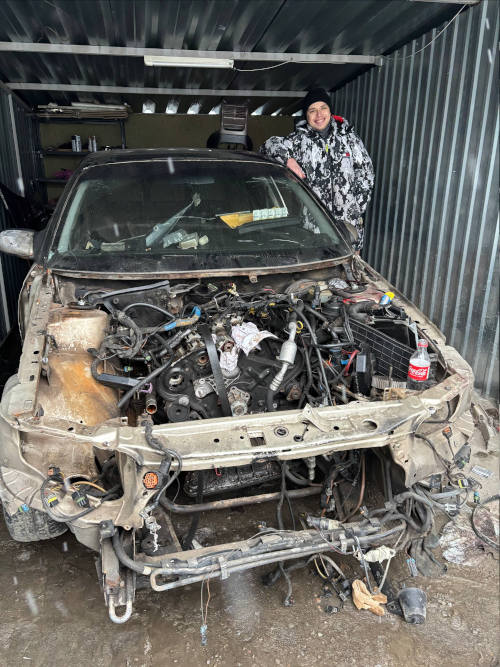
Chrysler 300
Chrysler 300 engine swap compatibility overview
The Chrysler 300 engine swap discussion covers the modern US-market Chrysler 300 sedan across its major production run from 2005 to 2023, including the first-generation LX-platform cars and the second-generation LD-platform cars. This vehicle family is relevant for swaps because it was factory-built around a longitudinal front-engine, rear-wheel-drive or all-wheel-drive layout, with factory V6 and HEMI V8 options depending on year, trim, and generation.
A Chrysler 300 can be a practical swap platform, but it should not be treated as a universal “anything fits” chassis. Physical engine bay space is only one part of the problem. A swap that physically bolts into the car may still fail because the transmission cannot be controlled, the immobilizer does not recognize the ECU, the CAN bus does not communicate correctly, the exhaust cannot support emissions monitors, or the driveline is not suited for the new torque output.
True Chrysler 300 engine swap compatibility must include mechanical compatibility, electronic compatibility, transmission compatibility, emissions compatibility, cooling compatibility, and driveline compatibility. Later sections should cover factory engines, realistic swap options, difficulty levels, execution risks, cost factors, and legal considerations.
Entity summary
| Field | Summary |
|---|---|
| Vehicle | Chrysler 300 |
| Generations covered | 2005–2010 LX platform; 2011–2023 LD platform |
| Production years | Modern US-market Chrysler 300: 2005–2023 |
| Body/platform type | Full-size / large unibody sedan, longitudinal front-engine layout |
| Factory drivetrain layout | Rear-wheel drive and available all-wheel drive, depending on year and trim |
| Engine orientation | Longitudinal |
| Main factory engine families | Chrysler V6 engines, 3.6L Pentastar V6, Gen III HEMI V8 family including 5.7L, 6.1L, and 6.4L variants depending on generation |
| Transmission types | 4-speed automatic, 5-speed automatic, and later 8-speed automatic depending on year, engine, and trim |
| Main swap difficulty range | Same-engine replacement is usually low difficulty; OEM-style HEMI swaps are moderate to high; cross-brand or Hellcat-level swaps are advanced |
| Primary compatibility bottleneck | ECU, immobilizer, CAN bus, transmission control, and emissions readiness |
| Best-suited swap category | Same-generation factory-family Mopar swaps using a complete donor system |
| Highest-risk swap category | Cross-brand swaps, diesel swaps, EV conversions, and high-output supercharged swaps |
Quick verdict
| Decision point | Practical answer |
|---|---|
| Easiest swap type | Same-engine replacement using the correct year-range engine and matching electronics |
| Best OEM-style swap | Factory-family HEMI swap from the same platform or closely related Chrysler/Dodge donor |
| Best performance-oriented swap | 5.7L or 6.4L HEMI, depending on generation, budget, emissions rules, and donor completeness |
| Most difficult swap category | Hellcat, LS/LT, diesel, EV, or other full-custom swaps |
| Biggest mechanical constraint | Engine mounts, oil pan clearance, steering clearance, exhaust routing, and AWD front driveline packaging |
| Biggest electronic/ECU constraint | PCM/ECU, TCM, BCM, immobilizer, CAN bus communication, and torque management |
| Biggest transmission constraint | Correct bellhousing, transmission control, torque capacity, driveshaft alignment, and differential matching |
| Biggest emissions/legal risk | OBD readiness, catalyst monitoring, EVAP operation, misfire monitoring, and state inspection compliance |
| Best recommendation | Use a complete same-generation donor vehicle whenever possible, especially for V6-to-V8 swaps |
The Chrysler 300 is best suited for factory-family swaps, especially swaps that stay within the Chrysler/Mopar ecosystem. A same-generation HEMI donor is usually a more realistic starting point than buying only an engine. Cross-brand swaps can be done in custom builds, but they should be treated as fabrication and electronics projects rather than normal compatibility swaps.
What “compatible” actually means
Engine swap compatibility is not a single yes-or-no question. For the Chrysler 300, compatibility should be evaluated across several systems before buying an engine or donor car.
- Mechanical compatibility means the engine can physically sit in the bay with workable mounts, oil pan clearance, steering clearance, firewall clearance, subframe clearance, exhaust routing, accessory placement, and service access. RWD Chrysler 300 models are usually simpler than AWD models because AWD packaging adds a transfer case, front driveline, and front differential clearance concerns.
- Electronic compatibility means the ECU, immobilizer, body control module, CAN bus, throttle control, sensors, and factory modules can communicate correctly. Earlier cars may be less networked than later LD-platform cars, but no modern Chrysler 300 should be treated like a simple carbureted swap. A running engine is not enough if the cluster, shifter, ABS, security system, or transmission cannot communicate properly.
- Transmission compatibility includes bellhousing pattern, flexplate or torque converter compatibility, automatic transmission control, torque capacity, driveshaft length, differential ratio, and shift behavior. A HEMI swap with the wrong transmission strategy can create limp mode, poor shifting, no-start conditions, or driveline vibration.
- Emissions and inspection compatibility includes OBD readiness, catalyst monitoring, oxygen sensors, EVAP function, misfire monitoring, and required emissions equipment. A Chrysler 300 swap can run and drive but still fail inspection if readiness monitors do not complete or the emissions system does not match the ECU calibration.
- Cooling and driveline compatibility includes radiator capacity, fan control, heat management, transmission cooling, torque load, driveshaft angles, axle strength, differential durability, and long-term reliability. More power requires more than a larger engine; it may require a stronger supporting system.
The next section should examine the Chrysler 300 platform reality and factory engine baseline before ranking specific swap options.
Before you start researching parts and pricing, check whether the swap you have in mind actually fits – and whether it's worth doing.
Check My Engine SwapChrysler 300 platform reality and factory engine baseline
The Chrysler 300 occupies a unique position in the engine swap world because Chrysler already engineered the platform around both V6 and V8 powertrains. Before evaluating potential swap candidates, it is important to understand what the factory vehicle architecture was designed to support. The original platform determines far more than engine bay space. It influences drivetrain alignment, transmission compatibility, electronics integration, emissions behavior, cooling requirements, and long-term reliability.
Platform and chassis reality
The modern Chrysler 300 was built on two closely related rear-wheel-drive platforms: the LX platform from 2005 through 2010 and the updated LD platform from 2011 through 2023. Both generations use a unibody structure rather than a body-on-frame design. For swap planning, this distinction matters because engine location, suspension geometry, steering placement, and drivetrain alignment are fixed by the structure itself.
The platform was designed around a longitudinal engine layout. Unlike many modern sedans that use a transverse engine and transaxle arrangement, the Chrysler 300 places the engine front-to-rear with the transmission mounted directly behind it. This architecture is one of the vehicle's biggest advantages. It creates a drivetrain tunnel large enough for conventional rear-wheel-drive transmissions and allows the factory installation of multiple V6 and HEMI V8 engine families.
Space inside the engine compartment is generally favorable compared to most front-wheel-drive sedans. However, available room should not be confused with unlimited flexibility. The steering rack sits low in the chassis and shares packaging space with the oil pan, exhaust routing, and front suspension components. Engine swaps that alter oil pan shape or exhaust manifold placement must be evaluated carefully around these areas.
The front suspension uses an independent design mounted to a front subframe. That subframe establishes the relationship between engine mounts, steering components, suspension geometry, and drivetrain alignment. Builders frequently focus on engine dimensions while overlooking the fact that crankshaft centerline location and transmission output angle must remain compatible with the existing driveline.
Rear-wheel-drive models are generally the simplest starting point because there is no front differential or transfer case occupying space beneath the engine. AWD-equipped Chrysler 300 models introduce additional packaging constraints. Depending on model year and drivetrain configuration, front driveline components may affect oil pan selection, exhaust routing, engine mount placement, and transmission compatibility.
Cooling system packaging is another platform characteristic worth noting. Chrysler designed the 300 to accommodate both V6 and V8 engines, which provides a stronger cooling foundation than many sedan platforms. Nevertheless, radiator dimensions, fan assemblies, transmission coolers, accessory drive spacing, and airflow management remain part of the factory engineering package and should be considered when evaluating alternative powertrains.
Generation differences that affect swaps
A common misconception is that all Chrysler 300 models share the same level of swap complexity. Mechanically, the overall platform philosophy remained similar throughout production, but the electronic environment evolved considerably.
First-generation LX vehicles from 2005 through 2010 generally operate with simpler electronic integration than later models. These vehicles still use OBD-II diagnostics, electronic engine management, and networked modules, but the number of interconnected systems is lower than on later LD-platform cars. When performing factory-family swaps, builders often find that matching donor components from the same generation reduces compatibility variables.
The 2011 redesign introduced the LD platform and expanded the role of electronic communication throughout the vehicle. Powertrain modules became increasingly interconnected with body control systems, instrument clusters, security functions, traction control systems, and transmission controllers. As a result, later vehicles often require more attention to module compatibility and software expectations.
Security integration also became more significant over time. Immobilizer systems, key authorization modules, and body control modules play a larger role in powertrain operation than many builders initially expect. A mechanically correct installation may still encounter startup issues if the vehicle's security architecture does not recognize the engine management system.
Transmission technology changed as well. Early Chrysler 300 models commonly used four-speed and five-speed automatic transmissions. Later vehicles adopted eight-speed automatic transmissions with more sophisticated control logic and closer integration with engine management. This evolution improved drivability and efficiency but increased the importance of maintaining proper communication between powertrain modules.
Emissions systems followed a similar path. All modern Chrysler 300 models operate under OBD-II requirements, but later vehicles generally monitor more systems and place greater emphasis on catalyst efficiency, EVAP performance, oxygen sensor functionality, and readiness monitor completion. For emissions-regulated vehicles, model-year differences can significantly influence overall swap feasibility.
Factory engines offered
| Engine code/name | Displacement | Configuration | Fuel type | Valvetrain/timing | Power | Torque | Production years | Donor vehicles | Known issues |
|---|---|---|---|---|---|---|---|---|---|
| EER 2.7L V6 | 2.7L | V6 | Gasoline | DOHC | Approximately 190 hp | Approximately 190 lb-ft | 2005–2010 | Chrysler 300 | Oil sludge concerns when poorly maintained |
| 3.5L High Output V6 | 3.5L | V6 | Gasoline | SOHC | Approximately 250 hp | Approximately 250 lb-ft | 2005–2010 | Chrysler 300 | Timing belt maintenance requirements |
| EZB / EZD 5.7L HEMI | 5.7L | V8 | Gasoline | OHV | Approximately 340–360 hp | Approximately 390 lb-ft | 2005–2010 | Chrysler 300C | MDS-related valvetrain wear, exhaust manifold hardware |
| ESF 6.1L HEMI | 6.1L | V8 | Gasoline | OHV | 425 hp | 420 lb-ft | 2005–2010 | 300C SRT8 | Heat-related wear in high-performance applications |
| ERB 3.6L Pentastar | 3.6L | V6 | Gasoline | DOHC | 292–300 hp | 260–264 lb-ft | 2011–2023 | Chrysler 300 | Oil cooler housing and valvetrain concerns |
| EZH 5.7L HEMI | 5.7L | V8 | Gasoline | OHV VVT | 363–372 hp | Approximately 394 lb-ft | 2011–2023 | 300C / 300S | MDS lifter wear, exhaust manifold issues |
| 6.4L Apache HEMI | 6.4L | V8 | Gasoline | OHV | 470–485 hp | 470–475 lb-ft | 2012–2014, 2023 | 300 SRT8 / 300C | Higher thermal load and operating costs |
The most important pattern in the factory engine lineup is continuity. Chrysler did not redesign the platform around entirely different engine architectures every few years. Instead, the vehicle remained centered around Chrysler V6 engines and the Gen III HEMI family. That continuity is valuable because factory mounts, transmissions, cooling systems, and electronic strategies were repeatedly adapted around related engine families.
Another notable pattern is that Chrysler offered both V6 and V8 configurations from the factory. This means the platform already has documented engineering solutions for multiple power levels. When evaluating future swap candidates, factory V8-equipped vehicles often provide useful reference points because many supporting systems already exist within the platform ecosystem.
Why the factory engine baseline matters
Mount geometry begins with the original engine family. Factory mount locations determine engine height, crankshaft position, oil pan shape, steering clearance, and accessory placement. Engines that share similar dimensions with factory-installed powertrains generally align more naturally with existing chassis geometry.
Bellhousing and transmission patterns are closely tied to factory engine selection. Chrysler engineered specific transmission pairings around each engine family. These relationships influence whether an existing transmission can remain in service or whether adapters, alternative transmissions, or custom driveline solutions become necessary.
ECU and wiring expectations originate from the factory powertrain package. Sensor architecture, throttle control strategy, immobilizer communication, CAN messaging, and module interaction are all based on the engine the vehicle was designed to operate. Later Chrysler 300 generations rely on these relationships more heavily than earlier models.
Cooling and exhaust capacity reflect factory output levels. Radiator sizing, fan control logic, catalytic converter placement, and heat management strategies were developed around specific engine families. Significant changes in power output often require corresponding changes elsewhere in the vehicle.
Emissions and inspection logic follows the original calibration strategy. Readiness monitors, catalyst monitoring, oxygen sensor operation, EVAP testing, and misfire detection all depend on expected engine behavior. A swap that performs well mechanically may still create inspection challenges if these systems no longer function as intended.
Transmission behavior and driveline durability are shaped by factory torque output. Shift schedules, torque management strategies, differential loading, driveshaft operating angles, and axle durability all reflect the characteristics of the original powertrain package. Higher-output swaps frequently influence components beyond the engine itself.
Once the Chrysler 300 platform and factory engine baseline are understood, the next step is to evaluate potential engine swap candidates and rank them according to difficulty level, integration requirements, and overall project risk.
Enter your vehicle and target engine to see a compatibility verdict, estimated cost, required changes, and whether it's the right move for your build.
Get My Swap VerdictBest engine swap options for the Chrysler 300, ranked by difficulty

Once the Chrysler 300 platform and factory engine baseline are clear, swap options can be judged by integration depth rather than horsepower alone. The Chrysler 300 is most cooperative when the builder stays close to the factory Mopar powertrain ecosystem. The farther the project moves away from Chrysler V6, Pentastar, and Gen III HEMI architecture, the more the swap becomes a custom engineering project instead of a factory-style conversion.
How swap difficulty levels actually work
For the Chrysler 300, swap difficulty is shaped by how closely the new engine matches the vehicle's original generation, drivetrain layout, transmission strategy, ECU expectations, and emissions system. An engine that comes from a related Chrysler, Dodge, or SRT vehicle may still require careful parts matching, but it usually starts with more usable relationships than a cross-brand engine.
Same-family swaps are typically the lowest-risk path because the vehicle was already designed around related engine families. A same-engine replacement or same-generation HEMI conversion usually has a clearer path for mounts, exhaust routing, transmission pairing, ECU behavior, cooling, and inspection readiness. That does not make every part interchangeable, but it reduces the number of unknowns.
Same-manufacturer swaps outside the exact factory combination are more complicated. A HEMI from a truck, SUV, or different-generation Dodge platform may share broad engine-family DNA with the Chrysler 300, but accessories, oil pan shape, intake layout, exhaust manifolds, wiring, calibration, and transmission pairing may differ. These swaps can be realistic, but they need donor planning rather than engine-only shopping.
Cross-brand swaps move into a higher-risk category. GM LS/LT, Ford Coyote, Toyota 2JZ, diesel, or EV conversions may be possible in a fabrication sense, but they introduce problems that Chrysler did not solve at the factory. These include custom mounts, non-native ECU communication, immobilizer bypass or replacement strategy, transmission adaptation, dashboard behavior, emissions monitoring, and driveline durability.
Standalone ECU control can make an engine easier to run, especially in race or custom builds, but it often creates new problems for a street Chrysler 300. Factory gauges, automatic transmission logic, ABS, stability control, OBD readiness, and emissions inspection may no longer behave as expected. Higher torque also pushes stress into the transmission, driveshaft, differential, axles, cooling system, and chassis mounts.
Level 1 swaps – lowest risk, OEM-style compatibility
Level 1 swaps are the most factory-like Chrysler 300 options. These are engines that were originally used in the same model family or are direct replacements for a factory Chrysler 300 powertrain. The main advantage is predictability: the vehicle already has a known relationship with that engine family, transmission type, cooling package, emissions layout, and ECU strategy.
| Engine code/name | Why it belongs in Level 1 | Main benefit | Main challenge | Best use case |
|---|---|---|---|---|
| EER 2.7L V6 | Factory first-generation Chrysler 300 engine | Lowest-disruption replacement for a 2.7L car | Limited performance value and maintenance-sensitive reputation | Basic repair where originality and low cost matter most |
| 3.5L High Output V6 | Factory first-generation V6 option | Better baseline than the 2.7L while staying within first-gen V6 architecture | Timing belt service and generation-specific electronics | First-gen V6 repair or mild factory-style refresh |
| ERB 3.6L Pentastar V6 | Factory second-generation Chrysler 300 V6 | Strong later-model V6 baseline with factory support | Oil cooler housing, valvetrain concerns, and year-specific calibration differences | Daily-driver replacement in 2011–2023 cars |
| 5.7L HEMI, same generation | Factory Chrysler 300 V8 family | Most realistic OEM-style V8 path | Requires correct donor electronics, transmission, exhaust, cooling, and driveline parts | Street performance build that remains close to factory architecture |
| 6.1L HEMI SRT | Factory first-generation SRT8 engine | Factory SRT-level performance in LX cars | Older donor availability, heat management, and SRT-specific supporting parts | First-generation SRT-style restoration or upgrade |
| 6.4L Apache HEMI | Factory Chrysler 300 SRT/300C engine in limited applications | Highest naturally aspirated factory-style performance baseline | Cost, cooling, transmission, calibration, and donor scarcity | High-budget OEM-style performance build |
The strongest Level 1 strategy is not simply choosing a factory engine name. It is matching the correct generation, transmission family, harness, PCM, emissions equipment, and supporting hardware. A 5.7L HEMI swap into a V6 Chrysler 300 is much more realistic when the donor package comes from the same platform era rather than from an unrelated truck application.
Level 2 swaps – moderate complexity
Level 2 swaps stay within the broader Mopar family but step outside the easiest Chrysler 300 factory combinations. These swaps may use engines from Dodge Charger, Dodge Challenger, Dodge Magnum, Jeep Grand Cherokee, Dodge Durango, or Ram applications, depending on year and configuration. They are still more logical than cross-brand swaps, but the builder must check accessory drive, oil pan, exhaust, ECU, transmission, and emissions details before assuming interchangeability.
| Engine code/name | Why it belongs in Level 2 | Main benefit | Main challenge | Best use case |
|---|---|---|---|---|
| 5.7L HEMI from related Dodge/Jeep applications | Same engine family, but donor configuration may differ from Chrysler 300 | Good parts availability and strong street performance | Oil pan, accessories, manifolds, wiring, and calibration may differ | Budget-conscious HEMI project with careful donor selection |
| 6.4L HEMI from Charger/Challenger/Jeep SRT applications | Same manufacturer and engine family, but not always identical to Chrysler 300 setup | Strong naturally aspirated power and factory-style Mopar identity | Transmission, ECU, cooling, exhaust, and emissions matching | Performance street build where factory-style integration is still desired |
| 6.4L BGE truck HEMI | Mopar HEMI-family engine but with truck-oriented configuration | Durable displacement option with strong torque potential | Truck accessories, intake, oil pan, calibration, and emissions differences | Custom HEMI build where the builder is prepared to adapt supporting systems |
| Gen III HEMI stroker build | Based on Chrysler HEMI architecture but modified beyond factory output | High power while staying in the HEMI ecosystem | Fuel system, tuning, cooling, transmission torque capacity, and inspection risk | High-output street/strip build using HEMI-compatible parts |
The key point with Level 2 Chrysler 300 swaps is that the engine family may be familiar, but the vehicle still needs a complete control and support strategy. A donor engine from a related Mopar product can reduce fabrication work, but it does not automatically solve PCM compatibility, transmission control, catalyst placement, or AWD packaging.
Level 3–5 swaps – high-effort custom builds

Level 3 through Level 5 swaps are where the Chrysler 300 stops behaving like a factory-supported platform and becomes a custom build. These swaps may still be attractive for power, uniqueness, or racing use, but they require a different mindset. The project is no longer about finding an engine that “fits”; it is about designing a complete powertrain system around the chassis.
| Engine code/name | Difficulty level | Main benefit | Dominant integration risk | Recommended only if... |
|---|---|---|---|---|
| 6.2L Hellcat HEMI | Level 4 | Extreme Mopar power with brand-family relevance | Transmission, cooling, fuel system, PCM/security integration, driveline strength | The builder has a complete donor strategy and budget for supporting systems |
| GM LS / LT V8 | Level 4 | Huge aftermarket support and strong power potential | Custom mounts, non-Mopar ECU, transmission adaptation, emissions conflicts | The car is intended as a custom street/strip or race build |
| Ford Coyote 5.0L | Level 4 | Modern high-revving V8 character | Engine width, wiring, control strategy, transmission pairing, exhaust packaging | The goal is a unique custom build rather than factory-style serviceability |
| Toyota 2JZ-GTE / turbo 2JZ | Level 4 | Strong turbo inline-six potential | Length, mounts, oil pan, transmission, wiring, cooling, emissions | The builder is comfortable with full custom fabrication and tuning |
| 3.0L EcoDiesel / VM diesel | Level 5 | Diesel torque and fuel-economy concept | Diesel emissions equipment, fuel system, CAN integration, inspection legality | The project is custom-only and emissions compliance has been researched first |
| Cummins inline-six diesel | Level 5 | Extreme torque and novelty | Weight, length, chassis packaging, cooling, transmission, legal compliance | The vehicle is a specialty fabrication project, not a normal street swap |
The main concern with these swaps is not whether a skilled fabricator can mount the engine. The larger issue is what happens afterward: how the transmission shifts, how the dash behaves, whether the car completes readiness monitors, whether the driveline survives torque spikes, and whether service access remains practical. For most Chrysler 300 owners, these swaps make sense only when the goal is a custom showcase, dedicated race car, or specialized fabrication project.
Engine swap option table
| Engine code/name | Difficulty level | Engine type | Fuel type | Donor vehicles | Main benefits | Main risks | Recommended only if... |
|---|---|---|---|---|---|---|---|
| EER 2.7L V6 | Level 1 | Factory V6 | Gasoline | Chrysler 300, exact donor years require verification | Lowest-disruption replacement | Limited performance value, maintenance sensitivity | The goal is basic repair, not performance |
| 3.5L High Output V6 | Level 1 | Factory V6 | Gasoline | Chrysler 300, exact donor years require verification | Factory first-gen V6 compatibility | Timing belt service, age, generation-specific electronics | The car is a first-generation V6 and the donor matches closely |
| ERB 3.6L Pentastar | Level 1 | Factory V6 | Gasoline | Chrysler 300, related Mopar applications require verification | Best later-model V6 service replacement | Year-specific sensors, calibration, oil cooler and valvetrain concerns | The swap stays within the correct 2011–2023 configuration |
| 5.7L HEMI, same-generation Chrysler 300 donor | Level 1–2 | Factory HEMI V8 | Gasoline | Chrysler 300C / 300S, depending on year | Most practical OEM-style V8 upgrade | Requires matching transmission, ECU, cooling, exhaust, driveline, and emissions parts | A complete same-era donor package is available |
| 6.1L HEMI SRT | Level 1–2 | Factory SRT HEMI V8 | Gasoline | 300C SRT8, related SRT applications require verification | Factory first-gen SRT performance | Donor scarcity, heat management, SRT-specific support systems | The build is based on an LX-era chassis with proper SRT components |
| 6.4L Apache HEMI | Level 2–3 | Factory/SRT HEMI V8 | Gasoline | 300 SRT8, 2023 300C, Charger/Challenger SRT or Scat Pack applications require verification | Strong naturally aspirated performance | Cost, cooling, transmission, PCM/TCM, emissions and driveline load | The builder wants a high-power Mopar build and has matching support parts |
| 6.4L BGE truck HEMI | Level 3 | Truck HEMI V8 | Gasoline | Ram HD applications, exact years require verification | Strong displacement and torque potential | Truck-specific packaging, calibration, oil pan, accessory and emissions differences | Custom adaptation is acceptable |
| Gen III HEMI stroker | Level 3 | Modified HEMI V8 | Gasoline | Aftermarket or HEMI-based build | High output while retaining HEMI architecture | Tuning, fuel, cooling, transmission and inspection risk | The car is built for performance and supporting systems are upgraded |
| 6.2L Hellcat HEMI | Level 4 | Supercharged HEMI V8 | Gasoline | Charger Hellcat, Challenger Hellcat, Trackhawk applications require verification | Extreme factory Mopar power potential | Fuel, cooling, transmission, security, driveline, brakes, emissions | The project has a complete donor and high-budget integration plan |
| GM LS / LT V8 | Level 4 | Cross-brand V8 | Gasoline | GM performance and truck applications vary widely | Aftermarket support and power-per-dollar | Custom mounts, wiring, transmission, emissions, dashboard and CAN conflicts | The vehicle is a custom build, not an OEM-style conversion |
| Ford Coyote 5.0L | Level 4 | Cross-brand V8 | Gasoline | Mustang/F-150 applications require verification | Modern V8 performance | Packaging width, wiring, control systems, transmission and exhaust fabrication | The builder wants uniqueness over simplicity |
| 2JZ-GTE / turbo 2JZ | Level 4 | Cross-brand inline-six | Gasoline | Toyota/Lexus applications require verification | Turbo power potential | Length, mounts, oil pan, transmission, wiring, cooling, emissions | The car is intended for custom performance or drift-style use |
| EcoDiesel / VM diesel | Level 5 | Diesel V6 | Diesel | FCA diesel applications require verification | Diesel torque concept | Fuel system, emissions equipment, CAN integration, inspection legality | Diesel compliance and full-system integration have been planned first |
| Cummins diesel | Level 5 | Diesel inline-six | Diesel | Ram truck applications | Extreme torque and novelty | Weight, length, structure, cooling, driveline and legality | The vehicle is a specialty fabrication project |
Best swap by use case
Best daily-driver swap: The best daily-driver choice is usually a same-engine replacement or a same-generation factory-family engine. For a 3.6L car, that means staying with the correct Pentastar configuration. For a HEMI car, it means using the correct 5.7L or factory-related HEMI setup with matching electronics and emissions equipment.
Best budget swap: The most budget-conscious swap is normally not a performance upgrade. It is replacing the failed engine with the same engine family and avoiding unnecessary transmission, wiring, and module changes. A cheap engine becomes expensive quickly if it requires custom control strategy or driveline changes.
Best OEM-style swap: A same-generation 5.7L HEMI package is the most logical OEM-style upgrade for many Chrysler 300 builds. It keeps the project inside the Mopar ecosystem, but it should be approached as a complete donor-system conversion rather than an engine-only installation.
Best performance swap: The 6.4L Apache HEMI is the strongest naturally aspirated factory-style option. It offers a major performance increase while staying within the broader Chrysler/SRT family, but cooling, transmission capacity, calibration, exhaust, and emissions planning become more important.
Best off-road/towing swap, if relevant: The Chrysler 300 is not an off-road or towing-focused platform, so this category has limited relevance. High-torque truck or diesel swaps are usually poor matches for the chassis unless the car is being built as a custom specialty project.
Best race/custom swap: A Hellcat HEMI, LS/LT V8, or turbo inline-six can make sense only when the project is deliberately custom. These swaps prioritize power and uniqueness over factory behavior, inspection stability, and simple serviceability.
Swap to avoid for most users: Most owners should avoid diesel, Cummins, EV, and cross-brand swaps unless they have fabrication experience, tuning support, and a clear legal plan. These projects can be impressive, but they are usually far beyond the practical needs of a street-driven Chrysler 300.
Choosing the engine is only the first decision. The next section should examine execution reality, common failure points, cost, legality, alternatives, and the questions builders usually ask before committing to a Chrysler 300 swap.
Engine swap execution reality for the Chrysler 300
Choosing the engine is only the first part of a Chrysler 300 swap. The final result depends on planning, measurement, wiring discipline, drivetrain alignment, cooling capacity, emissions strategy, and validation after the first start. A swap that looks logical on paper can still become unreliable if the engine, transmission, ECU, cooling system, emissions equipment, and driveline are not treated as one connected package.
Planning and measurement before removal
A Chrysler 300 swap should begin with measurement, not parts buying. The builder needs to confirm engine bay dimensions, mount locations, oil pan clearance, steering rack clearance, front subframe space, firewall clearance, accessory drive depth, radiator and fan packaging, exhaust routing, and transmission position before the original powertrain is removed.
This matters because the Chrysler 300 uses a longitudinal engine layout with a fixed transmission tunnel and rear driveline path. If the engine sits too high, too low, too far forward, or slightly off-center, the problem may not appear until the driveshaft, exhaust, shifter, cooling system, or service access is installed. AWD cars require even more checking because the front driveline and transfer case area can limit oil pan and exhaust options.
Wiring and emissions planning should happen at the same stage. The ECU strategy, donor harness, immobilizer plan, oxygen sensors, catalysts, EVAP equipment, and transmission control should be mapped before the swap begins. Waiting until the engine is mounted to solve electronics often turns a mechanical project into a long-term diagnostic problem.
Test fitting, mounting, and driveline alignment
The test-fit stage confirms whether the chosen engine can sit in the Chrysler 300 chassis without creating hidden geometry problems. Mocking up the engine and transmission together is usually safer than test fitting the engine alone because the transmission angle determines driveshaft alignment, shifter position, crossmember location, and rear differential relationship.
Mount design or mount kit selection must keep the crankshaft centerline, oil pan, steering clearance, exhaust path, and service access in acceptable positions. A swap can physically enter the engine bay and still fail as a usable vehicle if the transmission output angle is wrong, the flexplate or torque converter does not match, the shifter does not align, or the driveshaft operates at a poor angle.
For automatic-equipped Chrysler 300 builds, transmission pairing is especially important. The bellhousing, torque converter, flexplate, transmission controller, cooler lines, and calibration must all work together. On AWD cars, transfer case alignment and front driveline clearance add another layer of risk. Vibration, harsh shifting, axle stress, and premature bearing wear are often symptoms of geometry problems that should have been solved during mockup.
Wiring, ECU strategy, and first start validation
Wiring determines whether a swapped Chrysler 300 behaves like a finished car or an unfinished project. The cleanest path is usually retaining an OEM-style ECU strategy from a compatible donor package. That may preserve more factory behavior, but it still requires correct communication between the PCM or ECU, TCM, body control module, immobilizer, throttle system, sensors, shifter, ABS, and instrument cluster.
A standalone ECU can be useful for custom, race, or cross-brand swaps, but it may reduce compatibility with factory systems. It can run the engine while leaving the automatic transmission, dashboard, OBD readiness, stability control, and emissions monitors unresolved. For a street-driven Chrysler 300, this tradeoff should be considered before the wiring is cut.
First start is not the finish line. Initial validation should confirm oil pressure, charging voltage, fuel pressure, idle stability, throttle response, coolant circulation, fan operation, transmission engagement, scan-tool communication, and fault codes. The car then needs repeated heat cycles and road testing to check heat soak, shifting behavior, driveline vibration, readiness monitors, and coolant temperature under real driving conditions.
Common failure scenarios
| Failure scenario | Why it happens | Symptoms | Prevention |
|---|---|---|---|
| Incomplete or poorly documented wiring | Harness changes are made without a clear circuit map | No-start, random fault codes, dead sensors, intermittent shutdowns | Use wiring diagrams, label circuits, and document every modification |
| ECU/immobilizer mismatch | The ECU, key/security module, and body module do not recognize each other | Crank/no-start, start-and-stall, security warning | Plan the donor ECU and security strategy before installation |
| CAN bus or module communication errors | Factory modules do not receive expected powertrain messages | Warning lights, limp mode, dead gauges, traction control faults | Keep compatible modules together where possible and verify scan-tool data |
| Incorrect transmission pairing | The engine and transmission combination does not match mechanically or electronically | No shift, harsh shift, limp mode, converter issues | Use verified engine/transmission pairings or plan full transmission control |
| Bad driveline angles | Engine or transmission sits outside the correct alignment range | Vibration, u-joint wear, axle stress, drivetrain noise | Measure transmission output angle and driveshaft geometry during mockup |
| Undersized cooling system | The new engine produces more heat than the original cooling package can manage | Overheating, heat soak, fan cycling problems, transmission temperature rise | Upgrade radiator, fans, coolant routing, and transmission cooling as needed |
| Exhaust heat management problems | Headers, cats, or pipes sit too close to wiring, steering, or body components | Melted wiring, heat smell, sensor failure, cabin heat | Plan exhaust routing, heat shielding, and sensor placement before final assembly |
| Accessory belt alignment issues | Accessory drive parts come from mismatched donor configurations | Belt throw, squeal, charging issues, power steering or AC problems | Use matched brackets, pulleys, tensioners, and accessory layout |
| Fuel system mismatch | Pump, pressure, injectors, or fuel control do not match the engine calibration | Lean codes, rich codes, misfires, poor starting, power loss | Match fuel delivery to the engine and ECU requirements |
| Emissions readiness failure | OBD monitors cannot complete after the swap | Inspection failure, permanent check engine light, incomplete monitors | Retain compatible emissions equipment and verify readiness before inspection |
| Poor serviceability after installation | The engine fits, but key parts are blocked by mounts, headers, or accessories | Difficult spark plug access, impossible sensor replacement, long repair times | Check service access during test fit, not after final installation |
Engine swap cost and timeline reality
Chrysler 300 swap cost is driven more by integration depth than by the price of the engine. A same-engine replacement is usually the lowest-cost category because the vehicle can often retain its original mounts, transmission strategy, cooling layout, wiring architecture, and emissions logic. The more the swap changes those systems, the faster cost and downtime increase.
Moderate same-manufacturer swaps can move into expensive territory because the project may need donor electronics, transmission work, exhaust fabrication, cooling upgrades, fuel-system changes, tuning, and driveline parts. High-effort custom swaps grow non-linearly because each solved problem can reveal another: custom mounts affect exhaust routing, exhaust routing affects heat management, transmission changes affect driveshaft length, and ECU changes affect emissions readiness.
Exact cost depends on labor rate, donor condition, parts availability, fabrication quality, location, and inspection requirements. A cheap engine is not automatically a cheap swap. Wiring labor, tuning time, failed parts, rework, and project delays often become the real budget drivers.
Legal and emissions considerations
A swapped Chrysler 300 can run well and still fail inspection. Street legality depends on local, state, and country rules, so regulations must be verified before the project begins. This section is not legal advice; it is a reminder that emissions compliance is part of swap feasibility.
For OBD-II inspection areas, the ECU must usually support readiness monitors for catalyst efficiency, oxygen sensors, EVAP operation, misfire detection, and other required systems. If the swap deletes catalysts, changes oxygen sensor placement, removes EVAP functions, or uses a standalone ECU that cannot communicate required readiness data, the car may not pass inspection.
Diesel swaps and race-focused swaps carry even greater legal risk. Diesel emissions systems, EGR, DPF, SCR, NOx control, and fuel-system requirements can be difficult to integrate into a gasoline Chrysler 300 chassis. Before choosing any non-factory or custom powertrain, the builder should confirm whether the vehicle is intended for street use, off-road use, or race-only operation.
When an engine swap is the wrong solution
An engine swap is not always the best answer to a Chrysler 300 problem. If the goal is basic reliability, rebuilding the existing engine or replacing it with the same factory engine may be more predictable than converting the entire powertrain package. This is especially true when the vehicle is a daily driver that must pass inspection and remain easy to service.
If the goal is more performance, the better route may be buying a factory HEMI or SRT model, improving maintenance, restoring the cooling system, upgrading the transmission, changing gearing, or building the existing engine conservatively. Some owners spend more converting a V6 car than they would have spent starting with a factory V8 model.
A swap is also the wrong solution when the owner cannot verify wiring, emissions, tuning, transmission control, or driveline compatibility. In that case, the project risk is not just cost; it is ending up with a car that starts sometimes, fails inspection, overheats in traffic, shifts poorly, or cannot be diagnosed easily.
Frequently asked questions
What is the easiest engine swap for the Chrysler 300?
The easiest swap is usually a same-engine replacement using the correct engine family, year range, sensors, wiring, and emissions equipment. This keeps the project closest to the factory layout and avoids unnecessary transmission or ECU changes.
What is the cheapest engine swap for the Chrysler 300?
The cheapest practical swap is normally replacing the failed engine with the same factory engine type. A different engine may look affordable at purchase, but wiring, mounts, tuning, exhaust, cooling, and transmission work can make it more expensive overall.
Is a same-family swap better than a cross-brand swap?
For most Chrysler 300 owners, yes. Same-family Mopar swaps usually preserve more factory relationships between mounts, transmission, ECU, emissions equipment, and driveline parts. Cross-brand swaps are better treated as custom builds.
Can the factory transmission be reused?
Sometimes, but it depends on the engine, generation, bellhousing pattern, torque capacity, and transmission control strategy. Reusing the factory transmission is most realistic when the new engine matches a factory-supported pairing.
Do I need a standalone ECU?
A standalone ECU may be useful for custom or race builds, but it is not automatically the best choice for a street Chrysler 300. It can simplify engine control while complicating automatic transmission behavior, factory gauges, OBD readiness, and inspection.
Why do engine swaps fail inspection?
Swaps commonly fail inspection because readiness monitors do not complete, emissions equipment is missing, oxygen sensor data is wrong, EVAP operation is incomplete, or the ECU calibration does not match the installed hardware.
Can a swapped Chrysler 300 be reliable?
Yes, but reliability depends on integration quality. A carefully planned factory-family swap with compatible cooling, wiring, transmission, emissions, and driveline parts has a better chance than a loosely assembled custom swap.
What usually causes swap projects to go over budget?
Unexpected wiring problems, tuning time, missing donor parts, custom fabrication, cooling changes, exhaust work, transmission issues, and inspection problems are common budget drivers. The engine itself is often only one part of the total cost.
Is a performance swap better than rebuilding the factory engine?
Not always. If the car needs reliable daily transportation, a rebuild or same-engine replacement may be more sensible. A performance swap makes more sense when the owner is prepared for supporting-system upgrades and longer downtime.
Which Chrysler 300 swap should most owners avoid?
Most owners should avoid diesel, EV, cross-brand, and extreme forced-induction swaps unless they have fabrication experience, tuning support, and a verified legal plan. These projects can work, but they are rarely the practical choice.
Final rule for choosing the right swap
An engine swap is a system redesign, not just an engine replacement. The best Chrysler 300 swap is not always the most powerful option; it is the one that keeps the engine, mounts, transmission, ECU, cooling system, emissions equipment, and driveline working together. If the required custom work cannot be verified, budgeted, and maintained, rebuilding the existing setup or starting with a more suitable factory model is usually the smarter decision.
Stop comparing specs in your head. Enter your Chrysler 300 and the engine you want – get a structured verdict with cost, complexity, and a clear recommendation.
See If This Swap FitsYears
No year pages with content are configured for this model yet.