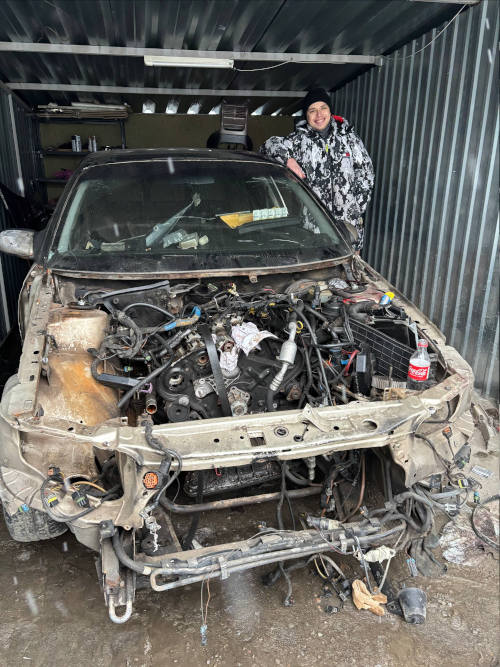
The Ford Ranger is one of the most engine-swapped compact and midsize trucks in North America, but there is no single list of engines that will simply bolt into every Ranger. A 1988 Ranger, a 1999 Ranger, a 2007 Ranger, a 2020 Ranger and a 2026 Ranger are fundamentally different vehicles even though they share the same name.
On older Rangers, the main questions are usually engine mounts, oil-pan clearance, transmission compatibility and wiring. On newer Rangers, electronics can become the deciding factor. The engine ECU may need to communicate correctly with the transmission, body control module, instrument cluster, ABS, security system and other modules before the truck behaves normally.
That is why an engine that physically fits between the Ranger's frame rails is not necessarily a compatible engine swap.
This guide covers Ford Ranger engine swap compatibility by year and platform, including factory-engine replacements, Explorer 5.0 swaps, 289/302 and other Ford V8 conversions, GM 5.3/LS swaps, EcoBoost conversions, diesel and TDI swaps, and the much more complicated engine-swap reality of 2019-and-newer Rangers.
Important: This article focuses primarily on U.S.-market Ford Rangers. Ford also sold global Ranger models during years when the Ranger was absent from the U.S. market. Global T6 Rangers use different gasoline and diesel powertrains, so always identify the market, year, engine code, transmission and drivetrain before buying a donor engine.
Ford Ranger Engine Swap Compatibility Chart
The chart below is a practical starting point. “Factory-family” means the chassis was available with that engine or closely related hardware. “Common custom swap” means the conversion has substantial precedent but still requires additional parts, fabrication or electronics work.
| Ranger Platform | Years | Common Factory Engines | Best Swap Directions | Typical Difficulty |
|---|---|---|---|---|
| Early Compact Ranger | 1983–1992 | 2.0/2.3 Lima I4, 2.8/2.9 V6, 3.0 V6, 4.0 V6 depending on year | Same-family replacement, later Ranger V6, 289/302/5.0 V8, selected diesel swaps | Low to High |
| Second-Generation Compact Ranger | 1993–1997 | 2.3 Lima, 3.0 Vulcan, 4.0 OHV | Same-family replacement, Explorer 5.0 V8, 302/5.0 custom builds | Low to High |
| Third-Generation Compact Ranger | 1998–2011 | 2.5 Lima, 2.3 Duratec, 3.0 Vulcan, 4.0 OHV/SOHC | Same-family replacement, 4.0 upgrade, Explorer 5.0, LS/5.3, EcoBoost or diesel custom swaps | Low to Very High |
| U.S. Ranger Return | 2019–2023 | 2.3L EcoBoost | Compatible 2.3 EcoBoost replacement; other engines are major conversions | Moderate to Extreme |
| Current U.S. Ranger | 2024–Present | 2.3 EcoBoost, 2.7 EcoBoost V6, 3.0 EcoBoost V6 in Raptor | Matching factory powertrain; cross-engine conversions require extensive integration | Moderate to Extreme |
The easiest Ford Ranger engine swap is nearly always another compatible version of the engine already installed in the truck. Moving to an engine that Ford offered in the same chassis is usually the next easiest route. Everything beyond that should be treated as a complete powertrain conversion rather than an engine-only swap.
Before you start researching parts and pricing, check whether the swap you have in mind actually fits – and whether it's worth doing.
Check My Engine SwapFord Ranger Factory Engine Guide by Year
Knowing the Ranger's original engine family is essential because many apparent swap questions are really replacement-engine interchange questions.
| Engine | Displacement | Configuration | Approximate Ranger Years | Best Use in a Swap |
|---|---|---|---|---|
| Lima I4 | 2.0L | SOHC Inline-4 | 1983–1988 | Period-correct replacement |
| Lima I4 | 2.3L | SOHC Inline-4 | 1983–1997 | Older Ranger replacement and budget build |
| Lima I4 | 2.5L | SOHC Inline-4 | 1998–2001 | 1998–2001 four-cylinder replacement |
| Duratec I4 | 2.3L | DOHC Inline-4 | 2001–2011 | Later compact Ranger four-cylinder replacement |
| Cologne V6 | 2.8L | OHV V6 | 1983–1985 | Period-correct replacement |
| Cologne V6 | 2.9L | OHV V6 | 1986–1992 | Older Ranger replacement |
| Vulcan V6 | 3.0L | OHV V6 | 1991–2008 | Durable factory-family replacement |
| Cologne V6 OHV | 4.0L | OHV V6 | 1990–2000 | Factory-style torque upgrade on compatible older Rangers |
| Cologne V6 SOHC | 4.0L | SOHC V6 | 2001–2011 | Factory performance engine for later compact Rangers |
| EcoBoost | 2.3L | Turbo Inline-4 | 2019–Present U.S. | Factory replacement and modern swap candidate |
| EcoBoost | 2.7L | Twin-Turbo V6 | 2024–Present U.S. | Factory current-generation V6 |
| EcoBoost | 3.0L | Twin-Turbo V6 | 2024–Present U.S. Raptor | Factory Ranger Raptor performance engine |
Quick Ford Ranger Engine Interchange Answers
Will a 1994 Ford Ranger engine fit a 2000 Ford Ranger?
It depends on the engine.
A 1994 and 2000 Ranger could both be equipped with the 3.0L Vulcan V6 or 4.0L Cologne OHV V6, so there are legitimate same-family interchange possibilities. However, sensors, intake and exhaust equipment, engine harnesses, emissions systems and ECU calibration changed over time.
The four-cylinder situation is different. A typical 1994 four-cylinder Ranger uses the 2.3L Lima while a 2000 four-cylinder Ranger uses the later 2.5L Lima. They are related, but a complete engine assembly should not be assumed to interchange without checking accessories, electronics and emissions hardware.
Can I swap a 1988 Ranger engine with a 1993 Ranger engine?
Only after identifying both engines. A 1988 Ranger could use a 2.0/2.3 four-cylinder or 2.9L V6, while a 1993 Ranger could use the 2.3L four-cylinder, 3.0L V6 or 4.0L V6.
A 2.3-to-2.3 project stays within the Lima family but still crosses major fuel-control and wiring changes. A 2.9-to-3.0 or 4.0 conversion is a different-engine swap and should be planned around the donor transmission, wiring, ECU, cooling and exhaust rather than just the long block.
Can a 2011 Ranger engine fit a 2007 Ranger?
Potentially. Both model years can share relevant engine families, particularly the 2.3L Duratec and 4.0L SOHC V6. The 3.0L Vulcan was available in 2007 but was discontinued before the end of compact Ranger production, so a 2011 donor is not automatically equivalent to every 2007 truck.
Verify the engine code, transmission, emissions configuration, harness and ECU before buying the donor.
What engines can be swapped into a 2007 Ford Ranger?
The lowest-risk choices are engines Ford already offered in the platform: a compatible 2.3L Duratec, 3.0L Vulcan or 4.0L SOHC depending on the truck's original configuration.
A 4.0 conversion, Explorer 5.0 V8, GM LS/5.3, EcoBoost or diesel can also be built, but each increases the amount of drivetrain, wiring and fabrication work.
What engines will bolt into a 1992 Ford Ranger?
“Bolt right in” should be used carefully. Matching versions of the factory 2.3L, 2.9L, 3.0L or 4.0L engines are the nearest thing to direct replacement options depending on the original truck.
Moving between those engine families can require different mounts, transmission, radiator, wiring, ECU and exhaust components even though Ford offered the engines in closely related Ranger chassis.
Will a 2015 Ranger engine fit a 2017 Ranger?
There was no U.S.-market Ranger for either model year. This question therefore applies to the global T6 Ranger.
Both years belong to the broader T6 platform, but global Ranger engines vary by country and can include different diesel families, transmissions and emissions systems. Match the exact engine code and market specification rather than assuming compatibility based on model year alone.
Best Engine Swaps for a 1983–1992 Ford Ranger
Early Rangers are among the best candidates for custom engine swaps because they have relatively simple electronics, a separate frame and an enormous amount of Ford drivetrain knowledge behind them.
The main limitation is physical size. The Ranger is still a compact truck. Steering clearance, oil-pan geometry, radiator space and transmission position matter even with mechanically simple engines.
Best Swap for a 1986–1988 Ranger
For a simple truck, staying with a 2.3L or 2.9L-era drivetrain keeps the project manageable. If performance is the goal, a Ford small-block V8 becomes much more attractive.
The classic options include:
- 289 Ford small-block V8
- 302 / 5.0L Ford small-block V8
- Later 4.0L Ranger/Explorer V6
- Selected modern four-cylinder turbo engines
- Diesel conversions for specialty builds
1988 Ford Ranger 289 Engine Swap
A Ford 289 can be installed in an early Ranger, but it is a custom V8 conversion rather than a factory interchange.
The 289 shares the compact Windsor small-block architecture that makes 289/302 engines attractive for Ranger swaps. The project still needs the correct engine mounts, transmission, oil-pan clearance, radiator, exhaust, driveshaft and fuel system.
For most builders, a later 302/5.0 makes more practical sense than an original 289 because donor engines, EFI systems and Ranger-specific swap knowledge are much easier to find.
Best Engine Swap for a 1991 Ranger
If reliability is the goal, staying within the factory Ranger V6 ecosystem is usually easiest. If the purpose of the truck is performance, the 5.0/302 remains one of the most proven directions.
A complete engine-and-transmission donor is strongly preferable to buying a bare engine and trying to assemble the rest of the drivetrain separately.
Best Engine Swaps for a 1993–1997 Ford Ranger
The 1993–1997 Ranger is an excellent compromise between old-school mechanical simplicity and newer EFI drivability. Factory engine choices include the 2.3L Lima four-cylinder, 3.0L Vulcan V6 and 4.0L Cologne V6.
Best Engine Swap for a 1997 Ford Ranger
For a daily driver, a compatible 3.0 or 4.0 factory drivetrain is generally the most sensible upgrade.
For V8 power, the 1996–2001 Explorer/Mountaineer 5.0 drivetrain is especially attractive because it packages the Ford 302 with a compact accessory arrangement, factory EFI and a truck/SUV-style drivetrain.
The swap is still not bolt-in, but it is much closer to the Ranger/Explorer ecosystem than using an unrelated V8 donor.
Best Engine Swaps for a 1998–2011 Ford Ranger
The 1998–2011 Ranger is responsible for many of the engine-swap questions owners ask today. These trucks are old enough to be affordable project vehicles but modern enough to have OBD-II electronics, PATS security and increasingly integrated instrument-cluster logic.
Best Engine Swap for a 1998 or 1999 Ranger
A compatible 2.5L four-cylinder, 3.0L Vulcan or 4.0L V6 is the easiest replacement depending on the original truck.
For a performance project, the Explorer 5.0 V8 is one of the best-known conversions because 1996–2001 Explorer donors share substantial Ford truck/SUV architecture and provide the engine, ECU, transmission and many supporting components in one package.
Best Engine Swap for a 2000 Ford Ranger
A compatible factory engine remains the lowest-risk answer. If the truck already has the 3.0L or 4.0L, rebuilding or replacing that engine may cost much less than changing engine families.
If the goal is specifically V8 power, a 5.0 Explorer-based conversion is more established than jumping immediately to a modular Ford V8 such as the 4.6L.
Common Engine Swaps for a 2001 Ford Ranger
The 2001 model year is a transition point because the 2.3L Duratec replaced the older Lima architecture and the 4.0L SOHC replaced the earlier OHV version.
Useful options include:
- Compatible 2.3L Duratec replacement
- 3.0L Vulcan replacement
- 4.0L SOHC replacement or conversion
- Explorer 5.0 V8 custom swap
- 2.3 EcoBoost custom conversion
- LS/5.3 custom conversion
- Diesel or TDI specialty conversion
Best Engine Swap for a 2003 Ranger XLT
A 2003 Ranger can use very different drivetrains depending on trim, so the most reliable swap begins with the engine already in the truck.
A compatible 2.3 Duratec, 3.0 Vulcan or 4.0 SOHC replacement preserves the highest amount of factory integration. A move from a four-cylinder to a 4.0L V6 is possible but should be planned around the entire donor powertrain.
If reliability matters more than maximum power, a factory Ranger drivetrain is generally a better answer than a heavily customized cross-brand swap.
Best Engine Swap for a 2005–2006 Ranger
The same three main engine families dominate this period: 2.3 Duratec, 3.0 Vulcan and 4.0 SOHC.
Keeping the replacement inside that ecosystem gives the best chance of retaining normal diagnostics, instrument-cluster operation, emissions readiness and serviceability.
Best Engine Swap for a 2007 Ranger
A 4.0L SOHC drivetrain is the most logical factory-style performance direction. For a serious project, Explorer 5.0, LS/5.3, EcoBoost and diesel conversions are possible, but the amount of custom work rises sharply.
Best Engine Swap for a 2009–2011 Ranger
By the final years of the old U.S. compact Ranger, the most important factory options were the 2.3L Duratec and 4.0L SOHC.
These later trucks are still far easier to modify electronically than a 2019+ Ranger, but cluster, PATS, ABS and vehicle-speed integration have to be considered in any major swap.
Ford Ranger and Ford Explorer Engine Swap Compatibility
Ranger and Explorer engine compatibility deserves its own section because the two vehicle families shared engines and related drivetrain technology for many years.
That does not mean every Explorer engine fits every Ranger.
| Explorer Engine | Ranger Swap Potential | Main Considerations |
|---|---|---|
| 4.0L OHV V6 | High in compatible older Rangers | Year, wiring, transmission, emissions components |
| 4.0L SOHC V6 | High in compatible 2001–2011 Rangers | PATS, ECU, cluster, transmission and timing-system condition |
| 1996–2001 Explorer 5.0L V8 | Excellent custom V8 donor for older Rangers | Mounts, transmission, PATS, VSS, cooling and exhaust |
| 4.6L Modular V8 | Possible but significantly harder | Engine width, packaging, electronics and exhaust clearance |
| Later EcoBoost / modern engines | Custom only | CAN communication, transmission, security and fuel system |
Ford Explorer 5.0 Swap Into a Ranger
The 5.0L Ford V8 is arguably the most important non-factory Ranger engine swap.
A 1996–2001 Ford Explorer or Mercury Mountaineer 5.0L donor is especially useful because the engine is the compact Windsor/302 architecture and comes with a relatively short accessory drive, EFI and a compatible 4R70W automatic transmission package.
For many 1990s and early-2000s Ranger projects, buying a complete 5.0 Explorer donor is more effective than buying only the engine because the project may need:
- 5.0L engine
- 4R70W transmission
- Engine wiring harness
- PCM
- MAF and intake components
- Accessory drive
- Starter and charging wiring
- Fuel-system components
- Transmission wiring
- PATS-related components on applicable years
Is the Explorer 5.0 a Bolt-In Ranger Swap?
No. It is a well-supported conversion, not a factory engine interchange.
Engine mounts, exhaust, transmission crossmember, cooling, driveshaft length and sometimes steering clearance still need attention. Four-wheel-drive trucks also require a complete transfer-case strategy.
Why Is the Explorer 5.0 So Popular?
It combines several things Ranger builders want:
- Compact pushrod V8 dimensions
- Strong low-RPM torque
- Factory electronic fuel injection
- Large Ford small-block aftermarket
- Abundant transmission knowledge
- A donor vehicle closely related to the Ranger platform
A 5.0 Ranger can therefore retain much more OEM-style behavior than many more exotic V8 swaps when the conversion is carefully planned.
Ford Ranger 289, 302, 351 and 460 Engine Swaps
289 V8 Swap
The 289 is physically attractive because it belongs to the compact Ford small-block family. It works best in classic-style Ranger builds where the owner specifically wants a period Ford V8.
For most modern projects, however, a later 302/5.0 offers better parts availability, fuel-injection options and swap support.
302 / 5.0 V8 Swap
The 302 is the conventional answer when someone asks for an easy Ford V8 swap into an older Ranger. Explorer-based EFI versions are especially useful, while carbureted 302 builds can simplify engine management at the expense of modern diagnostics and emissions compatibility.
351 Windsor Swap
A 351W provides more displacement while retaining Ford small-block architecture, but its taller deck height makes packaging more difficult than a 302.
Hood clearance, exhaust spacing and accessory positioning become more important. Unless the project specifically needs the 351, a 302/5.0 often produces a cleaner Ranger build.
460 Big-Block Ranger Swap
A 460 can physically be installed in a Ranger only as a serious fabrication project. It is not a practical bolt-in conversion and should not be approached simply by searching for an “engine swap kit.”
A big-block Ranger may require major work involving:
- Custom engine mounts
- Oil-pan and crossmember clearance
- Steering relocation or redesign
- Heavy-duty transmission
- Custom driveshaft
- Cooling-system redesign
- Front suspension changes
- Brake upgrades
- Rear axle upgrades
It makes sense as a specialty drag or show build, not as the easiest way to create a fast street Ranger.
Ford Ranger 5.3L / LS Engine Swap
GM 4.8, 5.3, 6.0 and other LS-family engines are common swap candidates because they are compact, relatively light for a V8, widely supported and available with many transmission options.
A 5.3L Ranger can make excellent power, but crossing from Ford to GM eliminates much of the factory compatibility that makes the Explorer 5.0 attractive.
What a Ranger 5.3 Swap Usually Requires
- Engine and compatible GM transmission
- Custom or aftermarket Ranger engine mounts
- Oil pan with correct crossmember clearance
- Custom transmission crossmember
- Driveshaft
- Fuel pump and pressure regulation
- GM ECU or standalone management
- Custom wiring
- Radiator and fans
- Headers or custom exhaust manifolds
- Gauge and speedometer strategy
- Transfer-case solution for 4WD
On an early Ranger, the electronics can be separated relatively cleanly. On a later Ranger, losing Ford PCM communication can affect much more of the vehicle.
2.3 EcoBoost Swap Into an Older Ford Ranger
A modern 2.3L EcoBoost is appealing because it produces far more power and torque than the naturally aspirated four-cylinder engines used in old Rangers while keeping the physical engine relatively compact.
That makes a 2.3 EcoBoost-powered 1980s, 1990s or early-2000s Ranger an interesting alternative to a V8.
Can You Put a 2.3 EcoBoost in a 1991 Ranger?
Yes as a custom conversion. The engine's size is manageable, but the modern EcoBoost architecture introduces direct injection, electronic throttle control, turbo plumbing, intercooling and modern ECU requirements.
The project needs more than an engine:
- EcoBoost-compatible transmission
- Engine mounts
- Correct oil-pan configuration
- ECU and engine harness
- High-pressure direct-injection fuel hardware
- Low-pressure fuel supply
- Intercooler
- Radiator and fans
- Turbo downpipe and exhaust
- Electronic throttle pedal
- Vehicle-speed and gauge integration
Duratec vs. EcoBoost Swap in a 1997 Ranger
A naturally aspirated Duratec is easier to package and produces less heat. The EcoBoost provides dramatically more performance but introduces turbo, intercooler, direct-injection and control-system complexity.
For a simple lightweight Ranger, the Duratec may be the smarter engineering solution. For a performance-oriented project, EcoBoost has much greater power potential.
Ford Ranger 2.7 EcoBoost Swap
The 2.7L EcoBoost V6 is now a factory Ranger engine in the current U.S. Ranger, but that does not make it a direct swap for older Rangers.
In a 2024-and-newer Ranger originally configured with the 2.3L EcoBoost, a 2.7 conversion is mechanically more logical because Ford offers both engines in the same current platform. Even then, the engine should be viewed as part of a complete donor powertrain.
Engine harnesses, PCM calibration, transmission programming, fuel delivery, cooling, exhaust, security and related modules may differ.
Installing a 2.7 EcoBoost in a 1983–2011 Ranger is a completely different project and requires custom mechanical and electronic integration.
2020–2023 Ford Ranger Engine Swap Options
U.S.-market Rangers from 2019 through 2023 use the turbocharged 2.3L EcoBoost. If the original engine fails, another correct 2.3L Ranger-spec engine is by far the simplest replacement strategy.
What Is the Easiest Way to Replace a 2020 Ranger Engine?
Use a compatible 2.3L EcoBoost long block or complete engine and retain as much of the original Ranger-specific external hardware, sensors and electronics as practical.
Engines from other Ford vehicles may share the 2.3 EcoBoost architecture, but intake, turbocharger, oil pan, accessory drive, calibration and transmission interfaces can vary. “2.3 EcoBoost” alone is not enough to confirm interchangeability.
What Is the Best Engine Swap for a 2020 Ranger XLT?
For a daily-driven truck, another Ranger-spec 2.3 EcoBoost is the clear answer.
A 2.7, 3.0, V8 or diesel can be engineered, but once the original 2.3 architecture is removed, the project must solve communication with the transmission, BCM, ABS, instrument cluster, security system and other networked components.
Can You Engine Swap a 2022 Ranger?
Yes, but same-engine replacement is very different from changing engine families. A matching 2.3 EcoBoost replacement can preserve the factory vehicle architecture. Installing an unrelated engine turns the truck into a CAN and powertrain-integration project.
Enter your vehicle and target engine to see a compatibility verdict, estimated cost, required changes, and whether it's the right move for your build.
Get My Swap Verdict2024–2026 Ford Ranger Engine Swap Options
The current U.S. Ranger offers three factory EcoBoost engines:
| Engine | Factory Output | Current Application |
|---|---|---|
| 2.3L EcoBoost I4 | 270 hp / 310 lb-ft | XL, XLT and Lariat |
| 2.7L EcoBoost V6 | 315 hp / 400 lb-ft | Available XLT and Lariat configurations |
| 3.0L EcoBoost V6 | 405 hp / 430 lb-ft | Ranger Raptor |
Best Engine Swap for a 2024–2026 Ranger XLT
The most logical factory-style upgrade is the 2.7L EcoBoost because Ford already engineers the current Ranger platform around both the 2.3 and 2.7.
That does not mean a 2.7 engine can simply be dropped into a 2.3 XLT using the original engine harness and calibration. The complete powertrain configuration needs to be compared, including PCM, wiring, transmission strategy, cooling, fuel system and emissions equipment.
Can You Put the Ranger Raptor 3.0 in an XLT?
Mechanically possible does not mean economically sensible.
The Raptor uses a complete performance package built around the 3.0 EcoBoost, including different drivetrain, cooling, calibration and chassis assumptions. Reproducing only the engine while ignoring the supporting systems creates a much larger project than the horsepower figure suggests.
Are There 2026 Ranger Engine Swap Kits?
Do not expect a single kit to turn a current Ranger into a different factory configuration. Modern swaps require hardware and software integration.
Mounts are only one part of the problem. PCM configuration, security, transmission communication, fuel control, emissions and network behavior are equally important.
Ford Ranger Diesel Engine Swap Options
Diesel Ranger swaps attract owners looking for fuel economy, low-RPM torque or an overland-style drivetrain. The best candidate depends heavily on the generation and intended use.
| Diesel Direction | Why Builders Consider It | Main Challenge |
|---|---|---|
| VW TDI | Compact, light and fuel-efficient | Transmission adaptation and electronics |
| Cummins R2.8 | Compact diesel repower concept and good low-end torque | Cost, adapters, gearing and legal compliance |
| Cummins 4BT | Simple heavy-duty diesel reputation | Weight, vibration and physical height |
| Mercedes diesel | Mechanical simplicity on selected older engines | Custom transmission and mounting |
| Global Ford Ranger diesel | Ford Ranger lineage | Market-specific electronics, emissions and parts availability |
What Diesel Engine Can Fit in a 2008 Ford Ranger?
There is no U.S. factory diesel engine that simply bolts into a 2008 Ranger.
A VW TDI or compact diesel repower engine is physically easier to package than a large truck diesel. A Cummins 4BT is frequently discussed, but its size, weight and vibration can make it a poor match for a lightweight Ranger unless the truck is being built specifically around it.
Can You Diesel Swap a Ranger With No Wiring?
Not realistically if the goal is a complete street truck.
A mechanically controlled diesel can reduce engine-management wiring, but the truck still needs starter, charging, gauges, fuel shutoff, cooling fans and chassis electrical systems.
In later Rangers, the absence of the original ECU can also disrupt instrument-cluster, transmission and security functions.
TDI Swap Into a 2003 Ranger
A TDI can make sense because of its compact dimensions and efficiency. The difficult part is not fitting the engine. The project needs a transmission adapter or compatible gearbox, mounts, cooling, fuel delivery, exhaust, throttle integration and a strategy for the Ford gauges and electronics.
Emissions legality should be researched before starting the conversion, especially if the truck needs OBD-based inspection.
Can a Ford Transit Engine Fit a Ranger?
Sharing the Ford badge does not make Transit and Ranger engines directly interchangeable.
Some Ford engine families may share basic architecture across vehicles, but a Transit can use different engine orientation, oil pans, accessory drives, transmissions, calibration and emissions equipment.
Treat a Transit engine as a possible donor only after comparing the exact engine code and installation architecture.
What Makes an Engine Compatible With a Ford Ranger?
1. Engine Mounts
Mounts determine much more than whether the engine stays attached to the truck. They establish engine height, crankshaft centerline, transmission location and drivetrain angles.
Incorrect engine position can create steering interference, exhaust problems and driveshaft vibration even when the mounts themselves are strong.
2. Oil Pan and Crossmember Clearance
The oil pan has to clear the Ranger crossmember at the correct engine height. Four-wheel-drive Rangers add front differential clearance to the problem.
Clearance should be checked under engine movement and suspension travel, not only while the truck is sitting on a lift.
3. Transmission
Choose the transmission at the same time as the engine.
Bellhousing pattern, input shaft, torque capacity, shifter position, electronic controls and transfer-case compatibility all affect whether a drivetrain combination is viable.
4. Driveshaft and Differential
Moving the transmission output changes driveshaft length and operating angles. Large torque increases may also expose weaknesses in the original differential and axle shafts.
5. Wiring and ECU
An older Ranger may require little more than a properly wired engine ECU and functional gauges. A newer Ranger expects much more communication between modules.
Decide early whether the project will retain a factory ECU, use a donor vehicle network or run standalone management.
6. PATS and Immobilizer
Ford's Passive Anti-Theft System can prevent a correctly wired engine from starting if the PCM, key and security system do not agree.
On swaps involving later Ford electronics, PATS planning should happen before the donor drivetrain is installed.
7. Instrument Cluster
Modern clusters receive engine speed, coolant temperature, warning status and vehicle-speed information electronically.
A swapped engine that runs perfectly may still leave the Ranger with a dead tachometer, incorrect gauges or warning lights if those signals are not reproduced correctly.
8. Fuel System
Carbureted engines, port-injected engines, modern direct-injected EcoBoost engines and diesels require completely different fuel-system strategies.
Do not assume the original Ranger pump and lines can supply every donor engine.
9. Cooling
Cooling should be designed for sustained load. A system that holds temperature during a ten-minute idle test may overheat while towing, climbing a grade or driving slowly off road.
10. Exhaust and Emissions
Header clearance can become one of the hardest packaging problems in a V8 Ranger. Catalytic converter position and oxygen-sensor logic also affect whether an OBD-II truck remains emissions compliant.
Ford Ranger Engine Swap Difficulty Chart
| Level | Example | What Changes |
|---|---|---|
| 1 – Direct Replacement | 2007 4.0 to compatible 4.0 | Normal engine replacement with year-specific verification |
| 2 – Factory-Family Conversion | Older four-cylinder Ranger to factory Ranger V6 | Engine, transmission, wiring, cooling and exhaust |
| 3 – Proven Custom Swap | Explorer 5.0 into 1990s/2000s Ranger | Mounting and driveline changes plus significant electronics integration |
| 4 – Cross-Brand / Modern Custom Swap | 5.3 LS, TDI or EcoBoost into old Ranger | Custom powertrain integration and ECU strategy |
| 5 – Modern Networked Swap | Unrelated V8/diesel into 2019+ Ranger | Mechanical fabrication plus deep CAN/security/module integration |
Ford Ranger Engine Swap Parts Checklist
Engine
- Complete engine or long block
- Intake manifold
- Throttle body
- Exhaust manifolds or headers
- Starter
- Alternator
- Accessory drive
Transmission and Driveline
- Compatible transmission
- Torque converter or clutch/flywheel
- Transmission crossmember
- Driveshaft
- Transfer case for 4WD
- Transfer-case adapter where required
- Differential gearing review
Mounting
- Engine mounts
- Engine-side brackets
- Oil pan
- Clearance for steering and front differential
Electronics
- Engine harness
- PCM/ECU
- Transmission controller where required
- PATS/security components
- Electronic throttle pedal where required
- Gauge and cluster interface
- CAN integration on newer vehicles
Fuel
- Correct fuel pump
- Fuel pressure regulator
- Fuel lines
- Injectors
- High-pressure system on direct-injected engines
Cooling
- Radiator
- Electric or mechanical fan strategy
- Fan shroud
- Coolant hoses
- Expansion tank
- Transmission cooler
- Intercooler for turbocharged engines
Exhaust
- Headers/manifolds
- Downpipes
- Catalytic converters where required
- Oxygen sensors
- Full exhaust system
How Much Does a Ford Ranger Engine Swap Cost?
The engine itself is often not the largest expense. Total cost depends on how far the project moves away from the Ranger's original drivetrain.
| Swap Type | Rough Planning Range | Main Cost Drivers |
|---|---|---|
| Same-engine replacement | $2,500–$7,000+ | Engine, labor, service parts and accessories |
| Factory-family V6 conversion | $4,000–$10,000+ | Complete donor drivetrain, wiring, cooling and exhaust |
| Explorer 5.0 swap | $5,000–$12,000+ DIY-oriented build | Donor, mounts, transmission, exhaust, driveshaft and wiring |
| 5.3 / LS swap | $6,000–$15,000+ | Engine/transmission, fabrication, wiring, cooling and driveline |
| EcoBoost swap into old Ranger | $8,000–$18,000+ | Modern engine controls, transmission, turbo plumbing and fuel system |
| Diesel conversion | $8,000–$20,000+ | Engine, adapters, drivetrain, fuel system and fabrication |
| Custom 2019+ Ranger conversion | $15,000–$30,000+ possible | CAN integration, security, fabrication and calibration |
These are broad project-planning numbers rather than quotes. Professional fabrication, premium components or repeated troubleshooting can raise the total significantly.
What Builders Usually Forget to Budget
- Driveshaft work
- Transmission controller
- PATS programming
- Fuel-system conversion
- Exhaust fabrication
- Cooling fans and shrouding
- Custom hoses and fittings
- Gauge integration
- ECU tuning
- Brake upgrades
- Rear axle upgrades
- Unexpected donor-engine maintenance
How Long Does a Ford Ranger Engine Swap Take?
A straightforward same-engine replacement can often be completed by an experienced shop in several days.
A factory-family conversion may take weeks once donor parts and debugging are included. A properly finished 5.0, LS, diesel or EcoBoost conversion can easily become a multi-month project.
Modern 2019+ Ranger conversions can take substantially longer because mechanical installation may be completed long before every electronic system works correctly.
Common Ford Ranger Engine Swap Problems
Using Only the Engine Instead of a Complete Donor
Buying the cheapest engine often costs more in the end. A complete donor can provide the transmission, harness, ECU, accessories, sensors and hundreds of small brackets and connectors that become expensive individually.
Transmission Mismatch
An engine may fit while the original Ranger transmission cannot bolt to it, cannot survive its torque or cannot communicate with the new ECU.
PATS No-Start
If the PCM and security system do not authenticate correctly, the engine may crank but refuse to run normally.
Dash Cluster Problems
Speedometer, tachometer, temperature gauges and warning indicators can fail when signals that used to come from the factory PCM disappear.
Driveshaft Vibration
Changing transmission position changes driveshaft length and angles. Incorrect geometry can produce vibration at specific speeds and shorten universal-joint life.
Oil Pan Interference
A donor engine may physically fit the bay while its oil pan occupies the same space as the Ranger crossmember or front differential.
Cooling Problems Under Load
A swap that stays cool at idle may overheat on the highway, while towing or during slow off-road driving.
Exhaust and Steering Interference
This is particularly common in V8 swaps. The steering shaft often occupies the same area where the left-side exhaust wants to run.
Incomplete CAN Integration
In modern Rangers, removing the original PCM can affect the transmission, ABS, traction control, instrument cluster and other modules.
Making the engine run is therefore only one part of making the truck work.
Legal and Emissions Considerations
Engine-swap rules vary by state and country. Check the requirements where the truck will actually be registered before purchasing a donor.
Depending on the jurisdiction, requirements can include:
- Using an engine of the same model year or newer
- Retaining the donor engine's emissions equipment
- Functional catalytic converters
- Functional evaporative-emissions equipment
- OBD-II communication
- Completed readiness monitors
- No emissions-related fault codes
Can You Smog a 5.0-Swapped Ranger?
Potentially, but the answer depends on the state, the Ranger's model year and the donor engine.
A well-integrated EFI 5.0 using the correct ECU and emissions hardware generally provides a better starting point for emissions compliance than a carbureted or standalone-engine-management conversion.
Do not assume that because an engine passes a tailpipe test the vehicle will automatically pass an OBD or engine-change inspection.
Can a TDI-Swapped Ranger Pass Smog?
Changing both engine family and fuel type can introduce additional regulatory requirements. Research this before fabrication because an inspection failure cannot always be solved later with tuning.
When an Engine Swap Is Not the Best Upgrade
Rebuild the Original Engine
If the Ranger already has an engine that meets its intended use, rebuilding it avoids almost every compatibility problem discussed in this guide.
Upgrade to a Factory Ranger Engine
Moving from a smaller factory engine to the larger engine Ford already offered in the same generation may produce enough performance without converting the entire truck.
Change the Gearing
Oversized tires can make a Ranger feel underpowered because they effectively raise the gearing. Correct differential ratios can restore acceleration and towing performance without changing the engine.
Modify the Existing EcoBoost
On a modern Ranger, improving the factory EcoBoost platform may make far more sense than replacing it.
The current 2.7L Ranger already produces 400 lb-ft of torque and the factory Ranger Raptor 3.0L produces 405 horsepower. Re-engineering the entire vehicle around an unrelated engine may offer much less value than improving a powertrain Ford already integrated into the chassis.
Frequently Asked Questions
What is the easiest engine swap for a Ford Ranger?
A compatible replacement using the same engine family is the easiest. After that, engines Ford already offered in the same Ranger platform are generally the most manageable conversions.
What is the best Ford Ranger engine swap?
For an older Ranger performance project, the Ford 5.0/302 – particularly a 1996–2001 Explorer 5.0 donor – is one of the best-documented V8 directions. For a daily-driven Ranger, staying within its original factory engine family is normally the better solution.
What is the cheapest Ranger engine swap?
Usually another compatible version of the original engine. Custom mounts may be cheap, but transmission, wiring, exhaust and cooling costs make unrelated engines much more expensive as complete projects.
What Ford engines will fit in a Ranger?
Many Ford engines can physically fit, including Ranger four-cylinders and V6s, the Explorer 5.0 V8 and modern EcoBoost engines. The real question is whether the engine can be integrated with the transmission, mounts, wiring, cooling and emissions systems of the specific Ranger.
What is the most reliable engine swap for a 2003 Ranger?
A compatible factory 2.3L Duratec, 3.0L Vulcan or 4.0L SOHC is the lowest-risk direction depending on the truck's original engine. The 4.0 provides the strongest factory performance direction without moving to a cross-brand drivetrain.
What is the best engine swap for a third-generation Ford Ranger?
For the U.S. 1998–2011 compact Ranger, the answer depends on the goal. A compatible factory engine is best for reliability. A 4.0 SOHC provides a factory V6 performance route, while the Explorer 5.0 is one of the most established custom V8 conversions.
Can you put a 5.0 in a Ford Ranger?
Yes. The 5.0/302 is one of the most established Ranger V8 swaps. A complete 1996–2001 Explorer or Mountaineer 5.0 donor is particularly useful.
Can you put a 5.3 in a Ford Ranger?
Yes. GM 5.3/LS-family Ranger swaps are common custom projects. They require engine and transmission mounting, wiring, ECU integration, cooling, exhaust and driveline modifications.
Can you put a 289 in a Ford Ranger?
Yes. The 289's compact Ford small-block dimensions make it physically suitable for an early Ranger custom V8 build. A later 302/5.0 is usually easier to source and support.
Can you put a 460 in a Ford Ranger?
It can be done, but it is a major fabrication project rather than a normal Ranger engine swap. Packaging, front suspension load, transmission, cooling, steering and driveline strength all need to be redesigned around the big-block.
Can you EcoBoost swap an old Ford Ranger?
Yes. The 2.3 EcoBoost is especially attractive because of its compact dimensions and strong power output. The main complexity comes from direct injection, turbo plumbing, electronic throttle control, ECU requirements and transmission integration.
Can you diesel swap a Ford Ranger?
Yes. TDI, Cummins and other diesel conversions are possible, but there is no universal U.S.-market diesel Ranger engine that simply bolts into an old Ranger.
Can a Ford Explorer engine fit a Ranger?
Some can. Ranger and Explorer models shared several engine families, including versions of the 4.0 V6. The Explorer 5.0 V8 is also a popular Ranger custom-swap donor. Exact compatibility still depends on the Ranger year and drivetrain.
Can a 2011 Ranger engine fit a 2007 Ranger?
Potentially if both use a compatible version of the same engine family, particularly the 2.3 Duratec or 4.0 SOHC. Compare engine code, wiring, emissions equipment and transmission before purchasing the donor.
Can a 1994 Ranger engine fit a 2000 Ranger?
Some 3.0 and 4.0 same-family combinations can be viable because both years used those engine families. A complete donor should still be checked for sensor, wiring and emissions differences.
What is the best engine swap for a 2020 Ranger?
Another compatible Ranger-spec 2.3L EcoBoost is the best replacement. Changing engine families dramatically increases electronics and transmission-integration work.
What is the best engine swap for a 2024–2026 Ranger?
Staying within the current factory Ranger engine ecosystem makes the most sense. The platform supports the 2.3 EcoBoost, available 2.7 EcoBoost V6 and 3.0 EcoBoost in the Ranger Raptor. Even factory-to-factory conversions should be approached as complete powertrain integrations rather than simple long-block swaps.
How much does a Ford Ranger engine swap cost?
A basic same-engine replacement can cost several thousand dollars. A complete V8, LS, EcoBoost or diesel conversion frequently reaches $5,000–$15,000 or more, while professionally integrated modern builds can move well beyond that range.
How long does a Ranger engine swap take?
A straightforward replacement may take days. A factory-family conversion may take weeks. V8, diesel, EcoBoost and modern electronics-heavy conversions can take months once fabrication, tuning and debugging are included.
Is it easier to LS swap or 5.0 swap a Ford Ranger?
On older Rangers, the Explorer 5.0 generally offers the more Ford-native path because the donor comes from a closely related platform and preserves more Ford-specific drivetrain compatibility.
An LS can offer excellent aftermarket support and power potential, but it requires crossing brands for engine management, transmission and many supporting systems.
Do I need to swap the transmission with the engine?
Frequently, yes. A transmission needs the correct bellhousing pattern, torque capacity and electronic control strategy for the new engine. Planning around an engine while assuming the original transmission will work is one of the most common swap mistakes.
Final Recommendation
Ford Rangers are excellent engine-swap platforms, but different Ranger eras require very different strategies.
For 1983–2011 compact Rangers, factory Ford engines and the Explorer 5.0 provide the strongest combination of available knowledge, manageable packaging and parts support. LS, EcoBoost and diesel swaps can produce excellent trucks, but they require progressively more custom work.
For 2019-and-newer Rangers, electronics change the calculation. A modern Ranger is no longer simply an engine, transmission and chassis. The powertrain participates in a network of security, transmission, ABS, stability, body and instrumentation systems.
Before buying any engine, identify the exact Ranger model year, market, original engine, transmission and 2WD/4WD configuration. Then choose the donor engine and transmission together, decide the ECU strategy, and plan the mounts, oil pan, driveshaft, cooling, fuel and exhaust before fabrication begins.
The right question is not simply “Will this engine fit in my Ford Ranger?” The right question is whether the complete drivetrain can fit, communicate, stay cool, remain serviceable and survive real use.