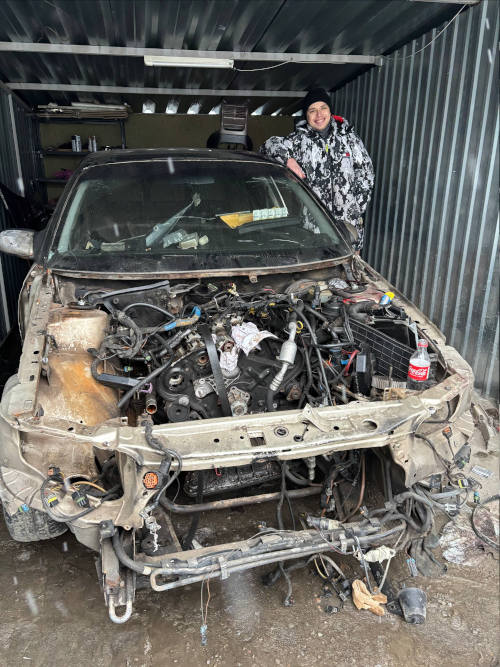
Honda Accord
The Honda Accord from the US market seems approachable in terms of swapability, as it is everyday, transverse, front-wheel drive, and has transverse four-cylinder and V6 engines for the majority of its history. That surface impression is only partially useful. Along its US production run, the Accord remained a unibody vehicle, and unibody swap issues are era dependent: early models primarily suffer from packaging issues, while later models suffer from packaging issues and control system mismatches simultaneously. Practically speaking, Accord engine swap compliance is a question of whether true compliance is only achieved when the engine is within packing limits of the chassis, the vehicle’s electronics system is in a coherent configuration, and the emissions system management and inspection are undetectably altered after the modifications are performed.
TL;DR
- In a Honda Accord, engine compatibility means mechanical fitment, electronic integration, and emissions survivability at the same time.
- An engine that fits the bay still fails if it breaks axle geometry, cooling margin, control logic, or inspection readiness.
- All U.S.-market Accords are unibody cars, so mount placement, load paths, and NVH matter more than many builders expect.
- Early Accords are mechanically simpler, but later Accords punish swaps through immobilizer logic, networked controls, turbo packaging, and hybrid integration.
- Level 1 means factory-adjacent swaps that stay close to the Accord’s original engine family, transmission logic, and electronics.
- Level 2 means the engine may still be realistic, but heat, transmission choice, calibration, and system planning start to dominate the project.
- Levels 3–5 are system builds, not engine changes, because driveline layout, ECU strategy, cooling, and chassis integration all shift at once.
- Most builders underestimate higher levels because fabrication solves local fitment, not vehicle-level control, thermal, and driveline problems.
- The lowest-risk Accord swaps are factory-adjacent Honda engines that preserve the most original packaging and control logic.
- K-series and J-series swaps stay realistic only when the transmission, ECU path, and driveline geometry are treated as part of the same donor system.
- Modern turbo Honda swaps escalate once intercooler, high-pressure fuel, transmission, and network expectations stop matching the target chassis.
- Cross-brand swaps escalate fast because the Accord stops being a parts-bin project and becomes a custom vehicle layout and control-system project.
- The engine is rarely the main cost, because wiring, rework, validation, exhaust, cooling, and repeated problem-solving consume the budget.
- Timelines stretch because builders estimate installation time and ignore decision time, debugging time, and correction time.
- Budgets and motivation usually die from incomplete planning, fragmented wiring, thermal rework, and driveline problems discovered late.
- Most swap failures are delayed failures, not first-start failures, and they appear after heat soak, load, vibration, and repeated use.
- The most common failure patterns are incomplete wiring logic, cooling systems with no margin, bad driveline angles, and accessory-drive geometry problems.
- In U.S. inspection reality, OEM ECU-based swaps survive best when the whole engine and emissions system still behave like a coherent factory-style package.
- Standalone ECUs can make non-native engines run more cleanly, but they usually make road-use emissions and inspection behavior harder to normalize.
- Legality has to be designed in early, because emissions and diagnostic problems get far more expensive once the car is physically finished.
- Rebuilding the original engine, using conservative forced induction, or optimizing gearing often solves the real problem with less system disruption.
- The final rule is simple: choose the path that improves the whole Accord as a vehicle, not just the engine sitting in the bay.
Before you start researching parts and pricing, check whether the swap you have in mind actually fits – and whether it's worth doing.
Check My Engine SwapHonda Accord Engine Swap Compliance Overview
What “compatible” actually means
In Accord speak, “compatible” means more than just a block clearing the fenders or a bellhousing pattern being able to be made to work. It means the engine, transaxle, mounts, axle geometry, accessory drive, cooling stack, exhaust routing, control modules, and legal emissions logic all land inside the same operating envelope. A swap can look finished and still be incompatible if it creates constant axle plunge, unstable idle quality, nonfunctional A/C requests, incomplete readiness monitors, or security-system faults. Compatibility is therefore a whole-vehicle judgment, not a bare-engine judgment.
The Accord can be factory swapped very easily, as it rewards swap builders for having baseline-aware swaps. This is due to Honda's repeated packaging of factory engines to very specific transverse layouts. These details can be more important than many builders expect. Changes in engine height, auxiliary unit height, width of the transmission case, position of the exhaust outlet, etc, powertrain run away from the stock assumptions for axle centerlines and subframes. After it gets out of that ‘box’, the car may be able to run, but it is no longer a car designed to work as a system around its chassis.
Mechanical, electrical, and emissions compatibility:
The swap compatibility of the Accord can be separated into three main categories. The first is the mechanical aspects: mount location, oil pan clearance to subframes, steering rack clearance, radiator and fan clearance, axle lengths, driveline angles, and exhaust routing. The second aspect is the electronic side of the swap. This includes PCM behaviour, immobilizer and chip coordination, cluster expectation, transmission logic (if equipped), ABS and body module cooperation, and, in more modern cars, the expectation of a message system that a set of modules has in the ‘cross-talk’ of the vehicle. Lastly, there is the emissions and inspection compatibility. This includes catalyst strategy, sensor plausibility, OBD monitor status, and whether, once completed, the car can “explain” itself to a scan tool and inspector.
The aforementioned three layers overlap each other. A cooling package that is too small causes emissions issues, as heat control influences combustion stability and catalyst action. A missing or mismatched immobilizer causes drivability issues because the engine may deny fuel authorization or may put the vehicle into a no-start state. A transmission or ABS module expects a certain behavioral response to torque, and if that is not the case, it may create torque-reduction conflicts, limp mode, or may turn on the light(s) even if the engine is fine. This is why the Accord violates the principle of “it fits, so it works".
Why do engines that *do* fit still fail
The Accord is tightly packaged around a transverse drivetrain and unibody front structure, causing those that do fit in the engine bay to fail to do so. Generally, the failure is geometric rather than horsepower-related. If the conversion alters the crank centerline, half-shaft angles, transmission placement, or accessory sweeps, it may lead to excessive tripod joint wear, increased wheel hop, fatigue of the exhaust flex section, interference with the fan or radiator, and noise, vibration, and harshness (NVH) where it was absent in the original configuration. In a unibody car, those loads are absorbed by the front structure and subframe, so “close enough” quickly leads to a persistent and potentially destructive effect.
The other failure mode is the electronic one. Honda is steadily transitioning the Accord line from an engine-control paradigm towards a more fully integrated paradigm with vehicle security, programmable modules, hybrid power management, telematics, and remote software update capabilities. This means that a physically mounted engine can also fail as a vehicle when the PCM, immobilizer, instrument cluster, ABS, transmission control, or hybrid control units disagree with each other about identity, torque, or operational state. The issue is aggravated with the current hybrids, as the powertrain is an integrated engine along with an engine-control-battery-motor system.
Generational differences in brief
The 1976-1989 U.S. Accord is in the easiest swap era. These earliest cars were among the first generations of the Accord in the U.S. They were simple, light, and mechanically unsophisticated by today’s standards. They had early carburetted and fuel-injected 4-cylinder engine options in a range from 1.6 litres to a later 2.0-litre 4-cylinder (SOHC and DOHC). From a swap logic perspective, these early models are more beneficial than later models in the Accord lineup, but today’s standards age means most of the reality. The simple design means the units are interconnected in a management system and controlled in a brittle way. In those situations, simplicity posed its own kind of risk.
Accords across the 90s remained unibody. But the baseline shifts bigger, quicker, and more cruel. Honda has added more powerful 4-cylinder packages, VTECs, and, by 1995, the first U.S. Accords V6. By 2001, the documentation supported by Accord owners included an immobilizer system, signaling a major shift in swap reality. The car has moved past the fuel, spark, and mounts system. Now, an Authorization and Module Interoperation system has been added as well. These models were, in comparison to contemporary vehicles, earlier in the electronic period, but they were definitely no longer electronically cavalier.
The 2003–2012 generation shifts more decidedly into modern integration. The seventh-gen Accord arrived with more powerful baseline 4-cylinder and V6s, and also a hybrid version, as well as reprogrammable control modules. The 2008 redesign includes an entirely new unit-body frame-rail system and an increase in the platform's mass, stiffness, and power thresholds. From a swap perspective, this is the point where Accord demands no more electronic shortcuts. Security protocols, control module initialization, and control strategy are of more importance. In addition, the weight of the engines and torque loads increases the mount and axle geometry requirements.
For the generation of Honda Accord dating from 2013, the car is described to be in the High Integration Era, due to the extensive incorporation of vehicle technologies and customer interface features. Compared to the previous generation, each of the new redesign iterations is described as having improved vehicle structure in terms of manufacturability and moldability of the components being used. The 2013 redesign is described to use the first high-tensile steel unit body with a steel and aluminum front subframe, and for the 2018 redesign, Honda is described to have integrated a unibody structure that is described to be both lighter and more rigid. With regard to the powertrain, the 2018 redesign is said to have incorporated a new baseline with regard to propulsion components. The greatest change is that propulsion and hybrid systems are incorporated. For the most part, each of the current hybrid system redesign iterations is said to have integrated more advanced software systems that provide improved telematic control, remote software updates, and improved vehicle infotainment systems. The propulsion motor for the traction subsystem of the hybrid system is described to provide 247 lb-ft of torque, while the total system output is rated at 204 hp. In the current redesign, integrally incorporated, the vehicle structure and the engine-bay components are said to contribute to the performance of the powertrain in terms of the limitations the vehicle structure provides.
Honda Accord Platform Reality: What It Allows and What It Punishes
Fundamental Architecture & Chassis Behavior
All generations of Accords sold in the U.S. market utilize unibody construction, allowing for few options when it comes to modifications. Unlike traditional body-on-frame construction, unibody designs distribute powertrain load differently. The design of the body, the front structure, the subframes, the attachment points, etc. They are all integrated and behave as a single unit. Changes to the engine, for example, regarding mass, mounting stiffness, or torque reaction, are taken directly by the body, the subframe, and the cabin. This means that, in all likelihood, the Accord will feel, and indeed be, mechanically assembled, but when the engine and all its components are swapped, it will feel dynamically awful.
Honda’s changes in generations of the Accord are especially impactful. The 2008 model features a new design of the unibody subframe, the 2013 model changed to a new body design incorporating additional high tensile steel, and a later steel/aluminum front subframe. The model sports an even lighter and more rigid design yet. Stiffness in a unibody construction frame helps to improve the performance of a stock car, but even more so, it amplifies the visibility of the mistake caused by the modification or swap. Engaging a driveline that operates outside its intended design will result in excessive vibration, noise, and fatigue failure of components in and around the unibody construction frame.
Mechanical restraints (mounts, crossmembers, steering)
The Accord’s design punishes engines that are too high, too long, or have accessories in non-factory positions. Front subframe, steering rack, lower control arm geometry, and duck line hood provide limited accommodation. A swap that changes sump depth, exhaust outlet angle, or position of the transmission case will quickly encounter subframe, steering shaft, or catalytic converter clearance issues. Due to the transverse layout, the driveline, in addition to front-rear, is concerned with left-right positioning. All of the plunge travel, axle symmetry, and mount loading are critical.
Driveline angle and cooling load are often the unconsidered mechanical death knells. An engine that sheds excessive heat may only overheat when stuck in traffic with A/C on or after multiple heat soaks. An engine that sits even just a little high or low may allow a car to move, but will cause chronic CV joint stress and torque steer in the case that the half-shafts no longer operate within the angles the platform anticipates. This is not cosmetic. These problems turn completed swaps into maintenance nightmares.
Electronic components (CAN bus, BCM, ABS, security)
The number of changes made to the Accord’s electronic baseline is higher than most people notice. Documented in the year 2001, Honda detailed the implementation of an immobilizer system for the Accord. More recent documentation indicates the immobilizer and PCM work are documented as separate assignments. The platform is also described mid-2000s to being within an adaptable, security-conscious module milieu. In subsequent vehicles, the engine is no longer seen as an operable entity autonomous of the controlling systems, such as the body, the brakes, the security controls, and, in the case of hybrids, the electrified powertrain components.
It is in this context that expectations inherent to the CAN era and torque modeling become significant. The latter modules of the Accord measure and respond to the acceptable ranges of message traffic, rational torque behavior, and acceptable state levels for authorization. Should the PCM present engine speed and throttle, but omit the relevant behavior to the ABS, BCM, cluster, transmission control, or hybrid system, the vehicle will accumulate fault indications regardless of the engine operation. The latest iteration of the Accord hybrid incorporates telematics control functions and software updates, in addition to a uniquely designed coordinated two-motor system. This indicates that the contemporary Accord incorporates powertrain identity as part of the overall integrated network behavior of the vehicle, rather than as an isolated engine choice.
Why Shortcuts Cause Long-Term Debugging Debt
Shortcuts assign one issue to one layer, simplifying it, while adding instability to the rest. A mixed harness may allow the engine to start. However, it could leave other components (fan logic, charge-system behavior, A/C requests, cruise functions, behavior of the gauges, readiness logic) half-working. A security workaround may silence one no-start issue, but leave the car susceptible to random authorizations. A monitor that never runs might be fine for the time being, but it isn't fine every time the car gets a scan or inspection. Debugging debt builds slowly, then becomes the real project.
Mechanical shortcuts do the same thing. Tougher mounts than stock can cover a packaging issue, but this can allow the shell to be loaded with excessive vibration. Improvised brackets can hold weight, but can distort under torque. A nearly correct engine position can keep the car drivable while obstructing the inner CV joints, flex sections, or radiator clearance (over time). Those mistakes continue to report back through noise, broken supports, uneven component wear, and endless diagnostics. The platform usually tells the truth; it just tells it late.
Factory Engines Offered in the Honda Accord (All Years)
Complete Factory Engine Specification Table
The factory engine baseline matters because most Accord swaps become harder in direct proportion to how far they move away from Honda’s original assumptions for mount position, transaxle pairing, cooling demand, fuel delivery, and control logic. The table below keeps the U.S. factory engine range in one place so the chassis baseline stays visible before any compatibility claims are made.
| Engine Code / Name | Displacement | Engine Type & Cylinders | Fuel Type | Valvetrain / Timing | Power | Torque | Production Years | Donor Vehicles | Known Issues |
|---|---|---|---|---|---|---|---|---|---|
| 1.6L SOHC CVCC inline-4 | 1.6L | Inline-4 | Gasoline | SOHC / belt | 68 hp | 85 lb-ft | 1976–1979 | 1976–1979 Accord hatchback, later sedan | Age-related vacuum, carburetion, and emissions-hardware sensitivity |
| 1.8L SOHC CVCC inline-4 | 1.8L | Inline-4 | Gasoline | SOHC / belt | 72 hp | 94 lb-ft | 1980–1981 | 1980–1981 Accord hatchback/sedan | Carburetor, vacuum hose, and age-related fueling drift |
| 1.8L SOHC inline-4 | 1.8L | Inline-4 | Gasoline | SOHC / belt | 75 hp | 85 lb-ft | 1982–1983 | 1982–1983 Accord sedan/hatchback | Aging emissions, hardware,e and harness condition dominate service reality |
| 1.8L SOHC inline-4 | 1.8L | Inline-4 | Gasoline | SOHC / belt | 86 hp | 93 lb-ft | 1984–1985 | 1984–1985 Accord sedan/hatchback | Fuel and vacuum aging remain the main baseline risk |
| 1.8L SOHC PGM-FI inline-4 | 1.8L | Inline-4 | Gasoline | SOHC / belt | 101 hp | 94 lb-ft | 1985 | 1985 Accord SE-i | Early PGM-FI sensors, wiring age, and fuel-system cleanliness matter |
| 2.0L SOHC 12-valve inline-4 | 2.0L | Inline-4 | Gasoline | SOHC 12-valve / belt | 98 hp | 114 lb-ft | 1986–1989 | 1986–1989 Accord DX/LX-type models | Age-driven fueling and ignition support issues are more common than hard-part failure |
| 2.0L SOHC 12-valve PGM-FI inline-4 | 2.0L | Inline-4 | Gasoline | SOHC 12-valve / belt | 110 hp | 114 lb-ft | 1986–1989 | 1986–1989 Accord LXi/SEi-type models | Harness age and sensor condition matter as much as the engine itself |
| 2.0L DOHC 16-valve inline-4 | 2.0L | Inline-4 | Gasoline | DOHC / belt | 120 hp | Not stated in the essential Honda summary | 1989 | 1989 Accord EX | Rarity and age complicate sourcing more than raw durability |
| 2.2L SOHC 16-valve inline-4 | 2.2L | Inline-4 | Gasoline | SOHC 16-valve / belt | 125–130 hp | 136.7–141.8 lb-ft | 1990–1993 | 1990–1993 Accord DX/LX/EX | Timing-belt service and distributor-era aging are baseline concerns |
| 2.2L SOHC 16-valve inline-4 | 2.2L | Inline-4 | Gasoline | SOHC 16-valve / belt | 130 hp | 139 lb-ft | 1994–1997 | 1994–1997 Accord DX/LX | Timing-belt upkeep and aging mounts/harnesses are the usual baseline issues |
| 2.2L SOHC VTEC inline-4 | 2.2L | Inline-4 | Gasoline | SOHC VTEC / belt | 145 hp | 147 lb-ft | 1994–1997 | 1994–1997 Accord EX | VTEC oil control and belt service are the main baseline watchpoints |
| 2.7L SOHC V6 | 2.7L | V6 | Gasoline | SOHC 24-valve / belt | 170 hp | 165 lb-ft | 1995–1997 | 1995–1997 Accord V6 | Timing-belt service is critical; V6 packaging is tighter than four-cylinder baseline |
| 2.3L SOHC inline-4 | 2.3L | Inline-4 | Gasoline | SOHC / belt | 135 hp | 145 lb-ft | 1998–2002 | 1998–2002 Accord DX | Timing-belt service and aging emissions hardware remain central |
| 2.3L SOHC VTEC inline-4 | 2.3L | Inline-4 | Gasoline | SOHC VTEC / belt | 150 hp | 152 lb-ft | 1998–2002 | 1998–2002 Accord LX/EX | VTEC control and belt service define the normal maintenance baseline |
| 3.0L DOHC VTEC V6 | 3.0L | V6 | Gasoline | DOHC 24-valve VTEC / belt | 200 hp | 195 lb-ft | 1998–2002 | 1998–2002 Accord V6 | Timing-belt discipline and tighter front-end packaging shape service behavior |
| 2.4L DOHC i-VTEC inline-4 | 2.4L | Inline-4 | Gasoline | DOHC i-VTEC / chain | 160–166 hp | 160–161 lb-ft | 2003–2007 | 2003–2007 Accord four-cylinder sedan/coupe | The chain-driven line is robust, but the electronic pairing burden rises in this era |
| 3.0L SOHC V6 | 3.0L | V6 | Gasoline | SOHC VTEC / belt | 240–244 hp | 211–212 lb-ft | 2003–2007 | 2003–2007 Accord V6 sedan/coupe | Timing-belt service is critical; V6 heat and packaging load the front structure more heavily |
| 3.0L V6 Hybrid system | 3.0L | V6 hybrid | Gasoline-electric hybrid | SOHC VTEC V6 + hybrid assist/belt | 255 hp system | 232 lb-ft system | 2005–2007 | 2005–2007 Accord Hybrid sedan | Battery, control electronics, and hybrid-specific cooling/authorization add complexity |
| 2.4L DOHC i-VTEC inline-4 | 2.4L | Inline-4 | Gasoline | DOHC i-VTEC / chain | 177–190 hp | 161–162 lb-ft | 2008–2012 | 2008–2012 Accord four-cylinder sedan/coupe | Mount, axle, and cooling geometry matter more as chassis size and curb weight rise |
| 3.5L SOHC VTEC V6 | 3.5L | V6 | Gasoline | SOHC 24-valve VTEC / belt | 268 hp | 248 lb-ft | 2008–2010 | 2008–2010 Accord V6 sedan/coupe | Timing-belt service remains critical; higher torque amplifies mount and axle sensitivity |
| 3.5L SOHC VTEC V6 | 3.5L | V6 | Gasoline | SOHC 24-valve VTEC / belt | 271 hp | 251–254 lb-ft | 2011–2012 | 2011–2012 Accord V6 sedan/coupe | High torque and tighter electronic expectations raise the line difficulty |
| 2.4L of swapsdirect-injected DOHC i-VTEC inline-4 | 2.4L | Inline-4 | Gasoline | DOHC i-VTEC, direct injection/chain | 189 hp | 181–182 lb-ft | 2013–2017 | 2013–2017 Accord LX/Sport/EX four-cylinder | DI hardware and intake deposit risk add to the normal hain-driven baseline concerns |
| 3.5L SOHC VTEC V6 | 3.5L | V6 | Gasoline | SOHC 24-valve VTEC / belt | 278 hp | 252 lb-ft | 2013–2017 | 2013–2017 Accord V6 sedan/coupe | Timing-belt service remains critical; integrated chassis electronics raise compatibility stakes |
| 2.0L Atkinson-cycle hybrid inline-4 | 2.0L | Inline-4 hybrid | Gasoline-electric hybrid | DOHC i-VTEC Atkinson-cycle / chain | 141 hp engine / 196 hp system | 122 lb-ft engine / 226 lb-ft motor | 2014–2015 | 2014–2015 Accord Hybrid sedan | Battery, inverter, motor control, and hybrid cooling paths dominate complexity |
| 2.0L Atkinson-cycle plug-in hybrid inline-4 | 2.0L | Inline-4 plug-in hybrid | Gasoline-electric plug-in hybrid | DOHC Atkinson-cycle / chain | 141 hp engine / 196 hp system | 122 lb-ft engine / 226 lb-ft motor | 2014 | 2014 Accord Plug-In Hybrid | Very limited donor pool; battery and control-system completeness are essential |
| 2.0L Atkinson-cycle hybrid inline-4 | 2.0L | Inline-4 hybrid | Gasoline-electric hybrid | DOHC i-VTEC Atkinson-cycle / chain | 143 hp engine / 212 hp system | 129 lb-ft engine | 2017–2022 | 2017–2022 Accord Hybrid | Hybrid battery, motor control, and system coordination define the baseline risk |
| 1.5L direct-injected VTEC Turbo inline-4 | 1.5L | Inline-4 turbo | Gasoline | DOHC VTEC Turbo, direct injection/chain | hp | 192 lb-ft | 2018–present | 2018–present Accord 1.5T | Turbo heat management, DI hardware, and modern electronic integration shape the baseline |
| 2.0L DOHC VTEC Turbo inline-4 | 2.0L | Inline-4 turbo | Gasoline | DOHC VTEC Turbo, direct injection/chain | p | 273 lb-ft | 2018–2022 | 2018–2022 Accord 2.0T | Turbo plumbing, heat rejection, and higher torque load the chassis harder than four-cylinder NA baselines |
| 2.0L Atkinson-cycle hybrid inline-4 | 2.0L | Inline-4 hybrid | Gasoline-electric hybrid | DOHC Dual-VTC Atkinson-cycle / chain | 146 hp engine / 204 hp system | 134 lb-ft engine / 247 lb-ft motor | 2023–present | 2023–present Accord Hybrid | High system integration, software dependence, and hybrid control architecture dominate compatibility reality |
Best Engine Swap Options for the Honda Accord, Ranked by Difficulty
How swap difficulty levels actually work
When evaluating swap difficulty, the focus is not the engine’s power, but rather the degrees of integration of components that must be changed to complete the swap. The level indicates the distance of the donor engine from the Accord’s original layout, control strategy, and emissions logic. Even a small power increase may prove difficult if the donor engine is from the incorrect transmission family, has a different throttle and security strategy, or requires the car to be re-engineered to incorporate a cooling and exhaust system layout. Conversely, a more powerful engine may be rated lower if it is from the right Honda family, generation, and electronics package.
This is why there is an apparent non-linear increase in levels. Level 1 often indicates that the donor engine is compatible with the Accord, making the project an exercise in basic parts interchange, while at Level 2 there is the possibility of a reasonable (from a mechanical perspective) engine, but the Accord requirements start with control modules, triggering patterns, transmission selection, heat rejection, and logic calibration. Once a swap descends into the range of Levels 3 to 5, each problem that is solved tends to create others, primarily due to the engine selection prompting the need for significant changes to driveline geometry, body integration, and the vehicle’s diagnostic system.
Above bracket fabrication, there is more area dominated by electronics, heat, and integration. A good enough fabricator may be able to get any engine to fit within an Accord bay, but that does not mean that the chassis will accept the axle angle, radiator, charge-air plumbing, catalyst position and control strategy that come with it. Modern vehicles can be quite fussy with things such as message traffic, immobilizer auth, throttle control, gearbox logic, torque management and readiness. The aforementioned problems do not magically disappear because the mounts are done and the welds are pretty.
The skill of fabrication is therefore less about the total difficulty and more about the local problems. It can address issues such as hood clearance, mount placement and exhaust routing, but it does not address issues such as a mismatched pedal, a donor ECU that is looking for a different body control module, or a transmission that completely alters the axle and shifter assembly. For an Accord, that distinction is more valuable than most people assume. A swap will only ever be low-risk as long as the engine, trans, ECUs, and emissions logic are close enough to the donor and target car, so that the end result still behaves like a complete Honda, and not a collection of individually solved problems.
The following explains the rankings in the context of the engines found in the Accords. When evaluating a particular engine, a level 1 engine in one generation of the Accord may become a level 3 engine in another generation by jumping a certain number of boundary levels. Here we look at things in the broad perspective, the deeper perspective than simply evaluating the engine, instead evaluating all of the vehicle's components as a whole and how much has to change to integrate the engine as if it were designed to be in the vehicle from the factory.
Level 1 Swaps (Lowest Risk, Near Bolt-In)
The majority of level 1 swaps succeed due to the fact that they are most likely to be closest to the Accord's native language. Most of them maintain the same overall architecture of the transmission, similar mounting relationships, and a control strategy that the target chassis can understand without turning the project into a full electrical redesign. These examples represent the greatest number of swaps of people, who primarily keep intact the structure and parts of the Accord at its core.
Benefit from factory-adjacent engines, as they provide easily packaged and easily diagnosable. That doesn’t equate to easy, but it certainly makes it more understandable. The engine is usually positioned where the chassis is designed to accommodate weight, the transaxle is known, and the emissions hardware can often be kept within the same model-year logic instead of being completely redesigned. This explains, better than anything else, the reason level 1 swaps are completed more often than ambitious builds.
While all units involve some combination of electronics and emissions, these will be manageable, as the donor and target are not debating issues of identity, throttle strategy, or fuel system philosophy. Projects are less likely to die in the final twenty percent the closer to the Accord’s original engine family or factory-option envelope the engine is. For most Accord owners, these are the swaps that make sense when the aim is to build an operational vehicle with an obvious parts path and a reasonable probability of enduring stability.
| Engine Code / Name | Engine Type & Cylinders | Fuel Type | Donor Vehicles & Years | Valvetrain / Timing | Swap Challenges (Specific to Accord) |
|---|---|---|---|---|---|
| H22A / H22A4 2.2L | DOHC VTEC inline-4 | Gasoline | 1992–2001 Honda Prelude | DOHC VTEC / belt | Best fit in 1990–2002 four-cylinder Accords, but OBD generation matching, Prelude intermediate-shaft and axle combinations, intake and accessory clearance, and OBD2 EGR behavior decide whether it really stays near bolt-in. |
| K24 Accord-family 2.4L | DOHC i-VTEC inline-4 | Gasoline | 2003–2017 Honda Accord 2.4L, 2004–2014 Acura TSX 2.4L | DOHC i-VTEC / chain | Lowest-risk in 2003–2017 four-cylinder Accords, but trigger-wheel generation, oil pan and exhaust-side layout, drive-by-wire pedal matching, and keeping the correct immobilizer and PCM pair are the Accord-specific traps. |
| J30 3.0L SOHC V6 | SOHC VTEC V6 | Gasoline | 1998–2007 Honda Accord V6, 2001–2003 Acura CL, 1999–2003 Acura TL | SOHC VTEC / belt | Works best in 1998–2007 V6-based Accords, where the long block is not the hard part; rear-bank exhaust clearance, transmission case choice, side-mount bracket differences, and 2001-plus immobilizer expectations are what keep the swap honest. |
| L15B 1.5T | Turbocharged inline-4 | Gasoline | 2018–present Honda Accord 1.5T, 2016–present Honda Civic 1.5T, 2017–2022 Honda CR-V 1.5T | DOHC VTEC Turbo / chain | Relevant mainly to 2018-plus Accord owners who want a like-family replacement, where the block is easy to source but the exact wastegate, high-pressure fuel hardware, CVT or manual calibration, catalyst package, and sensor set must match what the Accord body and ECU expect. |
Level 2 Swaps (Moderate Complexity)
Level 2 begins when the Accord stops forgiving assumptions. These swaps are still within the parameters of the Honda and Acura Universe, and are still plausible, but are now pushing beyond the donor logic the chassis was designed around. That usually means more power, a different intake and accessory layout, a taller engine package, or a control strategy that isn't going to just drop into place anymore. The swap is still plausible, but the risk shifts from simple assembly issues to more coordination issues.
At this point, heat management and electronics become more prominent because the Accord now has to support an engine that is often more torquey, rejects more heat, or requires different control hardware than the base vehicle. The radiator and fan setups that were sufficient at level 1 may become marginal, oem axles and transmissions become more critical, and poor ECU control strategies can turn promising builds into an endless sea of troubleshooting. At this level, the engine is rarely the thing that ends the project. It's the systems surrounding it that are underestimated.
Prioritizing planning is more important than the fabrication because the swap tends to stall at interface points. Those builders who select long block first and then trans, shifter, axle, pedal and control packages, later, often find that the engine is the easiest part to install. Mod-com Accord swaps can work when the chosen donor set is considered a system. They tend to stall when the engine is bought as a separate upgrade and the rest of the car is hoped to be transformed to accommodate the engine.
| Engine Code / Name | Engine Type & Cylinders | Fuel Type | Donor Vehicles & Years | Valvetrain / Timing | Swap Challenges (Specific to Accord) |
|---|---|---|---|---|---|
| K24A2 2.4L | DOHC i-VTEC inline-4 | Gasoline | 2004–2008 Acura TSX | DOHC i-VTEC / chain | One of the best-known upgrades for K-era Accords and a proven K-swap donor for 1990s chassis, but intake-manifold and brake-booster clearance, transmission case selection, mount logic, and emissions calibration usually push it beyond simple interchange. |
| J32 3.2L SOHC V6 | SOHC VTEC V6 | Gasoline | 2001–2003 Acura CL Type-S, 2002–2008 Acura TL | SOHC VTEC / belt | Popular in J-series conversations because it brings a clear power gain without leaving Honda, but the Accord-specific trouble points are transmission and axle strategy, throttle and ECU matching, rear-bank exhaust routing, and keeping the front end from becoming a heat-soaked packaging compromise. |
| J35 3.5L SOHC V6 | SOHC VTEC V6 | Gasoline | 2005–2017 Honda Odyssey, Pilot, Ridgeline, 2008–2017 Honda Accord V6 | SOHC VTEC / belt | The Accord can accept this engine in the right J-series context, but oil-pan orientation, VCM versus non-VCM control strategy, radiator and fan margin, and the transmission and axle package have to be selected together or the job escalates quickly. |
| Accord 2.0T / K20C4-family 2.0L | Turbocharged inline-4 | Gasoline | 2018–2022 Honda Accord 2.0T, 2019–present Acura RDX | DOHC VTEC Turbo / chain | Relevant mainly to 10th-generation Accords, where the attraction is factory-level performance in the same body, but the real challenge is CVT-to-10AT or manual migration, intercooler and charge-pipe packaging, high-pressure fuel compatibility, and networked torque and gear-state expectations. |
High-Effort Engine Swaps (Levels 3–5)
When swaps reach levels 3-5, consider them system builds rather than engine upgrades. The question shifts from whether the engine can be fitted, to whether the Accord can function fully with the new engine. Things like driveline geometry, transmission, shifter, cooling, fuel delivery, exhaust, brake, and diagnostics all need to be considered. Ignoring one system can cause the project to stall.
Things become even more complicated with cross-brand swaps. The second a donor vehicle with a different driveline and packaging from Honda is used, the Accord is no longer a parts bin vehicle, but a fully custom vehicle. This is the point where things like firewall, steering rack, tunnels, rear drive, and standalone control swaps need to be done instead of the normal decisions. While fabrication can still fix specific fit issues, it won't revert to factory like it used to.
In this territory, standalone ECUs become the norm. If the donor electronics depend on the rest of the donor environment following the engine, the control strategies will be custom (as opposed to the factory) ecosystem. If the body control (ECU) network, security logic, pedal strategy, transmission, and emissions hardware no longer match, a standalone or a heavily reworked control strategy becomes the practical answer. This isn't a shortcut; it's a custom system acknowledgement.
The upper levels of an Accord are defined by packaging, driveline, and cooling redesigns. Taller or larger Honda V6 engines may exceed front-end space and torque capacity. Contemporary turbo engines, including direct-injection, charge-air, and network-control demands, fall outside the predictions of older chassis. A hybrid system advances the project into an exercise with high-voltage control. Longitudinal cross-brand engines require more than just mounts; they require an entirely new vehicle layout. Such swaps are possible, but they are best undertaken when the builder is intending to completely re-engineer the car to accommodate the engine, and not the other way around.
| Engine Code / Name | Difficulty Level (3 / 4 / 5) | Engine Type & Cylinders | Fuel Type | Donor Vehicles | Dominant Integration Risks |
|---|---|---|---|---|---|
| K20C1 2.0T | 4 | Turbocharged inline-4 | Gasoline | 2017–present Honda Civic Type R, HPD crate-engine packages | The engine is attractive on paper, but the Accord-specific risk is system mismatch: Type R electronics, direct-injection support, turbo cooling, transmission and shifter strategy, axle geometry, and traction-control behavior all need to be solved as one package. |
| J37 3.7L SOHC V6 | 4 | SOHC VTEC V6 | Gasoline | 2007–2013 Acura MDX, 2009–2014 Acura TL SH-AWD, Acura ZDX | Its problem is not just size, it is cumulative load. Front-end packaging, oil pan and accessory layout, higher heat rejection, heavier torque delivery, transmission choice, and axle and subframe decisions all interact, so partial planning rarely works. |
| Accord Hybrid 2.0L powertrain | 5 | Hybrid inline-4 with electric drive system | Gasoline-electric hybrid | 2014–2015 Accord Hybrid and Plug-In Hybrid, 2017–present Accord Hybrid | This is not an engine swap in the traditional sense, it is a vehicle-controls transplant. Battery placement, inverter and cooling strategy, brake and charge coordination, CAN gateway behavior, and high-voltage safety define the build more than the engine does. |
| 2JZ-GTE 3.0L | 5 | Twin-turbo inline-6 | Gasoline | Toyota Supra, Toyota Aristo, Lexus GS300 family donors | A transverse Accord becomes a longitudinal driveline project at once, so the dominant risks are firewall and steering clearance, subframe and tunnel redesign, rear-drive conversion, cooling system layout, and full standalone vehicle management. |
Universal Engine Swap Execution Reality
Planning & Measurement
The true success of an engine swap begins without any physical work. Planning involves figuring out how the engine, cooling systems, drive systems, transmission, exhaust systems, accessory drives, control systems, inspection systems, and mounts can coexist in the Accord. This requires a lot of attention to detail, as it takes a considerable amount of time to resolve the logical truth contradictions that mounts and systems will create. Most stalled builds begin with an isolated donor engine and ignore the rest of the car, forcing the rest of the car to adapt to the engine. That approach creates a lot of wasted effort and rework.
Measurement is the first system checkpoint and it will find all of the unbridged enthusiasm gaps that exist. The Honda Accord is packaged in a unibody transverse chassis. Because of that, a small change to the engine's height, width, turbo, intake locations, or accessories alters a number of critical components. Driveshaft angles, radiators, and associated clearances, steering, catalytic converter, as well as a number of other items. A lot of builders think of these as separate packaging tasks, but these are interrelated, one major geometry problem with a number of different connected components.
The biggest struggle of these tasks is that they are not a lack of building mechanic skills, and instead they suffer from an oversimplified approach. The chassis, block, and other components appear to have clearances, but spacings and other components will create geometrically unsolvable relationships. These will create quitter pathways. These pathways will create a route of exhaust system clashes with the steering rack and emissions systems. Once these problems get discovered late, the project becomes a chain of corrections instead of a controlled build, and that is why sequencing is more important than momentum.
Engine Removal
Engine removal is another checkpoint, not merely a disassembly event. This phase demonstrates what the chassis truly offers, what the original mount logic is, how much usable space surrounds the subframe and rack, and how much of the factory control architecture integrates with the original powertrain. Many assume removal is the simplest task since the engine came from a functioning car. In truth, removal is the stage where undocumented dependencies begin to surface.
Commonly, Accord builds fail at this stage because the original car is stripped quicker than it is documented. Once brackets, lines, harness branches, grounds, sensors, and control interfaces lose their context, the new engine has no reliable baseline to map against. This results in weeks of confusion as the project stalls because nobody is fully certain which part of the old system performed which non-obvious job.
There is a structural reality as well. In a unibody Accord, the engine bay is not an empty space waiting for another drivetrain. The subframe, steering rack, firewall, and front-end service envelope are all part of the powertrain environment. The more aggressively the original system gets removed, the more difficult it becomes to differentiate between a real packaging limit and a self-created one.
Test Fit & Clearance
The test fit stage of the project brings the theory to the practical realm and moves the project out of the realm of engines into the realm of the entire powertrain. This step will prove whether the installed powertrain allows full steering, suspension, and service access movement in addition to the closing of the body panels and without compromising the installation position of multiple components. On an Accord, the internal clearances can usually fit the other parts of the car to be built around the engine.
The most common outcome of the test fitting is that the evaluation of fitment is done at a stand still. A powertrain can visually appear to have a clear fit, until it doesn't due to the torque reaction, heat expansion, engine roll, or driveline load. An engine's first heat cycle can reveal the underside of a hose that a fan will rub against once the engine is running, it can lead to a downpipe rubbing a subframe, and it can cause charge piping to be in an undesirable position due to the engine mounts settling. An engine's first loaded pull can expose that a component that passed clearance testing is no longer going to clear in operational conditions.
The test fit will also reveal the level of cooling and emissions components packaging that separates the good builds from the bad or better designs. The Accord does not reward designs that have a lot of thermal mass. The car will start and idle with a poorly designed thermal layout, but you will pay the price after a heat soak, in traffic, after a few weeks of real use, or after repeated use.
Mounting & Driveline Geometry
Mounting is not primarily about weight support. The main consideration about placing the powertrain is to keep the car with believable axle geometry, acceptable torque reactions, survivable NVH, and positive clearances under load. In an Accord, this is more important than most builders assume, because a transverse layout multiplies alignment errors. The engine can be mounted, and even still be positioned incorrectly.
Driveline geometry is the primary concern. If the transaxle is too inboard or outboard, too high or too low, or is positioned at the wrong operating angle, the half-shafts will be outside of the expected range relative to the chassis. This can cause an immediate no-go condition. It most commonly causes vibrations during acceleration, unacceptable torque steer, and inner joint wear, seal wear, and axle and mount fatigue.
Most builders incorrectly attribute these problems as a normal harshness from a swap. Geometry issues are often normalized, rather than corrected. Stiffer mounts may damp engine movement, but transfer more loads to the imposition into the shell and the front structure. On a unibody Accord, these mount choices extend beyond themselves to cabin vibrations, bracket fractures, exhaust wear, and a car that feels more and more wishy-washy as time goes on.
Wiring & ECU Strategy
Wiring is the point at which a swap either becomes a coherent vehicle or a bench experiment. The choice is not limited to just connecting the engine. The other questions to consider are whether the finished Accord will still function as a vehicle with stable input/outputs/authorizations/diagnostics. And this is the reason why ECU strategy is just as important as harness quality.
OEM-logic tends to work when the donor powertrain is similar to the Accord’s original configuration. In this case, the engine, throttle, transmission, immobilizer, cluster, behavior, and readiness logic can still be relatively easy to integrate. In contrast, a standalone approach tends to be less authentic. The engine may run more easily under standalone control , and the rest of the vehicle becomes more difficult to control.
The most applicable mistake is wiring logic fragmentation. One part of the vehicle is designed as if it uses factory control, another part is a simplified race car, and a third is just a collection of workarounds. This can provide an impressive first start, but rarely delivers a durable road car. The delayed costs are manifest, at best, in control issues with the fan, behavior of the gauges that varies, intermittent no-start lines, readiness status that is less than complete, or a vehicle that can only work when a collection of finite conditions are satisfied. This is a unique vehicle that has no place in a competition.
First Starts and Initial Validation
First starts do not indicate success. It shows only that fuel, spark, compression, timing, and some degree of control logic came together for that moment. The checkpoint is initial validation under varying conditions: cold start, hot restarts, idle quality after heat soak, electrical load (if applicable), cooling fan cycling, clutch or converter operation, and stable sensor plausibility. Many swaps fall short of passing this initial test and fail immediately after the first start.
What typically happens is that validation is done too early. A car that idles "cleanly" in the shop might still have marginal charging, poor fan control, hidden air pockets in the cooling system, unstable fuel control trims, driveline vibration that only shows up when the powertrain is loaded against the mounts, and some other issues. The Accord punishes shallow validation above all because its packaging and front-drive geometry can mask issues until the car sees heat, torque, and repeated starts.
A finished swap has to survive normal use–not just a single successful first fire. If the engine starts, revs, and drives once, that is it still not enough to pass. The Accord will collect enough validation when it stops behaving like a complete car after the novelty is gone, the bay is heat-soaked, the fans have cycled, and the owner stops accepting new sounds as a part of the fresh build.
Enter your vehicle and target engine to see a compatibility verdict, estimated cost, required changes, and whether it's the right move for your build.
Get My Swap VerdictEngine Swap Cost & Timeline Reality
Budget Ranges by Difficulty Level
Because the difficulty of swaps is integrated, rather than determined by the long block alone, costs will scale non-linearly. Low-risk factory-adjacent Accord builds usually land in the low four figures, assuming the majority of the donor system is already aligned and the car does not require a major rethink of transmission, wiring, or cooling. Moderate builds usually enter the mid four figures and beyond due to the addition of electronics coordination, the need for a transmission decision, a rework of the mounts, and an increase in debugging time. High-effort builds increasingly enter five-figure territory, not because every part is exotic, but because the car ceases to accept partial solutions.
More easily understood is the cost of a single dramatic purchase. The cost of accumulated revision, for example, to the mount strategy, harness work, exhaust changes after actual heat testing, axles and shifters after geometry issues emerge, and tuning/ECU revisions after the initial control plan is determined to be incomplete, cost money. A lot of the largest invoices aren't the engine, but rather the price paid to discover what the real build is, after the optimistic build has already slaughtered the budget.
The opportunity cost is real. An Accord that sits half-finished for months consumes space, attention, shop access, mental bandwidth, and sometimes the owner’s only usable chassis. That is a real cost that is never reflected in the budget. A swap that appears cheaper initially will often be more expensive than a more conservative alternative because it will interrupt use for too long and force too many rounds of correction.
Realistic Time Estimates
Time is like an elastic band; it stretches, but it does take an equal amount of time to do so. A structured swap may take several weeks, if not over a month, especially when considering the slight work that is not seen. Moderate builds are the same; they can take several months, as there are several waiting points like the fabrication review, harness decisions, ECU logic, exhaust and cooling validation, and fitment revisions (this may take several times); Moderate builds take several months. Do not get fooled: high effort builds are better understood in seasons, not weekends, and especially when custom driveline is involved and/or a standalone control strategy.
The reason the timelines are slipping is because builders are assuming assembly time and are skipping over decision time completely. The visible blocks of time are the ones that get built- you may see it, but the pieces that get placed and move are the ones that still take several months: the decisions are endless and they must repeat. so the decisions must be re-made time and time again: why does the fan logic not turn? why do the axle angles feel wrong? Why does the check engine light turn off? and the only reason why your agreement needs to change is the ECU isn’t the same as the one Accord.
The time it takes to re-fabricate is not as bad as the time that is caused as a result of fabrication. The reason the experienced builders hate planning is not to do it: it is to frustrate. An example of this is when bad assumptions are made. One wrong assumption at the start of a plan can mean you may have to do three correct actions later to rectify it. That is why experienced builders plan for the worst with regards to planning, because the lack of an end for a project. The visible, if not hidden incompatible components are the ones that turn a controllable timeline into an open-ended project.
What Builders Tend to Underestimate
What builders fail to adequately consider is the time and resources required for wiring and thermal validation, emissions compliance, and the time required to “trim” a vehicle from “running” to “functioning normally”. Most people plan their budgets for things like mounts and exhaust and the engine as those types of parts are tangible. They tend to overlook the costs of actually doing things like repeated inspections for signal quality, chasing intermittent electrical behavior, and the time consumed chasing an elusive problem that is heat soak related. The cost of such time is real, and even if the owner does the work, that time is difficult to bear.
One of the biggest unknowns are the assumptions that cause changes to the primary bolt-on. An engine selection leads to a trans selection, then to a specific axle logic, a specific shifter logic, then influences mount geo, changes exhaust, and alters cooling flow. Those are all independent decisions on the paper. In an actual Accord, they are all interdependent. One unforeseen change on the transmission side will affect the entire front end…
Lastly, a large number of builders fail to consider how difficult it is to achieve a factory level of composure. A vehicle can make more power and still be worse. Should the idle quality suffer, the cooling system is too close to its limit, the cabin vibrates more than anticipated, and the behavior of the vehicle diagnostics becomes erratic, the owner is going to end up with a faster, and frankly, less usable, Accord than how it used to be. The problem is not philosophical, it is engineering.
Common Honda Accord Engine Swap Failure Scenarios
Incomplete Wiring or Wiring Issues
In a swapped Honda Accord, one of the most common delayed issues is not the engine, but the incomplete electrical functionality of the swap. This is the most common source of a build up of negative feedback that can affect your confidence. Even if the car starts and runs well, over time, the car can develop inconsistent behavior in the fan, charging, gauges (if they even work), and can develop no-start issues after the car is hot. The wiring is most likely incomplete or fragmented even if the wiring is not completely bad, it is likely still a compromise.
A lot of these issues can also show up once a build is completely done and many people do not seem to realize that these issues can and often do show up, mechanical vibration, poor electrical connection, poor grounding, poor electrical cycling all show weaknesses of the build. What looks ok and acceptable when the builder first starts the car often can take days, Weeks, or even months to really show unacceptable setbacks to when the car is actually in use. This is done to show that the build is not done, and that the build's electrical wiring is incomplete.
Cooling System Issues
Cooling issues with swapped Honda Accords rarely show up immediately, but most issues that arise lead to a loss of performance. The car runs acceptably in mild conditions if it is in traffic, with the air conditioning on, after repeated pulls, or after a hot shutdown followed by a restart. This cycle can mislead an owner because the system does work, but only in ideal conditions.
There rarely is one single problem. There is a breakdown of a thermal system. Airflow area, shroud, fan control, hose placement, coolant volume, radiator placement, and exhaust heat mixing. Surviving one condition isn’t a solution, it’s a band-aid. In Accords especially, tight front-end packaging makes it horrifying because the engine bay can trap heat faster than whatever makeshift setup can get rid of it.
Misaligned driveline angles
A delayed failure due to misaligned driveline angles is one of the priciest because the car moves, possibly for a long time. The symptoms accumulate instead of announcing themselves. Under load the Accord may develop vibration, wheel-hop sensitivity, repeated inner-joint wear, seal seepage, or disproportionate torque steer. Owners often blame the engine choice when the real fault is its position.
These problems arise from use because axles, mounts, and transmission supports require a break in period for those small misalignments. After cycles of repeated loading they stop hiding small errors. A swap with poor geometry often feels acceptable for the first few drives, until it worsens as the system settles, heats, and is subjected to real torque. That delayed onset is what makes it expensive. By the time it's recognized, many components are already reacting.
Problems With Accessory Drive & Belt Geometry
Problems with accessory drives may emerge over time compared to most other issues. The engine may perform great while still suffering belt walking, noise, inconsistent charging, unstable A/C, and untimely tensioner wear after the swap becomes a routine occurrence. Such issues rarely come from a singular, obvious error. Such issues stem from modified pulley relationships, limited stiffness of brackets, exposure to heat, and drive paths that are acceptable in theory, but marginal in practice.
In the case of a transverse bay of the Honda Accord, small modifications to the accessories can have a great effect, since space is limited on the fender, radiator, and subframe sides. When a belt drive system is too close to exhaust heat, too close to a critical chassis point, and is under a poor wrap angle, it may behave in an acceptable manner for a while, but then degrade after the engine has been exposed to a hot cycle and significant vibration. When that occurs, the failure appears to be random, but is actually based on geometry.
Legal & Emissions Considerations (USA)
ECU-based OEM swaps
Swaps that use OEM ECUs only work best when the engine, ECU, emissions equipment, and model-year logic are aligned enough to complete the monitors and present believable diagnostics. While it does not guarantee easy approval, it does give the car a language it can speak. The scan tool will pick up the structured data, the emissions system will operate in a way that are familiar to inspectors, and the vehicle will look like a cohesive powertrain instead of a custom experiment.
The trouble with this system is that OEM with control works cleanly only when the rest of the system follows. If the engine is controlled with a factory ECU, but the body side logic, the transmission operation, throttle strategy, catalyst arrangement and layout, or sensor set diverge from the donor, the expectation is that the car will be more difficult to inspect than less difficult. OEM control is only an advantage when it still belongs to an OEM-like system. If it is used as a partial solution, it will only become another mismatch.
Swaps with stand-alone ECUs
Standalone control systems provide a solution to a different issue. It can create a simpler starting, tuning, and stabilization process for a non-native engine, especially now that the donor ECU does not relate to the Accord chassis. From an execution perspective, that is often rational. From an inspection perspective, it typically moves the project in the opposite direction, as the vehicle is now required to establish the emissions and diagnostics legitimacy without the framework within which factory control systems operate.
This tension is important because road-driven Accords are judged not only based on their operational condition, but also their predictive behavior in terms of how they align with the inspector's ideologies. A standalone-equipped car could potentially drive better than some factory-ECU hybrid solution but could also be tougher to remain compliant and predictable. The concern is not whether the standalone car is capable from a technical standpoint, but rather, if the 'finished car' continues to provide and present a road-usable diagnostics and emissions story.
Inspection Reality
This simplified reality is more severe than what builders anticipate. The vehicle does not receive credit for the effort and does not receive credit for the quality of the fabrication, the increased horsepower, the time invested, etc. Vehicles only receive credit for behavior, readiness, emissions integrity, and whether the finished system is consistent. An Accord could be very well-built and still fail because the emissions as a narrative are fragmented.
This is exactly why the legality of design systems should be taken from the very beginning, rather than as the very last step of the design. The more the project delays the system design, the more it is likely that the project ends up with systems that are fragmented. By the time the car is physically complete, changing ECU strategy, catalyst layout, or sensor logic is far more costly than making those decisions early.
When Is an Engine Swap the Wrong Choice?
Rebuilding The Engine
An engine swap feels decisive, but in the majority of Accords, rebuilding the existing engine is the more rational option. A rebuild keeps the chassis fit, control logic, diagnostics, accessory layout and inspection behavior while restoring the mechanical condition the owner actually lost. If the problem is merely wear, oil consumption, loss of compression, unreliability due to age, a swap is likely addressing the problem at an excessively high level of complexity and is aiming to solve the wrong problem.
Rebuilds also keep the vehicle's known baseline, which is important than peak potential in a road car. While a rebuilt engine may offer less headline value than a swap, it often improves the car more because the Accord stays balanced, legal, serviceable and usable without months of integration risk.
Conservative Forced Induction
Sometimes the real goal isn’t a different engine, but instead, modestly more output from an engine the chassis already understands. When the base engine and overall system are in good condition, conservative forced induction can achieve this goal. It can be smarter than a swap because it keeps the engine’s original position, original transmission relationship and much of the vehicle’s original control framework.
This still won't be easy, but it usually gets to the heart of the problem. For example, if the owner would like stronger acceleration without a complete overhaul to the driveline, a gentle boost would be a good approach to achieve the goal relatively easily (compared to requiring a cross-family engine swap). The main point of difference is that the car as a whole remains the same. This reduces the number of systems that have to be reengineered.
Gearing & Driveline Optimisation
Many owners of Accords have experienced a feeling of sluggishness that comes in part from a misalignment between the intents of the owner (or driver) and the combination of drivetrain, tires and gearing. Often the engine gets blamed for the drive-ability failure. The good news is that in some situations, drivetrain and gearing optimisation allows car owners to solve their problems with far less effort than re-designing the complete prop shaft assembly. Overall it creates less collateral complications. In fact, the owner wanting a sharper response, stronger acceleration in the range they actually use, and a more holistic performance feel will often find a geared change more holistic than a staged engine type transplant. This approach will also have the benefit of preserving the system's reliability, serviceability and inspectability. That means it won't create logic loops or other failure points in the system, refining and enhancing the experience in the areas that were originally unsatisfactory.
Final Rule: Picking a Tool
In regard to Honda Accord engine swaps, a big mistake would be to think that the most interesting donor is the best choice. While this may fulfill the most 'fun' criteria, the most coherent choice is the one that keeps the car coherent in the end. To be coherent, the engine, for example, must fit in a way that it does not deform any other parts, the wiring should be able to be simplified into one logical pathway, the cooling system should still be able to manage TH boiling point, the driveline should not be unstable when torqued, the diagnostics should be believable, and the whole thing still passes inspection. Other than that, it remains a collection of unfinished systems with fully completed components.
That is the rule that is most important: select the solution with the least off-the-shelf systems that retain the most integrity. If the goal is reliability, rebuild. If it is only moderate additional power, then look at a minor power enhancing modification or a driveline efficiency upgrade. If the goal is to not do a swap, then pick an engine that keeps the greatest proportion of factory system logic, system enclosure, and compliance. The best choice is the one that makes the rest of the car better, not just the spec sheet.
Frequently Asked Questions
Why do 1990–2002 four-cylinder Accords still dominate serious swap discussions?
Those cars sit in a sweet spot that later Accords never fully preserve. The 1990s and early-2000s four-cylinder Accord combines a transverse Honda layout with enough mechanical simplicity to stay understandable when the powertrain changes, yet it is still modern enough to benefit from better engine families than the earliest carbureted cars. Honda’s own Accord timeline shows that this era moves from the 2.2-liter and 2.3-liter four-cylinders into the first strong V6 years, before the later turbo and hybrid eras reshape the platform’s logic. That makes these cars easier to reason about as complete projects, not just as engine bays.
The other reason is that later integration arrives in steps, not all at once. By the 2001–2002 model years, Accord documentation already references an immobilizer-equipped ignition strategy, which means even the late sixth generation is no longer purely mechanical, but it still stops short of the deeper network dependence seen later. In practice, that creates a platform where a builder can still reshape the powertrain without immediately inheriting the full burden of modern module coordination, drive-by-wire expectations, hybrid logic, and broader vehicle-network behavior.
What makes the 2003–2007 Accord a pivot generation instead of a simple continuation?
The seventh-generation Accord looks familiar from the outside, but it changes the swap equation more than people remember. Honda introduces a new 2.4-liter i-VTEC four-cylinder, a 240-hp 3.0-liter V6, and a new 5-speed automatic in the 2003 redesign, so the car already begins from a more integrated and more performance-oriented baseline than the 1998–2002 generation. It is still recognizably a classic transverse Accord, but it is no longer a simple extension of the older F- and H-era logic. That is why many builders find it more promising on paper than in execution.
This generation also lives closer to Honda’s reprogrammable-control era than the earlier cars do. Honda service resources for this period already treat PCM initialization and ECU reprogramming as normal realities, and immobilizer behavior is fully established as part of the engine-start environment. That changes the meaning of a “Honda-to-Honda” swap. The question stops being only whether the long block belongs, and starts becoming whether the engine, ECU, key logic, transmission behavior, and body-side expectations still agree well enough to behave like one vehicle.
Why do V6 Accord builds usually rise or fall on the transmission decision?
On a V6 Accord, the engine usually looks like the star of the project, but the transmission decides whether the rest of the car will tolerate it. Honda’s V6 Accord generations move from the early 2.7-liter setup into the 3.0- and 3.5-liter years, while Acura TL donors add 3.2-liter and 3.5-liter variants with their own transmission pairings and control assumptions. That creates a trap: the long block appears interchangeable because it belongs to the same broad J-series world, yet the drivetrain behavior, axle logic, shifter environment, and control strategy are not automatically identical just because the engines share family DNA.
That is why a J-series project fails faster at the transmission layer than at the engine layer. The Accord can usually be persuaded to carry the mass and dimensions of another J-family engine, but it reacts badly when the gearbox choice changes axle position, driveline angle, shift logic, or the control relationship between engine and chassis. Builders who chase the engine only often end up solving a drivetrain system they never intended to redesign. Builders who start from the transmission question usually understand much earlier whether the swap remains a Honda parts exercise or becomes a custom front-drive packaging project.
Why are 2008–2012 Accords less forgiving of casual mount placement than earlier cars?
The eighth-generation Accord carries a stiffer and more deliberate body structure than the cars that came before it. Honda describes the 2008 Accord as the first vehicle to use its new unit-body frame rail system, and that matters because a more rigid front structure does not hide geometry errors the way a softer, lighter shell sometimes can. The car is also physically larger and available with stronger four-cylinder and V6 outputs, so even small mistakes in powertrain placement produce more noticeable consequences in axle behavior, torque reaction, and cabin NVH. The shell simply reports the truth faster.
That is why “close enough” mount logic ages poorly on these cars. A swap can appear acceptable during static fitment, then feel increasingly compromised once the engine sees real torque and the mounts settle into repeated load cycles. On an older Accord, a mild error might remain a tolerable annoyance. On the 2008–2012 platform, the same error is more likely to show up as vibration, axle unhappiness, exhaust stress, or a car that feels harsher than its output justifies. The issue is not that the chassis is weak. It is that the chassis is honest.
Why do 2013–2017 Accords punish half-modern, half-legacy swap thinking?
The ninth-generation Accord still looks like a conventional transverse sedan or coupe, which tempts builders into treating it like a slightly newer version of the seventh- or eighth-generation car. That is the wrong mental model. Honda gives the 2013 Accord a new aluminum-and-steel front subframe, electric power steering, and a reworked chassis, while the powertrain side now includes direct-injected four-cylinders and, soon after, hybrid variants using Honda’s two-motor architecture. Those changes do not make the car impossible to modify, but they do make mixed-era thinking much more expensive.
What fails here is not imagination, it is partial modernization. A builder may want the straightforwardness of an older swap while keeping the refinement of a newer Accord, but the car no longer separates those ideas neatly. Steering, subframe behavior, electronic throttle expectations, direct injection, and hybrid-adjacent model complexity all push the platform away from casual engine-family interchange. The ninth generation rewards clean system decisions, one direction or the other. It punishes projects that try to live halfway between an older Honda swap culture and a newer integrated vehicle architecture.
Why are 2014-and-newer hybrid Accords poor foundations for conventional swap goals?
A hybrid Accord is not just an Accord with an unusual engine bay. Honda’s 2014 Accord Hybrid and Plug-In Hybrid introduce the company’s two-motor hybrid approach, and the later 2017 Accord Hybrid raises total system output to 212 horsepower while keeping the powertrain centered on coordinated engine, motor, battery, and control behavior. That means the “engine” is only one actor inside a larger drive system. Once a builder approaches the car as if it were a normal gasoline Accord waiting for a different long block, the project starts from the wrong premise.
The real issue is not whether components can be removed and replaced. The issue is that the hybrid Accord’s value lies in interaction, not in isolated hardware. Motor torque delivery, battery management, regeneration strategy, charge behavior, and drive-state control all influence how the car moves and how the electronics interpret that movement. A conventional swap goal, such as more output or a different engine family, usually ignores that system identity instead of working with it. That is why hybrid Accords almost always make better case studies in integrated powertrain design than they do starting points for traditional swap logic.
When is a TSX donor actually better than another Accord donor for a K-series-based project?
A TSX donor makes sense when the project is not merely asking for “a K24,” but for a more performance-oriented K24 package with its own head, intake, calibration, and supporting logic. Acura positions the early TSX around a 200-hp 2.4-liter i-VTEC four-cylinder, while the contemporary 2003 Accord 2.4 begins at 160 horsepower, so the TSX donor naturally attracts builders who want more than a simple replacement-level four-cylinder. In that narrow sense, the TSX can be the smarter donor because it brings a different factory intent, not just a different badge.
It becomes the worse donor when the builder confuses engine appeal with total compatibility. The more the Accord project depends on existing Accord mounts, transmission relationships, electronics, and emissions behavior, the more another Accord donor tends to reduce surprises. A TSX donor helps when the whole project is prepared to follow the TSX-style engine-side logic. It hurts when only the attractive part of the donor is imported and the rest of the chassis is expected to behave as though nothing upstream has changed. That is why the TSX question is not really about brand preference. It is about how much donor identity the finished Accord is willing to absorb.
When does a TL donor help a J-series Accord build, and when does it just create a prettier mismatch?
An Acura TL donor helps when the Accord build already accepts that a V6 project is a drivetrain-and-controls decision, not just an engine decision. The TL brings attractive J-series variants, including the 3.2-liter standard TL setup and the 3.5-liter Type-S configuration, and those engines live in factory environments that already assume stronger output and, in the Type-S case, a more serious transmission pairing. If the Accord project is prepared to move toward that complete donor logic, the TL can be a meaningful step up rather than just a more glamorous source of parts.
It becomes a mismatch when only the headline engine difference is taken seriously. A TL donor does not erase the fact that the Accord has its own axle relationships, its own front-structure expectations, and its own control environment. If the builder wants TL output but still wants the Accord to behave as though it inherited only the long block, the project usually becomes confused at the transmission, axle, and calibration layers. A TL donor is therefore useful only when the Accord build is willing to behave more like a donor-system transplant. Without that willingness, the donor adds status and complexity in equal measure.
Why do some Accord swaps feel sorted on the first drive and mediocre after a month?
The first drive mostly tests whether the car can move. A month of use tests whether the systems agree with one another under heat, load, vibration, and repeated starts. On an Accord, that distinction matters because the chassis is compact, the front end is heavily packaged, and later generations use stiffer structures and more explicit subframe logic than many builders account for. That means a powertrain can feel exciting when fresh and still reveal cooling margin loss, driveline harshness, or mounting compromise once the novelty wears off and the car enters ordinary use.
The disappointment usually comes from systems that were solved locally rather than globally. A mount may hold the engine but transmit too much load into the shell, a thermal package may survive mild weather but not traffic, and an axle setup may feel acceptable at first but deteriorate under repeated torque cycles. The Accord amplifies that pattern because it does not have much unused tolerance in its original package. A car that feels “done” on the first drive can still be only partially integrated. Time is what exposes the difference between a functioning swap and a settled one.
Can you put a Civic Type R engine in an Accord and still keep OEM-like road manners?
Mechanically, the idea is attractive because both cars belong to Honda’s modern turbo four-cylinder era. The problem is that the Civic Type R does not donate only an engine concept. Honda’s Type R package is manual-only and built around a limited-slip, front-traction-focused mission, while the 2018 Accord 2.0T arrives with its own 252-hp turbo package and is offered around the Accord’s own 6-speed manual or 10-speed automatic environment. So the moment a builder reaches for a Type R donor, they are usually importing a much more specific vehicle philosophy than the Accord originally had.
That does not make the swap meaningless, but it does make OEM-like manners much harder than the donor headline suggests. The Accord’s road manners come from its whole vehicle calibration, not from sharing a broad turbo-Honda family. If the project keeps the Accord’s own trans, electronics, and thermal logic, the Type R engine loses some of the donor context that made it attractive. If the project follows the donor context more closely, the car stops behaving like an Accord. That is why the swap is technically plausible yet rarely clean in character. The difficulty is not making it run. The difficulty is making it belong.
Does a newer Accord automatically make a better swap chassis than an older one?
No, because production-car quality and swap friendliness move in different directions. Newer Accords gain better body engineering, stronger standard powertrains, improved subframes, turbocharged options, and sophisticated hybrid systems, which makes them better stock vehicles. Honda’s own materials show clear structural and powertrain progression from the 2008 unit-body frame-rail system, to the 2013 steel-and-aluminum subframe architecture, to the 2018 turbo and modern hybrid era. None of that automatically makes later cars easier to repower in a coherent way. It usually makes them more exacting.
An older Accord often gives up refinement in exchange for interpretability. A newer Accord gives you a better baseline engine and chassis, but it also asks the new powertrain to cooperate with more assumptions at once. That is why a newer shell is not automatically the better answer unless the project’s goal is tightly aligned with that shell’s native logic. If the builder wants a custom drivetrain identity, older Accords often remain the more workable canvas. If the builder wants modern performance without losing factory behavior, the better answer is usually to stay closer to the newer Accord’s own engine family rather than treat the car as a blank platform.
Stop comparing specs in your head. Enter your Honda Accord and the engine you want – get a structured verdict with cost, complexity, and a clear recommendation.
See If This Swap FitsYears
No year pages with content are configured for this model yet.