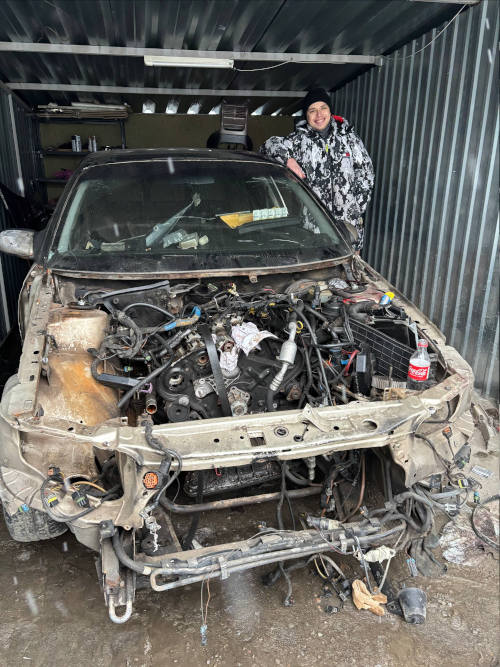
Jeep Cherokee
Jeep Cherokees are not one swap platform. In the U.S. market, the name encompasses a full-size SJ truck-based vehicle for 1974–1983, the compact XJ for 1984–2001, the KL crossover for 2014–2023, and the revived 2026 Cherokee which will have a hybrid-only powertrain. That matters because the baseline chassis, engine orientation, driveline packaging, and control architecture change so much across those decades that a swap logic that works on one Cherokee can be completely wrong on another. A more useful framing of the swap compatibility issue is not to ask, “will the engine physically go in,” but rather, “does the vehicle have sufficient systems to support the engine as an integrated whole without permanent issues to drivability, cooling, systems, or inspection?”
Jeep Cherokee Engine Swap Compatibility Overview
What “compatible” actually means
In the context of the Cherokee, compatibility refers to a three-part standard. First, the engine must fit mechanically within the bay without requiring changes to mount geometry, steering, driveline, oil pan, or cooling stack.
Integrating the new engine with the controller systems of the existing vehicles may require overcoming numerous challenges such as SJ hardware systems, Renix or early Chrysler EFI systems, the Joe XJ, the more modern heavily networked KL systems, and the hybrids which would include the integrated combustion engine, electric machines, battery controls, and transmission logic. Additionally, the built vehicle must pass various inspections such as emissions testing. A vehicle that is built but does not allow the installed systems to communicate, cycle, and does not allow all the required monitors and OBD systems to meet the required criteria is a vehicle that is not truly compatible.
There are three different types of vehicle systems that require compatibility to ensure the system or parts of the vehicle being built is functioning as it is designed to. While Mechanical fitment is a vehicle builder’s first layer of concern, there are still two other layers that require consideration. Mechanical fitment consists of the vehicle frame, the crossmember, the location of the engine mounts, as well as the length of the transmission and the placement of the transmission. With all of this in mind, the XJ engine integration and the SJ frame and crossmember design may appear simple. With the majority of XJ vehicles being designed to accept the engine layout of either an inline-4 or an inline-6, the design of the vehicle does allow for more concern with the location of the engine mounts, as well as the transmission and the support for the transmission.
KL and the 2026 Cherokee are even stricter because transverse or electrified packaging, module dependencies, and calibration expectations can defeat a swap even if the engine clears the sheet metal.
Electronic compatibility determines whether a vehicle is ‘running’ or ‘finished.’ In some cases, a pre-networked or lightly networked platform can be modified to accept a different engine, provided the logic for ignition, fuel, charging, and gauges is made compatible. When the Cherokee reaches the late-model modular control system era, the engine controller operates in concert with other controllers. These include the body control module, the ABS module, the transmission control unit, the immobilizer, the instrument cluster, and the emissions control system. They all have expectations for certain signal messages, torque specifications, and fault-state behavior. A modern engine can be designed such that it fails to meet the required specifications for torque modeling or the required security handshake. As a result, the vehicle enters limp mode, and the engine may crank and even ignite, but the vehicle will report severe operational restrictions. The system will then generate communication fault codes, and may even disable critical systems.
Why engines that ‘fit’ still fail.
Engines that‘fit’ often fail simply because the vehicle was designed around more than the physical dimensions of the engine. One point of failure is the cooling load. A Cherokee fitted with a naturally aspirated engine may not have an adequate cooling system for a more powerful engine such as a turbocharged V6 or a hybrid system, resulting in inadequate radiator area, poor fan control, and insufficient air flow. Another design consideration is the driveline angle.
Bolting the powertrain in does not eliminate the possibility of vibration, transfer-case stress, axle-joint wear, or vibration, chronic shaft geometry issues as mounted height or transmission tail position changes.
The failures in late vehicles are caused by another issue. The rest of the vehicle does not accept the new engine. Problems like immobilizer mismatch, absent CAN messages, faulty translation of accelerator pedal position to torque, and transmission torque reduction requests that are not in sync with the new engine calibration. The outcome is frequently described as a vehicle that starts and drives, but is also very frustrating. For vehicles with KL parts and newer, the physically installed engine and the fully integrated powertrain have a wide enough gap that many desirable swaps are lost more to software and regulatory issues than to fabrication difficulties.
Short generational variations
Hailing from the SJ generation, the Cherokee is the most truck-like of the lot. It features a separate frame, a longitudinal drive train, and simple control logic with a factory baseline that accommodates AMC six and V8 engine configurations.
The XJ redefines the game by switching to an integrated body-and-frame construction retaining a longitudinal configuration plus simple longitudinal factory engines, particularly the 2.5 and 4.0. The KL changes are more difficult than most realize as it goes to the Fiat Compact Wide architecture, transverse, nine-speed automatic, and contemporary modular interdependence. The returning 2026 Cherokee goes even further by making the U.S. model hybrid-exclusive with a 1.6-liter turbo hybrid, electric drive assist, and a highly integrated control environment.
Before you start researching parts and pricing, check whether the swap you have in mind actually fits – and whether it's worth doing.
Check My Engine SwapJeep Cherokee Platform Reality: What It Enables and What It Penalizes
Advantages and Limitations of Body-on-Frame

The body-on-frame construction of the SJ Cherokees from 1974 to 1983 has the advantage of easier swap packaging due to the framed construction and modularity. Simplified body supports, cross members, and load isolations hold better to the fabrication of heavy engines, long transmissions, and various transfer case and other combinations than body integrated supports. The SJ also has an advantage because of the truck-based chassis that it shares with the Wagoneer and J-series family giving it a more full-sized Jeep truck envelope than any of the later Cherokees.
That advantage, however, does carry limits. The frame still does not erase the math of packaging. The width of the frame rails, location of the front cross member, location of the steering gear, the travel of the front axle, the line of the hood and other parameters set hard limits. In addition, the separate body and frame of the SJ introduce their own unique torsional behaviors, therefore, a powertrain that is mounted with too little isolation or without proper relationship to the frame can create driveline shake, contacts with the fire wall, breakage of the exhaust, and rapid fatigue of the mounts.
The same considerations regarding ladder-frame construction do not apply to the XJ, KL, and projected 2026 model Cherokees.
For the 1984 to 2001 XJ, the radical departure was Jeep’s XJ from body-on-frame construction to a fully integrated body and frame. This was significant advancement that offered both a reduction in weight and improvement in packaging efficiency, but body-integrating construction frame systems leave the body more sensitive to the locations of mounting, bracketing, and crossmember load placement. Integrated frames improve design compactness, but also make the body more structurally significant. Insufficiently designed mounts on the XJ do not just create unwanted engine movement; they also introduce undesirable noise and vibration into the passenger cabin, adversely affect service access, and structurally load the body in a manner that was outside the designs intended use.
The KL and 2026 model Cherokees are again different. Both are unibody crossovers, but they are also unibody crossovers not as simple as the XJ, and not at all simple. Moreover, KL employs what is described as a Fiat Compact Wide platform. This includes transverse driveline packaging, modern independent suspension, and nine-speed automatic transmission integration. Given the projected 2026 model’s published hybrid specifications and anticipated controller-heavy features, that model promises to move the platform even closer to tightly controlled cross-functional integrated structure.
Because structure, powertrain arrangement, and electronics are more interconnected, these generations penalize improvisation more than SJ or XJ in practical swap terms.
SJ and XJ Cherokees have longitudinal engine layouts, but neither are as favorable as the SJ engine bay. The SJ posts more flexibility in terms of design as the frame has more design space and modular points to work with powertrain separations. The XJ is more constricted but the design appears to be modular as the unibody design with an engine bay has much greater consideration for vertical mount heights, oil sump design, steering column and drivetrain clearances, and exhaust routing. Relative to the factory XJ design, those are the preferences of the shell: AMC I4, I6, and an overall compact engine. After this baseline, the factory design does not consider the interior of the engine bay and upper levels of the vehicle, as front accessory drives and engine clearance assess the design.
KL moves the trade-off from space to geometry. It’s engine bay is designed for a transverse engine layout, so the subframe, half-shaft pathways, and the interconnected electronic nine speed automatic. Because of that, a longitudinal engine is more than a mount provision; it will span across the front structure and the entire driveline.
The subframe, transmission, axles, and front-end cooling system, have been designed to utilize and support a certain range of the overall size and torque output of the engine. If the engine block, transmission bellhousing, turbo plumbing, cooling requirements, or torque output are greater, even another transverse engine is not automatically compatible.
The powertrain will be hybrid from the factory in the 2026 Cherokee, which increases the threshold even further. The new mechanical packaging will have combustion components, electric machines, battery cooling, and an eCVT, which means the engine will be just one component. Therefore, if the rest of the system is not changed or aligned, it will be necessary to change the torque delivery, regenerative braking, cooling, and front-end packaging. That means the target window is significantly smaller than that of the older Cherokees.
The electronic constraints including CAN bus, BCM, ABS and security.
The SJ baseline is pre-CAN and is functionally simple for the current standards. It's not easy, but it means the engine is not trapped inside a dense web of module expectations. The XJ starts with a similar advantage with Renix and early Chrysler EFI, but then is gradually integrated as the 1990s progress.
The reason why XJ electronics is less strict than KL or 20206 hardware is because there are less controllers that warrant coordinated torque, emissions, and security behavior all at once.
KL is the final point where the Cherokee becomes a modern, fully networked vehicle. The engine controller, body controller, ABS/ESC, transmission control strategy, immobilizer, and instrument cluster all need to be working together. This is the point where CAN (Controller Area Network) expectations become a make-or-break factor. If some control unit doesn’t send a message, other control units will turn off and not work as intended, and if the control unit doesn’t send the right torque value, it will cause rough shifting, generate fault codes, and the vehicle’s traction control will be disabled. The engine is no longer a separate or stand-alone controller; it is part of a networked control system that is surrounded by the other controllers of the vehicle.
The 2026 Cherokee fits in the category of highly integrated vehicle systems. The published features of Uconnect, a digital cluster, a hybrid powertrain, and electric assist (if equipped) strongly suggest that Cherokee controllers will allow seamless integration of powertrain, regenerative braking, charge status, thermal management, and driver display controls. This means that the most important 'handshake' may not be between the vehicle’s engine and transmission, but rather between the entire propulsion system and all other vehicle systems. This means that modern hybrid Cherokees are some of the worst candidates for thinking about engine swaps in the traditional engine-first way.
Factory Engines Offered in the Jeep Cherokee (All Years)
Complete Factory Engine Specification Table
| Engine Code / Name | Displacement | Engine Type & Cylinders | Fuel Type | Valvetrain / Timing | Power | Torque | Production Years | Donor Vehicles | Known Issues |
|---|---|---|---|---|---|---|---|---|---|
| AMC 258 I6 | 4.2 L | Inline-6 | Gasoline | OHV, 2 valves per cylinder, timing chain | 110 hp | 195 lb-ft | 1974–1983 (SJ) | Jeep CJ, Wagoneer, J-Series | Durable low-speed engine, but emissions-era carburetion and CEC/vacuum complexity can age badly. |
| AMC 360 V8 2-barrel | 5.9 L | V8 | Gasoline | OHV, 2 valves per cylinder, timing chain | 175 hp | 285 lb-ft | 1974–1983 (SJ) | Wagoneer, Grand Wagoneer, J-Series | Front timing cover/oil-pump wear is a well-known AMC V8 weak point, especially on older units. |
| AMC 360 V8 4-barrel | 5.9 L | V8 | Gasoline | OHV, 2 valves per cylinder, timing chain | 195 hp | 295 lb-ft | 1974–1983 (SJ) | Wagoneer, Grand Wagoneer, J-Series | Same AMC V8 front-cover/oil-pump wear concern; fuel and heat management matter on aging carbureted installations. |
| AMC 401 V8 4-barrel | 6.6 L | V8 | Gasoline | OHV, 2 valves per cylinder, timing chain | 215 hp | 320 lb-ft | 1974–1978 (SJ) | Wagoneer, J-10, J-20 | Strong torque engine, but shares AMC V8 age-related lubrication and front-cover wear concerns. |
| AMC 150 / 2.5 I4 | 2.5 L | Inline-4 | Gasoline | OHV, 2 valves per cylinder, timing chain | 105–130 hp | 132–150 lb-ft | 1984–2000 (XJ) | Wrangler YJ/TJ, Comanche, Dodge Dakota | Simple and durable, but output is modest and early fueling variants vary materially by year. |
| GM LR2 60° V6 | 2.8 L | V6 | Gasoline | OHV, 2 valves per cylinder, timing gear/chain family | 110–115 hp | 145–150 lb-ft | 1984–1986 (XJ) | Chevrolet S-10, Chevrolet Citation, Chevrolet Celebrity | Notorious for being the least-loved early XJ engine because performance was weak for vehicle weight. |
| Renault J8S Turbo Diesel | 2.1 L | Inline-4 | Diesel | SOHC, timing belt | 85 hp | 132 lb-ft | 1985–1987 (North America XJ) | Renault 18, Renault 21, Renault Fuego | Very limited U.S. support footprint and parts familiarity today. |
| AMC 242 / 4.0 I6 | 4.0 L | Inline-6 | Gasoline | OHV, 2 valves per cylinder, timing chain | 173–193 hp | 220–231 lb-ft | 1987–2001 (XJ) | Wrangler, Comanche, Wagoneer, Grand Cherokee | Excellent durability overall; early 2000–2001 0331 heads are known for cracking. |
| VM Motori 425 Turbo Diesel | 2.5 L | Inline-4 | Diesel | OHV, timing gear/belt family | 114 hp | 221 lb-ft | 1994–2001 (XJ) | Export Voyager/Grand Voyager diesel applications, export Jeep diesel use | Rare in the U.S. and support is mostly an export-market story. |
| 2.4 Tigershark MultiAir I4 | 2.4 L | Inline-4 | Gasoline | SOHC, 16-valve, MultiAir 2, timing chain | 180–184 hp | 170–171 lb-ft | 2014–2023 (KL) | Chrysler 200, Jeep Renegade, Jeep Compass, Fiat 500X | Excessive oil-consumption complaints are well documented enough to have produced an FCA settlement site. |
| 3.2 Pentastar V6 | 3.2 L | V6 | Gasoline | DOHC, 24-valve, VVT, timing chain | 271 hp | 239 lb-ft | 2014–2023 (KL) | Jeep Cherokee KL, related Pentastar-family Chrysler/Dodge/Jeep applications | Family-wide reputation includes oil-cooler/filter-housing leak concerns on Pentastar derivatives. |
| 2.0 Turbo GME-T4 I4 | 2.0 L | Inline-4 | Gasoline | DOHC, 16-valve, turbocharged, timing chain | 270 hp | 295 lb-ft | 2019–2023 (KL) | Jeep Wrangler JL, Alfa Romeo Giulia/Stelvio, Jeep Cherokee KL | High-output modern turbo package; integration and thermal-management demands are more significant than on the older naturally aspirated Cherokee engines. |
| 1.6 I4 Turbo Hybrid | 1.6 L | Inline-4 hybrid system | Gasoline-electric hybrid | Turbocharged I4 with hybrid drive motors and eCVT-based system | 177 hp engine / 210 hp system | 230 lb-ft system | 2026–present (current Cherokee) | 2026 Cherokee launch application in North America | Too new in the U.S. market for a stable long-term failure pattern; the key baseline fact is high system integration, not legacy swap friendliness. |
Best Engine Swap Options for the Jeep Cherokee, Ranked by Difficulty
How do swap difficulty levels work
Difficulty levels are not a measure of engine size or horsepower. They measure how far the completed vehicle moves away from the factory relationship of engine, transmission, mounts, cooling, electronics, and emissions logic. The Jeep Cherokee nameplate has varying relationships by generation, so the same engine can be a mild swap in one Cherokee and a system-level rebuild in another.
The rating scale also does not rise in a straight line. A Level 1 swap typically stays closer to the factory mechanical layout and factory control logic, so even if the amount of work is high, the predictability is also high. Level 2 is where the stalling begins, because even if the engine fits, the systems may be misaligned. From Level 3 to Level 5, the difficulty is non-linear because at that point the vehicle is no longer merely an engine swap, it becomes a custom powertrain integration program.
Every other consideration other than fabrication has more importance depending on the level of the project, be it the electronics, the heat rejection, or the control strategy. A fabricator can determine the mount position, tunnel clearance, and exhaust routing, but that does not answer the questions of torque-management expectations, transmission behavior, instrument communication, security logic, or the completion of the emissions monitor. For this reason, modern Cherokee engine swaps, particularly KL-era projects, become complicated well before the engine is even ready to be installed.
A lot of fabrication work is still going to be done, but this does not change the impact that integration has on the project. A clean set of mounts does not change the closed-loop control transmission strategy, and it does not guarantee that the engine will be cooled properly, that the driveline will behave as it is supposed to, or that the communication on the network will be of the desired quality. Because of this, it is the overall compatibility of the entire system that the level of difficulty is a reflection of, as opposed to simply showing that the builder has the capacity to properly weld and machine the components.
Level 1 Swaps (Lowest Risk, Near Bolt-In)
Level 1 swaps tend to succeed the most because they are the most consistent with the original design logic of the Cherokee. They incorporate use of engine swaps that are in the vicinity of the factory, geometry of the factory-style mounting, and powertrains that are understood by the chassis, the cooling package, and the driveline. Within the SJ and XJ generations, these are the swaps that maintain the vehicle's original longitudinal Jeep architecture and do not impose a new identity on the vehicle.
Engines adjacent to the factory simplify complex problems. Contained within an envelope are the bellhousing pattern, oil pan configuration, accessory placement, exhaust-side clearance, and gauge behavior. This also applies to XJ projects within the Jeep/AMC inline-four and inline-six family, as emissions and electronics remain more predictable.
| Engine Code / Name | Engine Type & Cylinders | Fuel Type | Donor Vehicles & Years | Valvetrain / Timing | Swap Challenges (Specific to Jeep Cherokee) |
|---|---|---|---|---|---|
| AMC 242 / 4.0L I6 | Inline-6 | Gasoline | Jeep Cherokee XJ 1987–2001, Comanche 1987–1992, Wrangler YJ/TJ 1991–2006, Grand Cherokee ZJ/WJ 1993–2004 | OHV, timing chain | Best fit for XJ conversions from 2.5L, but accessory drive differences, sensor year-matching, exhaust routing, and transmission-control compatibility still need to follow the donor generation closely. |
| AMC 150 / 2.5L I4 | Inline-4 | Gasoline | Jeep Cherokee XJ 1984–2000, Comanche 1986–1992, Wrangler YJ/TJ 1984–2002 | OHV, timing chain | Mechanically simple in XJ, but not attractive unless replacing like-for-like; late and early fuel-system differences, transmission ratios, and emissions-equipment matching can create unnecessary regression if donor years are mixed. |
| AMC 258 / 4.2L I6 | Inline-6 | Gasoline | Jeep Cherokee SJ 1974–1983, CJ 1972–1986, Wagoneer/J-Series 1970s–1980s | OHV, timing chain | Natural Level 1 choice for SJ trucks, but carburetion, ignition-era differences, front accessory spacing, and emissions plumbing must stay coherent with the chassis year to avoid chronic tuning and underhood heat issues. |
| AMC 360 V8 | V8 | Gasoline | Jeep Cherokee SJ 1974–1983, Wagoneer/Grand Wagoneer 1970s–1991, J-Series trucks 1970s–1980s | OHV, timing chain | Factory-correct for SJ, so packaging is familiar, but mount position, front-drive accessory depth, cooling load, and transmission/transfer-case pairing still punish casual parts mixing across emissions-era variations. |
| AMC 401 V8 | V8 | Gasoline | Jeep Cherokee SJ 1974–1978, Wagoneer and J-Series 1970s | OHV, timing chain | Fits the SJ logic well, but radiator capacity, exhaust-side heat, and axle/driveline load rise enough that the swap only stays low-risk when the rest of the drivetrain matches the engine’s torque character. |
| Chrysler 3.7L PowerTech V6 | V6 | Gasoline | Jeep Liberty KJ 2002–2007, Dodge Dakota 2004–2010, Ram 1500 2002–2010 | SOHC, timing chain | Sometimes considered for XJ because it stays in the Chrysler/Jeep family, but it is only near Level 1 when used in highly planned Jeep-centric builds; oil pan shape, accessory width, and management strategy are less natural than the 4.0L baseline. |
Level 2 Swaps (Moderate Complexity)
Level 2 is where the swap moves beyond logic that is factory-adjacent, but doesn't become fully custom. These sorts of swaps still tend to keep a recognizable Jeep layout, but factors like electronics, cooling, exhaust, and transmission strategy become the priority. This is the range where planning becomes far more important than fabrication, as the project stalls far more due to unfixed interface issues than due to a lack of metalwork.
Many Cherokee swaps get stuck because the engine choice seems reasonable, but the reality is that the conversion is going to ask for a much more robust approach to transmission, cooling, and electronic management. Those issues tend to lead the swap to Level 3, and the build ends up being a lot more elaborate than it looks.
| Engine Code / Name | Engine Type & Cylinders | Fuel Type | Donor Vehicles & Years | Valvetrain / Timing | Swap Challenges (Specific to Jeep Cherokee) |
|---|---|---|---|---|---|
| Jeep 4.7L PowerTech V8 | V8 | Gasoline | Grand Cherokee WJ 1999–2004, Dakota/Durango 2000s | SOHC, timing chain | Most relevant to XJ builders chasing an all-Jeep V8 path, but firewall space, front-sump and steering conflicts, transmission selection, and cooling-system margin become much stricter than with the factory inline-six. |
| Jeep/VM 2.8L CRD | Inline-4 turbo diesel | Diesel | Jeep Liberty CRD 2005–2006, export Jeep applications | DOHC, timing belt | Diesel torque and packaging work against the XJ and older SJ cooling and vibration baseline, while fuel-system integration, intercooling, and transmission gearing demand better planning than the engine’s size suggests. |
| Cummins R2.8 Turbo Diesel Crate | Inline-4 turbo diesel | Diesel | Cummins Repower program, aftermarket crate application | DOHC, timing chain/gear-driven system | Popular in concept for XJ and SJ, but it quickly becomes a moderate-complexity package because engine mass, NVH, intercooler routing, gearing, and diesel-specific support systems change the character of the whole Jeep. |
| Jeep 2.0L Turbo GME-T4 | Inline-4 turbocharged | Gasoline | Jeep Wrangler JL 2018–present, Cherokee KL 2019–2023, Alfa Romeo Giulia/Stelvio 2017–present | DOHC, timing chain | Can make sense only in KL-to-KL logic or advanced Jeep-family projects, but charge-air cooling, torque-model dependence, transmission communication, and underhood heat move the swap out of the easy category immediately. |
| Chrysler 3.6L Pentastar V6 | V6 | Gasoline | Wrangler JK/JL 2012–present, Grand Cherokee WK2 2011–present, Dodge/Chrysler family 2011–present | DOHC, timing chain | Frequently considered because it is common and powerful, but in an XJ or SJ it creates packaging, accessory-drive, and transmission-strategy issues, while in KL it does not solve the deeper network constraints that made the original package work. |
| AMC/Jeep stroked 4.6L–4.7L inline-six based on 4.0L architecture | Inline-6 | Gasoline | Aftermarket build using 4.0L/4.2L Jeep components | OHV, timing chain | Often easier than a foreign-engine swap in XJ because the external package stays familiar, but tuning quality, injector sizing, cooling reserve, and emissions behavior determine whether it remains moderate or becomes a reliability problem. |
High-Effort Engine Swaps (Levels 3–5)
For levels 3 through 5 consider system builds instead of engine swaps. These types of projects typically disrupt the factory relationships of engine position, trans control, driveline geometry, chassis load path, and the integrated network. In Cherokee terms, this is where the builds start to become custom Cherokee builds instead of differentiating the engine.
While cross brand swaps dominate this range, brand continuity is not a guarantee of being within this range. The LS in XJ swap is notorious not only because of its transmittable chain reaction and its easy attainable elements, but also the multiple unresolved consequences of transmission behavior, transfer case selection, cooling, steering, exhausts, and instrument logic. All of this, and even more, applies to projects with a Hemi, EcoBoost, or BMW in the KL and newer architectures where the original engine is integrated with the network and stability systems powertrain.
At these application levels, standalone ECUs become standard as the engine block typically cannot be integrated with the original vehicle logic. While this does assist in making the engine functional, the vehicle remains non-integrated. The builder still has to manage the transmission controller, ABS/ESC, immobilizer, instrument cluster, HVAC load, and emissions readiness. A standalone ECU only resolves combustion.
Repackaging and the redesign of the cooling system become necessary as well. High power and cross-brand combinations usually cause changes in sump requirements, front accessory positions, fan setup, and the placement of intercoolers, headers, and drivetrain angles. Once that occurs, the dominant risk changes from single-component fitment to a loss of system stability, thermal margin, and long-term serviceability of the project.
| Engine Code / Name | Difficulty Level (3 / 4 / 5) | Engine Type & Cylinders | Fuel Type | Donor Vehicles | Dominant Integration Risks |
|---|---|---|---|---|---|
| GM LS-series V8 | 3 | V8 | Gasoline | Chevrolet Silverado, Tahoe, Camaro, Corvette, GMC Sierra, van platforms | XJ and SJ projects can be completed, but the real risks are driveline-angle stability, transfer-case strategy, steering and exhaust coexistence, radiator and airflow margin, and loss of unified transmission and instrument behavior. |
| GM LQ4/LQ9/LY6 truck V8 family | 3 | V8 | Gasoline | GM 2500/3500 trucks and SUVs | Truck variants amplify front-end mass and heat load, which raises substructure stress, front-spring requirements, braking balance concerns, and underhood thermal accumulation beyond what a Cherokee was calibrated around. |
| Chrysler 5.7L Hemi V8 | 4 | V8 | Gasoline | Ram 1500, Dodge Charger/Challenger, Chrysler 300, Durango, Grand Cherokee | Looks brand-consistent, but packaging width, exhaust-side heat, accessory bulk, transmission-control demands, and security/electronics dependencies push the build into deep integration territory, especially outside SJ applications. |
| Chrysler 6.4L Hemi V8 | 4 | V8 | Gasoline | Dodge Charger/Challenger Scat Pack, Ram HD, Jeep SRT-family applications | The engine’s output exceeds the Cherokee’s original cooling, driveline, and traction-management assumptions, so the dominant risks are system overload, not just mount fabrication or hood clearance. |
| Ford 5.0L Coyote V8 | 4 | V8 | Gasoline | Ford Mustang, F-150 | Cross-brand control strategy, wide DOHC packaging, accessory-drive bulk, and high-rpm thermal behavior create a build that depends on custom electronics and custom underhood architecture rather than on normal swap logic. |
| Toyota 2JZ-GE / 2JZ-GTE | 4 | Inline-6 | Gasoline | Toyota Supra, Lexus GS/IS/SC, Toyota Aristo | The inline-six layout seems attractive for XJ, but sump configuration, steering relationship, transmission pairing, standalone management, and emissions survivability make it a full custom integration job. |
| BMW M57 / N57 diesel family | 4 | Inline-6 turbo diesel | Diesel | BMW 3 Series, 5 Series, X5, X6 diesel models | These swaps become electronic and emissions projects immediately, with CAN translation, automatic-transmission strategy, intercooling, particulate and aftertreatment logic, and serviceability all creating system-level risk. |
| Jeep 6.2L Hellcat V8 | 5 | Supercharged V8 | Gasoline | Durango Hellcat, Challenger/Charger Hellcat, Ram TRX family context | At Cherokee scale this is not an engine swap in the normal sense; driveline survival, chassis load management, heat rejection, traction-system coherence, and packaging of the supercharger and supporting hardware dominate the build. |
| Modern transverse hybrid systems outside original KL/current Cherokee architecture | 5 | Hybrid powertrain | Gasoline-electric hybrid | Late-model FCA/Stellantis and non-Stellantis hybrid crossovers | These projects fail at the architecture level because propulsion, battery management, brake blending, thermal management, security, and network communication are inseparable, making the Cherokee shell only one small part of the problem. |
| Electric drive conversion using full EV traction package | 5 | Electric motor system | Electric | Tesla, Nissan Leaf, aftermarket EV conversion components | The dominant risks are no longer engine-related at all; they shift to battery placement, crash-safe high-voltage routing, braking balance, thermal control, reduction-drive strategy, and full loss of original emissions and powertrain logic. |
Universal Engine Swap Execution Reality
Planning Phase and Tooling
In this phase, a decisions is made that determines the degree of control that can be exerted on the project. Will it be controlled integration, or a series of costly corrections? For a Jeep Cherokee, this means much more than simply measuring the length of the bay and height of the hood. It means understanding the relationships between the positions of the engine and transmission, the paths of the front axle and half-shafts, the volume of the radiator, the path of the exhaust, the envelope of the accessories, and the control strategy of the finished vehicle. The mistakes of projects often happen here because the builder views the engine as the only variable and believes the rest of the vehicle will be seamlessly adapted afterwards.
TThere is no reason why, in principle, measuring in this way should lead to errors. There is often a viability of a package that fails depending on a range of considerations, including steering travel as well as the suspension movement, the depth of the fan, the heat shield, and access for service. The Cherokee nameplate does not make this easier, as the platform changes so much by generation. An SJ has truck-style structural tolerances, an XJ compresses everything into a tighter unibody envelope, and KL-era architecture essentially leaves no space for informal planning because the engine is only one component in the larger, interdependent drivetrain package.
The most typical planning failure is not optimism about authority; it is a disregard for the complexity of interactions. Engine height changes impact hood clearance, driveline angles, intake routing, and oil pan shape. Changes in transmission strategy will effect mount location, shifter logic, cooling, and shifter electronic control. Therefore, good planning works as a filter for systems. It is able to exclude combinations that may fit, but will not work as a complete Cherokee.
Engine Bay Clear Out
The beginning of the project is signified by the removal of the original powertrain. However, this is more of a crucial reference point for the preservation of relationships. Once the original powertrain is removed, a builder loses access to mount geometry, hose routing logic, harness branch locations, transmission alignment, and the relationship between the engine and the rest of the chassis. Clearing the bay helps preserve these references but cutting the bay too early in the process will destroy information that the project will rely on for stability.
In older Cherokee models, there is usually a risk of a model sustaining physical damage to areas that would have served as baseline templates. For more recent models, particularly the aimed at networking models, a greater risk is damage to the control environment as a whole. Connectors lose the contextual closure, harness branches lose ID, and the job shifts from modifying the system to deconstructing what used to be there. That is a slower and more failure-conducive way to build.
Removal also instills a false sense of confidence. With an empty bay, any engine looks theoretically possible. That illusion is one of the reasons projects get out of control too quickly. The empty space conceals the fact that the finished vehicle still needs to accommodate airflow, steering travel, belt routing for servicing, heat management, exhaust clearance, transmission behavior, and the full complement of electrical logic.
Fit & Clearance Test
Test fitting should not be celebrated, but rather should be viewed as a way to identify areas of conflict. The more useful engineering question is not whether the engine will enter the bay at all, but rather whether the engine will be able to occupy a position that will not cause any interference with the other systems. In the Cherokee projects, the first fit is often assumed to be highly successful without consideration of what will be the final position of the radiator, the final depth of the fan, full exhaust routing, or real (not theoretical) suspension and steering movement.
Problems with clearance rarely remain contained within one area. Less clearance means a tighter firewall means a different position for the transmission. A compromised oil pan position alters the relationship of the front suspension or axles. Changes to accessory drive clearance affects the cooling stack and service access to the drive belt. In XJ builds, the unibody shell makes these tradeoffs more severe because the engine bay, while efficient, is not generous. With KL-style architecture, the test fits often reveal that the packaging is tight, but that is also structurally prejudiced around the original drivetrain to a degree that meaningful rearrangements are resisted.
This is the point where many swaps shift from manageable to unmanageable. One interference point created by the builder is solved, while three secondary problems are created. When that happens often enough, the vehicle can be assembled, but it also loses thermal capacity, serviceability, and a margin of operational safety. In a practical sense, a Cherokee that is only functional when being lifted or for a short time has not advanced beyond the fitment stage of design.
Mounting \& Driveline Geometry
Mounting is commonly seen as an issue of fabrication. In fact, it is an issue of geometry first, structural load second, and fabrication definintely third. Mounts do not simply hold the engine in place. They define the position of the crank centerline, the angle of the transmission, the relation of the transfer-case or final-drive, the position of the shifter, the behavior of the axle joints, the transfer of vibrations, and how the structure reacts to engine torque over time.
On a Cherokee, poor mount logic becomes apparent after the project is apparently complete. The vehicle starts and moves, and even feels fine at low speed, but under load vibration develops, U-joints wear quickly, the exhaust system shifts into contact, and the engine rocks is such a way that it pulls on hoses and harnesses. The XJ is especially sensitive because the shell itself load and vibration, but the SJ does give a bit more structural tolerance. Even there, poor alignment and crossmember logic just move to fatigue over time.
The mounting errors are cumulative in nature. A small error in the transmission angle, combined with a slight error in the mount height, and an overly aggressive working angle of the rear shaft creates an issue that no single correction can fully remedy. This is why driveline alignment must consider all components in relation to one another. When the powertrain has been mounted, all other rotating parts will suffer the impact of the errors.
Wiring and ECU Strategy
The wiring strategy marks the point at which engine swaps become more about integration than mechanical work, the decision is no longer about whether the engine can run, it is about how the engine controller will work with the rest of the vehicle. In the case of an older Cherokee, the control strategy may be simple enough that the engine can be made to run with a few compromises. However, in more recent vehicles, especially those with a modular CAN architecture, the ECU strategy is a critical factor in determining whether the vehicle will function as a single integrated unit.
The majority of failures at this stage arise due to fragmented logic. One subsystem of the vehicle thinks the new engine is factory-fresh. Another expects ghost messages. A third is simply bypassed. The result is a vehicle that starts but does not behave as a coherent system. Gauges are wrong. The fans don’t do what they are supposed to. The transmission response feels out of sync with the engine. Engine faults come and go.
The greater problem is that wiring problems are often masked by short-term success. A Cherokee can idle and rev and even drive around the block and still contain unresolved problems in power distribution, sensor ground, communication, or thermal control logic. Those problems will come to the surface eventually, but only after heat cycles, vibrations, weather, or load cycles. Thus a stable ECU strategy relies less on achieving a ‘first start’ and more on the vehicle maintaining coherent system logic throughout.
First Start & Initial Validation
A first start does not necessarily mean that a project is a success. While it does indicate that it has met a minimal level of sophistication, it does not say much about how the Cherokee will perform under sustained heating, moving air flows, transmission loads, repeated cycles, re-starts, or at real road speeds. This is the reason many projects get prematurely labelled as completed.
The first start has to be validated against a set of different criteria. Once the engine bay finishes heat soaking, will the engine still be thermally stable? Will the charging system perform as expected with the vehicle’s electrical demand? Will the driveline remain smooth under acceleration or when coasting? Will the fan control strategy, throttle control, and idle control be re-stabilized when the system goes through a controlled transition from a cold start to operating temperature and then post drive restart? The answers to those questions relate to system behaviour, not to an event that is a start-up.
When it comes to Cherokee swaps, and, in particular, those with non-factory combinations, the first drive almost always reveals more truth than the first start. Load will expose the weaknesses in the mounting, temperature will expose the weaknesses in the airflow, and repeated use will expose the weaknesses in the wiring. A project that started easily, but that then produces inconsistencies after two heat cycles is not close to being completed. It is still in the process of debugging.
Enter your vehicle and target engine to see a compatibility verdict, estimated cost, required changes, and whether it's the right move for your build.
Get My Swap VerdictEngine Swap Cost & Timeline Reality

Project budgeting based on difficulty level
Cost estimation here is a non-linear function. The costliest part of a swap is not the engine, but the number of other systems that have to be reworked. A low-risk Cherokee swap that stays close to factory architecture should be in the low-mid 4 figures range if done efficiently, barring unforeseen major secondary problems. Mod-complexity jobs frequently go to mid 4 figures to low 5 figures range as cooling, trans strategy, fab revisions, and wiring effort grow faster than steeper than expected. High system build efforts regularly enter the 5 figures and can go significantly beyond that once custom electronics, driveline redesign, and rework iterations are accounted for.
Transfers from one level to the next are rarely due to one big purchase. It’s all about accumulation. A revised mount position changes driveline work. Driveline changes expose cooling conflicts. Cooling changes require new front-end packaging. Packaging changes affect accessory routing or service access. By the time the builder fixes the fourth secondary effect, the project has already left its original budget logic behind.
Opportunity cost is something to factor in. A Cherokee that isn’t moving during a long swap is still eating up a storage space, workshop capacity, builder attention, and often money that could have been spent to restock the original engine or upgraded the rest of the vehicle. When a project reaches a point where it is mostly reliant on debugging rather than assembly, the costs stop feeling like a list of parts and start feeling like a measurement of time.
Reasonable Time Estimates
A timeline and a budget behave the same way. Straight forward, quick swaps where everything is clear with the donor package, chassis condition, and control strategy can be done in a matter of weeks (although this is rare). Moderate complexity swaps often take months. With a high effort Cherokee build, the work is also frequently includes redesign, rather than adapting existing parts, which is why these often become multi-month or multi-season projects.
The time spent hands on is rarely the time that is spent the longest. A builder may spend a limited number of days installing parts, yet calendar time is often lost waiting on decisions, corrections, testing, fabrication revisions, and clear diagnostics. This is why enthusiasts underestimate the time a project will take to occupy the vehicle. Delays often happen between work sessions.
The Oklahoma Cherokee tribe is especially vulnerable to this because there is an assumption that the vehicle is uncomplicated to begin with. While some generations are simple from some perspectives, age based simplicity does not mean simple integrative across generations. For example, older platforms often trap age-related uncertainty, whereas younger ones trap network-related uncertainty. Both types extend the timeline once the projects move beyond first-fit.
What Builders Consistently Underestimate
Builders consistently underestimate wiring, validation, and rework. Builders also underestimate the number of small decisions that need to be consistent in order for the vehicle to feel finished. The engine may be operational, the gauges may not be correct, there may be improvised fans, the transmission may be only partially happy, and there may be a driveline vibration that “will be solved later.” Those “later tasks often become the actual project.
Another blind spot is heat management. While it may be possible to speak in broad terms about radiator size without considering airflow sealing, fan control logic, and exhaust heat migration, hot-restart behavior will determine whether the Cherokee is capable of working in traffic, on hot days, or under repeated load. The same pattern is repeated in serviceability. A tight-fitting package may mean that what should be routine maintenance becomes partial disassembly, so the swap carries an operational penalty for the rest of the vehicle's life. \
Lastly, builders fail to see how much emotional momentum impacts the quality of decisions. Once an engine is bought and test-fitted, the evidence that the project has outgrown rationality is far less important than the pressure to continue. That’s how a rational swap becomes a sunk-cost build.
Common Jeep Cherokee Engine Swap Failure Scenarios
Incomplete or Fragmented Wiring
Fragmented wiring causes total failure, if ever, far in the future and more commonly creates delayed failure The Cherokee starts, drives, and is usable most of the time, but develops intermittent faults after vibration, weather exposure, or repeated heat cycles begin to stress connectors, grounds, and spliced branches. These types of intermittent failures can be hard to address because they mimic unrelated problems. A charging problem can present like a sensor problem, and a communication problem can present like a calibration problem.
It is the nature of the problem that is more fundamentally the issue–most of the time it is not a total failure. The vehicle behaves differently when it is hot vs cold, wet vs dry, or first drive vs third drive. That is a signature of a harness or a logic environment that is intended to function temporarily. Once that pattern appears, troubleshooting is very slow because the original build logic was never unified in the first place.
Cooling System Under-Sized or Misapplied Cooling System Failures
Cooling failures often occur after the swap is declared complete. The Cherokee may idle acceptably when outside temperatures are mild, however, the Jeep may overheat when stopped in traffic, during extended climbing, or after repeated acceleration and deceleration cycles. This occurs because cooling is not only about having a radiator of an acceptable size; cooling encompasses many factors, such as the airflow path, the behavior of the fan control, the logic of shrouding, engine and transmission heat rejection, and how the engine bay cools when vehicle speed drops.
Improper cooling systems often result in secondary symptoms before completely overheating the vehicle. The vehicle will have higher intake temperatures, excessive hot restarts, the wiring in the engine bay will age faster, the belts will need to be replaced more often, and the vehicle will begin to feel inconsistent to drive and not just “too hot.” These are referred to as delayed thermal penalties. They are common in Cherokee swaps because of the tight engine bay and changed accessory packaging, which are reducing the margin the original systems relied on.
Driveline Angles That Are Not Properly Aligned
Driveline issues often wait to show themselves until real road usage occurs. Short drives in a Cherokee may result in no problems but later cause issues during cruising, acceleration, or coasting. Problems can be essentially be described as “the rotating system is unhappy in a narrow operating window” which describes driveshaft vibrations which can be difficult to diagnose. To these builders, the problem with the driveline is that the geometry is “good enough” so that the vehicle will at least move.
As time passes, the symptoms become more clear. Vibrations become more noticeable with time, however, cv joints and seal output behavior become more aggressive, and vibrations become a more noticeable trait of the vehicle. These failures were just delayed until now as a result of the “close to being right” geometry. This problem is especially present in Cherokee swaps due to small repositionings of the engine.
Issues with geometry of the belt and accessory drive
Issues with accessory drives occur when the vehicle has gone through multiple variations of temperature as well as when the belt has been subjected to varying loads. Problems that seem easily fixable in the shop may present themselves due to engine movement. Once completed, the engine will show belt issues, poor functionality within the cooling system, inconsistent charging, and premature tensioner and bearing wear.
The accessory drive does more than just turn pulleys. The failure is systemic because it also supports cooling, charging, steering assist (where applicable), and the stability of the engine's front dress during real movement. In the cramped engine bays of the Jeep Cherokee, revised positioning of the accessories often solves one interference issue, but reduces belt wrap, alignment, and serviceability. The problem then shows up after the build is already in operation and normal usage has begun.
Legal & Emissions Considerations (US)
Swaps Using OEM ECU
Swaps using OEM ECUs have the greatest likelihood of passing inspections because the logic environment is kept in the factory calibrated state. That fact alone, however, does not make it easy, but it does mean engine management, emissions, and fault logic work together. This gives the best chances or monitor behavior stability, consistent and predictable relationships to emissions sensors, and the OEM-style drivability profile of a vehicle that has been engineered for a production run.
With respect to Cherokees, the above is important because inspections are their reality. Vehicles that are more credible as fully integrated and rationalish emissions logic are able to remain usable for a longer period of time. Swaps that are in the vein of OEM ECU and control strategies are the best for ensuring the vehicle does not become mechanically interesting but administratively rather fragile.
Standalone ECU Swaps
Standalone ECU swaps remove the balance of considerations. They frequently make achieving operational engine integration simpler, particularly in cross-brand or high-output builds, but at the expense of emissions and inspection survivability since the engine no longer exists in production-calibrated vehicle logic. Even when the standalone system is fully functional, the finished Cherokee may find it difficult to exhibit complete readiness behavior, proper fault management, and seamless factory interaction with the rest of the vehicle.
The practical reality is that standalone ECUs very often solve the engine but complicate the vehicle. In purpose-built projects, that trade is often acceptable, but it greatly increases the likelihood that the swap will not be operationally painless in normal use. The builder loses the system-level integrity that makes a swap behave like a durable street vehicle, but gains control over combustion and calibration.
Inspection Reality
Inspection does not care how innovative the build is. It cares whether the finished vehicle integrates like a coherent, emissions-capable road car. That is the right mental model for Cherokee swaps in the US market. The more the project relies on custom logic, incomplete monitor behavior, or inconsistent visibility between the engine package and the chassis era, the more fragile it becomes in inspection-driven contexts.
This is why we should consider legality as a design constraint, rather than an afterthought. A swap that functions as a result of disregarding certain systems is incomplete. It may be operational, and may even perform well, but if it cannot coexist within the practical ecosystem of the vehicle, it does not endure the full reality of ownership.
When an Engine Swap Is the Wrong Solution
Rebuilding the Original Engine
For some Cherokee owners, the answer to their problem appears to be a simple engine swap. However, the true issue lies engine condition, not so much engine identity. If the original engine fits the chassis, electronics, cooling package, and emissions framework, then rebuilding the engine often makes way more sense than replacing it with a system that is incompatible in philosophy. The vehicle stays coherent, the support structure stays the same, and the end product is way less of a headache to justify and live with.
This is especially true for older platforms like XJ and SJ where the baseline is known. An original-style engine may not be the most exciting option, but it more. At the end of the day, it is what is the most important when the end goal is a reliable Cherokee rather than a never-ending project.
Modest Inductions
Sometimes, the answer may not be an engine swap, but rather, some reliable increase in performance. As long as the builder is able to maintain thermal control and a balanced system, then moderate forced induction will be able to do that a lot better than an engine swap. The greatest part about it is that it will keep the original engine along with its mounts, packaging, and vehicle relationships intact.
This route does carry some risk, but often sidesteps the greatest costs of a complete engine replacement. The Cherokee retains its original structure and a lot of its original serviceability. When the original engine family is still acceptable, slight modifications to performance are often more seamlessly integrated compared to adjustments requiring a complete architectural overhaul.
Gearing & Drivetrain Adjustment
Many of the complaints that drive owners to an engine swap are actually complaints about gearing. The vehicle feels slow, strained, or poorly suited to the size and purpose of the tires, leading the owner to believe the engine is deficient. In fact, the experience of driving is often more profoundly affected by the axle ratio, behavior of the transmission, the choice of transfer case, and the mass of the tires than the engine.
For a Cherokee, and especially for those that are used for off-road driving or fitted with oversized tires, the correction of gearing is often the cleanest engineering solution because it can improve response, reduce strain on the transmission, enhance drivability, and all of that can be done without an engine change.
Frequently Asked Questions
Why does the Jeep Cherokee name create so much confusion in engine swap discussions?
The confusion comes from the fact that “Jeep Cherokee” is not one technical platform. The SJ, XJ, KL, and current hybrid-era Cherokee share a badge, but they do not share the same structural assumptions, drivetrain layout, or electronics philosophy. A swap conversation that makes sense for a 1998 XJ can be completely useless for a 2019 KL, because one is a compact longitudinal unibody truck-derived vehicle and the other is a transverse, networked crossover.
That matters because people often search by model name instead of by generation. As soon as that happens, the advice gets flattened into false universal rules. The Cherokee is one of the clearest examples of why badge continuity is not platform continuity. Good decisions on this vehicle start by separating generations first, then evaluating swap logic inside the correct architecture.
Why do XJ Cherokee swaps seem more realistic than KL Cherokee swaps even when the newer vehicle looks more advanced?
XJ swaps seem more realistic because the XJ still behaves like a mechanically honest platform. Its longitudinal layout, relatively simple control environment, and straightforward driveline relationships make it possible to change one major variable without redesigning the whole vehicle. That does not make every XJ swap easy, but it means the vehicle still tolerates coherent mechanical thinking.
The KL punishes that mindset because the vehicle is built around a much tighter relationship between engine, transmission, electronics, and front-drive packaging. In that environment, a swap is no longer just about finding room for a different engine. The powertrain is part of a deeply integrated control and packaging system. That is why the newer Cherokee is often less flexible than the older one, even though it is objectively more sophisticated.
Why do SJ Cherokees attract V8 swap ideas more naturally than later Cherokees?
The SJ starts from a truck-based logic that already accepts larger engines, larger driveline loads, and more variation in powertrain mass. Its body-on-frame layout does not remove all difficulty, but it gives the project clearer structural reference points and more tolerance for changes in engine size and torque. That makes V8 thinking feel native rather than forced.
Later Cherokees lose that natural alignment. The XJ still supports interesting swaps, but its unibody structure and tighter bay reward narrower, better-centered decisions. The KL leaves even less room for traditional V8 logic because the whole front package was not designed around that kind of architecture. So the SJ does not just offer more space, it offers a more compatible design philosophy for that type of build.
Why is the XJ’s unibody more important to swap planning than many builders expect?
Many people hear “unibody” and only think about stiffness or weight. In swap reality, the XJ’s integrated structure changes how loads, vibration, and mount forces enter the vehicle. That means a mount strategy that looks acceptable on paper can create long-term NVH, fatigue, and driveline instability once the vehicle starts seeing heat cycles and load transitions.
The XJ therefore rewards balanced packages more than brute-force fabrication. A swap that looks visually compact but transmits harshness into the shell, overloads local mounting areas, or shifts driveline geometry too far can feel permanently unfinished. On this platform, the structural character of the vehicle keeps judging the swap after the welding is done.
Why does the return of the hybrid Cherokee change the swap conversation so dramatically?
A hybrid Cherokee changes the conversation because the combustion engine stops being the sole propulsion identity of the vehicle. Once battery logic, electric assistance, regenerative behavior, thermal coordination, and hybrid transmission strategy are built into the core architecture, the engine cannot be treated as a self-contained module. It becomes one participant in a managed propulsion system.
That pushes swap thinking away from traditional engine replacement and toward full-system replacement. In other words, the question is no longer whether another engine can be mounted. The real question is whether the entire propulsion logic can be replaced without collapsing usability, diagnostics, and operating coherence. On a hybrid Cherokee, that threshold is far higher than on older generations.
Why do so many Cherokee swap projects look finished before they are actually reliable?
The visual completion point arrives much earlier than the reliability completion point. Once the engine is mounted, wired well enough to start, and the vehicle moves under its own power, the project feels emotionally complete. In engineering terms, though, that is only the moment when the real evaluation begins. Heat soak, vibration, hot restarts, fan control, charging stability, and driveline behavior have barely been tested at that stage.
Cherokees are especially vulnerable to this illusion because older ones look simple and newer ones can appear electronically self-contained. Both impressions are misleading. A truly finished swap is not the one that starts, it is the one that remains stable after repeated load cycles, repeated thermal cycles, and normal ownership conditions. Many projects reach the first milestone and get mistaken for having reached the second.
Why do transmission choice and engine choice have to be treated as one decision on a Cherokee?
Because the transmission is not just a follower. It defines length, mount position, shifter logic, cooling demand, ratio behavior, and the way torque reaches the rest of the driveline. In a Cherokee, that means the transmission often determines whether the engine can occupy a usable position rather than merely a possible one.
This becomes even more important as the platform gets newer. On an older XJ or SJ, a mismatched transmission may create packaging and driveline penalties. On a KL-style vehicle, it can also trigger deep control conflicts because the engine and transmission communicate as part of one managed system. Thinking about the engine first and the transmission second is one of the most common ways to make a Cherokee swap harder than it needed to be.
Why do some Cherokee owners end up disappointed even when the swapped vehicle is objectively faster?
Because vehicle satisfaction is broader than acceleration. A swapped Cherokee can gain output and lose the traits that made the platform appealing in the first place. It may become hotter in traffic, harsher at idle, more awkward to service, less predictable off-road, or more frustrating to diagnose. Those losses do not show up in headline performance figures, but they dominate long-term ownership.
This is where the platform’s original character matters. An XJ that becomes quicker but loses its simple, usable balance may feel worse overall. An SJ that gains torque but becomes awkwardly calibrated for its actual use case can feel less resolved, not more capable. A good swap therefore improves the whole driving and ownership experience, not just one measurable axis.
Why do cooling problems on a swapped Cherokee often appear after the project already seems sorted?
Cooling problems tend to arrive late because the cooling system only reveals its real behavior under compound stress. A Cherokee may idle in the shop, survive short drives, and even tolerate cool weather before the combination of traffic, ambient heat, sustained load, and underhood heat retention starts exposing weak airflow strategy. That is why early success can be deceptive.
The Cherokee platform amplifies this because many swaps change more than radiator demand. They change fan depth, accessory packaging, exhaust heat location, transmission heat contribution, and the path hot air takes after passing through the cooling stack. So the problem is rarely just “not enough radiator.” It is usually a system that no longer manages heat the way the original vehicle did.
Why do some Cherokee swap decisions make more sense for off-road use than for normal street use?
Off-road driving and daily driving punish different weaknesses. A swap that works well at lower road speeds, in shorter bursts, and with a strong low-end torque bias may still be compromised for highway refinement, emissions stability, fuel range, or urban heat management. On a Cherokee, especially an XJ or SJ, those tradeoffs can make the same build feel smart in one context and poorly judged in another.
The mistake is assuming that “more capable” means universally better. A Cherokee built for trail-focused use may accept compromises in NVH, service access, or operating smoothness that would be tiresome in everyday use. So the right answer depends less on the engine’s reputation and more on whether the finished package matches how the vehicle will actually live.
Why do modern engine management systems make cross-brand Cherokee swaps harder than older forum advice suggests?
Older swap culture grew up around vehicles that allowed more separation between engine operation and vehicle operation. Modern engine management does not behave that way. The engine now participates in torque modeling, emissions logic, fault coordination, transmission communication, and sometimes traction and stability expectations. That means a cross-brand swap is not just translating connectors, it is translating system behavior.
In a Cherokee, that gap is especially obvious when comparing older XJ logic with later KL logic. The older platform may still accept a well-managed foreign powertrain if the rest of the system is kept coherent. The newer platform usually resists that approach because the factory powertrain is woven into the rest of the vehicle far more tightly. Old advice often underestimates how much that changed.
Why do rebuilt stock-style engines often outperform ambitious swaps in real ownership terms on the Cherokee?
A rebuilt stock-style engine often wins because it preserves the vehicle’s original logic instead of forcing every supporting system to adapt. The mounts stay honest, the driveline stays familiar, the cooling package stays within known behavior, and the control environment remains closer to what the chassis expects. That produces fewer hidden penalties.
On a Cherokee, especially one meant to be driven regularly, that matters more than novelty. A rebuild may not generate the same excitement as a dramatic swap, but it often generates a more complete vehicle. When the goal is durable usability instead of technical spectacle, keeping the engine family aligned with the platform can be the stronger engineering move.
Why do oversized tires and gearing changes distort how owners judge whether their Cherokee needs an engine swap?
Because many complaints blamed on engine weakness are actually driveline mismatch problems. Once tire diameter increases, effective gearing drops, rotational mass rises, and the engine starts operating farther from the range where the original vehicle felt responsive. The driver experiences that as “not enough engine,” even though the real issue is often that the drivetrain no longer multiplies torque appropriately for the load.
This matters on Cherokees because they are frequently modified in ways that change the vehicle’s leverage before anyone touches the engine. An owner can chase horsepower to compensate for a gearing mistake, then end up with a more complicated powertrain and the same underlying mismatch. When the drivetrain is recalibrated correctly, the need for a swap often looks much less urgent.
Why do Cherokee swap threads so often underestimate serviceability after the build is complete?
Because the conversation usually centers on making the package fit, not on living with it afterward. A Cherokee can physically accept a powertrain that leaves poor access to belts, sensors, cooling components, or exhaust hardware, and that may not seem important during the excitement of the build. Over time, though, every maintenance event becomes slower, more intrusive, and more expensive in effort.
Serviceability is not a luxury variable. It is part of whether the swap was well judged. A vehicle that turns routine work into a packaging battle is carrying permanent integration debt. On a Cherokee, where many successful builds depend on preserving practical usability, long-term access often separates the mature project from the merely impressive one.
Final Rule: Choosing the Right Tool
An engine swap is only justified if it betters the entire Jeep Cherokee as a whole, not just the engine bay. If the finished product is more difficult to cool, more difficult to diagnose, more difficult to service, and less reliable, then the project is a failure even if the swap is technically awesome. Power is only one variable, and the Cherokee must retain its serviceability, reliability, legality, and system coherence, or else it will become a permanent experiment instead of a usable machine.
The guiding principle is quite straightforward. Pick the option that maximizes total vehicle integrity for the intended purpose. If that option is a swap, it needs to function like a cohesive unit, not just a bunch of solved problems. If it doesn't, then the engine swap is not the right solution.
Stop comparing specs in your head. Enter your Jeep Cherokee and the engine you want – get a structured verdict with cost, complexity, and a clear recommendation.
See If This Swap FitsYears
No year pages with content are configured for this model yet.