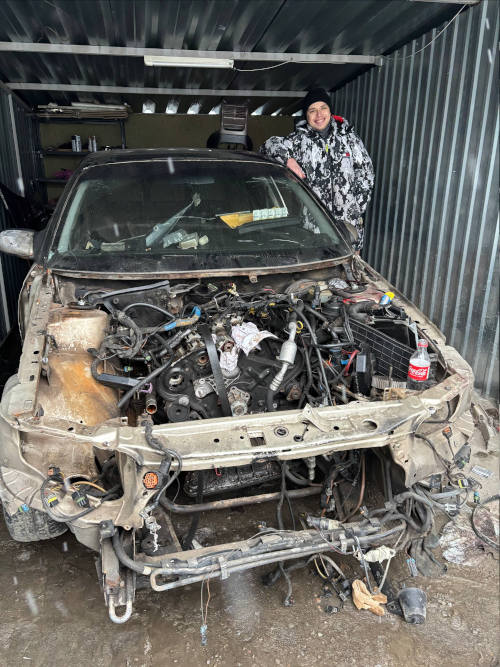
Nissan Pathfinder
Nissan Pathfinder engine swap compatibility overview
The Nissan Pathfinder is not a single swap platform. In the US market, the Pathfinder covers several very different generations, including the early truck-based WD21, the unibody R50, the body-on-frame R51, and the later unibody crossover-style R52 and R53 models. Because of those platform changes, an engine swap that may be realistic in one Pathfinder generation can be impractical or completely custom in another.
A Pathfinder engine swap should not be judged only by whether the engine physically fits in the engine bay. Physical fitment is only mechanical compatibility. A realistic swap also has to account for electronic compatibility, transmission compatibility, emissions compatibility, cooling compatibility, and driveline compatibility. The engine, transmission, transfer case or AWD system, ECU, immobilizer, body electronics, exhaust, catalytic converters, EVAP system, radiator, driveshafts, and differential ratios all have to work together.
This is especially important because older WD21 and R50 models are generally simpler than later R51, R52, and R53 vehicles. The R51 still has useful truck-based architecture, but its electronics and emissions systems are more involved. The R52 and R53 Pathfinder are much harder swap candidates because their transverse engine layout, CVT or modern automatic transmission, AWD system, body modules, immobilizer, and emissions controls are tightly integrated.
Later sections of this guide should examine the factory engines, platform differences, realistic swap candidates, difficulty levels, execution risks, cost ranges, and legal considerations before making a final swap recommendation.
Entity summary
| Field | Summary |
|---|---|
| Vehicle | Nissan Pathfinder |
| Generations covered | WD21, R50, R51, R52, R53 |
| Production years | US market, 1986–present; exact year breaks require verification by generation |
| Body/platform type | Varies by generation: truck-based/body-on-frame on WD21 and R51; unibody on R50, R52, and R53 |
| Factory drivetrain layout | RWD/4WD on earlier truck-style generations; FWD/AWD-style crossover layout on later generations |
| Engine orientation | Longitudinal on WD21/R50/R51; transverse on R52/R53 |
| Main factory engine families | Nissan VG, VQ, VK, and later hybrid/updated VQ-related systems depending on year |
| Transmission types | Manual, conventional automatic, CVT, and later automatic depending on generation |
| Main swap difficulty range | Level 1 to Level 5 depending on generation and engine choice |
| Primary compatibility bottleneck | Platform layout, transmission pairing, ECU/immobilizer/CAN integration, and emissions readiness |
| Best-suited swap category | Same-engine or same-generation Nissan factory-family swaps |
| Highest-risk swap category | R52/R53 non-factory swaps, cross-brand V8 swaps, diesel swaps, and full custom race builds |
Quick verdict
| Decision point | Practical answer |
|---|---|
| Easiest swap type | Same engine code replacement from a matching year/generation donor |
| Best OEM-style swap | Factory-family Nissan swap using the correct donor ECU, harness, transmission, emissions equipment, and driveline parts |
| Best performance-oriented swap | R51 VK56DE-style V8 swap where factory V8 precedent and complete donor parts are available |
| Most difficult swap category | LS swaps, diesel swaps, R52/R53 custom swaps, and any swap requiring full drivetrain/electronics redesign |
| Biggest mechanical constraint | Engine bay layout, mount geometry, oil pan clearance, steering clearance, and front differential/subframe clearance |
| Biggest electronic/ECU constraint | ECU, TCM, BCM, immobilizer, CAN communication, throttle control, and sensor matching |
| Biggest transmission constraint | Bellhousing pattern, transmission control, transfer case compatibility, driveshaft alignment, and CVT limitations |
| Biggest emissions/legal risk | OBD readiness, catalyst monitoring, EVAP, misfire monitoring, visual inspection, and state-specific legality |
| Best recommendation | Start with the exact Pathfinder generation, factory engine, drivetrain, and emissions system before choosing any donor engine. |
The practical recommendation is to treat the Nissan Pathfinder as several different vehicles under one name. WD21, R50, and R51 models are generally better suited to engine-swap planning because they use longitudinal engine layouts and more traditional SUV drivetrain architecture. R52 and R53 models are usually poor candidates for non-factory swaps because their powertrain, electronics, transmission, AWD, and emissions systems are deeply integrated. For most owners, the safest path is a same-code replacement or a same-generation Nissan factory-family swap, not a cross-brand or experimental conversion.
What “compatible” actually means
Engine swap compatibility is not a simple yes-or-no question. An engine can physically fit and still be a poor swap if the transmission cannot be controlled, the immobilizer prevents starting, the gauges stop working, the emissions monitors never set, or the cooling system cannot manage heat under load. For a Nissan Pathfinder, compatibility should be evaluated across five separate areas.
Mechanical compatibility means the engine can physically sit in the chassis without unsafe or excessive fabrication. This includes engine bay space, mount geometry, oil pan clearance, steering clearance, firewall clearance, subframe or crossmember interference, exhaust routing, intake placement, accessory drive clearance, and service access. On 4WD models, the front differential and axle layout can make oil pan and exhaust clearance more difficult. On later transverse-platform Pathfinders, physical packaging is even more restrictive because the engine, transmission, subframe, and AWD hardware are designed as a tightly packaged unit.
Electronic compatibility means the engine management system can operate correctly inside the vehicle. This includes the ECU or ECM, TCM, body control module, immobilizer, CAN bus communication, crank and cam sensors, MAF or MAP strategy, electronic throttle body, accelerator pedal, oxygen sensors, temperature sensors, and factory gauge communication. Older Pathfinder generations may have simpler wiring, but that does not make every swap easy. Newer models are more networked, and a mismatched ECU, missing security handshake, or broken CAN communication can prevent the engine or transmission from working normally.
Transmission compatibility means the engine can be paired with a gearbox that fits, shifts correctly, and survives the intended torque. This includes bellhousing pattern, starter location, clutch or flexplate compatibility, torque converter fitment, transmission mount position, driveshaft length, transfer case compatibility, differential ratios, and automatic transmission control. A running engine is not enough if the transmission goes into limp mode, the transfer case cannot be connected, or the driveshaft angles are wrong. CVT-equipped Pathfinder generations are especially restrictive because the transmission control system is not designed for broad engine-swapping flexibility.
Emissions and inspection compatibility means the finished vehicle can meet the legal and diagnostic requirements for its year and location. On OBD-II Pathfinders, the ECU must usually complete readiness monitors for misfire detection, catalyst efficiency, oxygen sensors, EVAP, and other emissions systems. A swap can start, idle, and drive while still failing inspection because catalytic converters, rear oxygen sensors, EVAP plumbing, fuel tank pressure monitoring, or ECU calibration are incomplete. This risk is higher in strict inspection states and especially serious in CARB-regulated areas.
Cooling and driveline compatibility means the swap can survive real use, not just run in the garage. The radiator, fans, hoses, thermostat strategy, oil cooling, transmission cooling, exhaust heat management, and underhood airflow must match the engine’s heat output. The driveline also has to handle the torque without unsafe vibration or repeated failure. Driveshaft angles, axle strength, differential ratios, transfer case load, engine placement, and transmission alignment all affect long-term durability.
Before ranking Pathfinder swap options, the next section should examine the platform reality and factory engine baseline for each generation.
Before you start researching parts and pricing, check whether the swap you have in mind actually fits – and whether it's worth doing.
Check My Engine SwapNissan Pathfinder platform reality and factory engine baseline

Before comparing individual engine swap candidates, it is necessary to understand the factory platform itself. The original Pathfinder architecture determines what can realistically be installed, which transmissions can be retained, how the electronics are expected to behave, and whether the finished vehicle can remain emissions-compliant. In many cases, swap difficulty is determined less by the engine itself and more by the platform that surrounds it.
The Nissan Pathfinder is unusual because the nameplate spans multiple fundamentally different vehicle architectures. Early generations were truck-based SUVs with longitudinal engines and traditional 4WD systems, while later generations transitioned into unibody crossovers with transverse powertrains, integrated AWD systems, and significantly more complex electronic controls. As a result, engine swap feasibility varies dramatically depending on generation.
Platform and chassis reality
The first-generation WD21 Pathfinder and third-generation R51 Pathfinder are generally the most truck-like members of the Pathfinder family. Both use body-on-frame construction and longitudinal engine placement. From a swap perspective, these platforms offer the greatest flexibility because engine placement, transmission alignment, transfer case packaging, and driveline modifications are generally easier to manage than on modern crossover platforms.
The R50 Pathfinder occupies a middle ground. Although it uses a unibody structure, it retains a longitudinal powertrain layout and traditional SUV packaging. This means many swap considerations remain similar to truck-based vehicles, even though available engine bay space, structural mounting locations, and front suspension packaging differ from the earlier WD21 and later R51.
The largest platform change occurred with the R52 Pathfinder introduced for the 2013 model year. Nissan moved to a transverse front-wheel-drive-based architecture with optional AWD. This significantly altered swap feasibility. The engine, transmission, front subframe, steering system, front differential, and AWD components are packaged as a tightly integrated assembly. While physical fitment may occasionally be possible, maintaining proper transmission operation, AWD functionality, electronic integration, and emissions compliance becomes substantially more difficult.
The current-generation R53 Pathfinder continues this crossover-oriented architecture while adding more advanced electronic integration, safety systems, network communication, and transmission management. As a result, modern Pathfinder swaps generally require significantly more planning than equivalent projects on earlier generations.
Across all generations, several packaging constraints consistently affect swap planning:
- Engine mount locations are designed around factory Nissan engine families.
- Oil pan shape must clear steering components, crossmembers, and front differential assemblies where equipped.
- Transfer case positioning limits transmission options on 4WD models.
- Radiator and fan clearance become increasingly important with larger engines.
- Exhaust routing is often constrained by frame rails, steering components, catalytic converter placement, and front driveline hardware.
- Accessory drive systems must clear radiator supports, cooling fans, and body structure.
Factory specifications published by Nissan, along with long-standing owner-community documentation from Pathfinder, Frontier, Xterra, and Titan communities, consistently show that drivetrain packaging varies substantially between generations even when similar engine families are used.
Generation differences that affect swaps
Not all Pathfinder generations present the same electronic challenges. Earlier WD21 models are generally the least electronically complex. Depending on model year, engine management systems are simpler and fewer modules communicate across the vehicle. While wiring and age-related component availability can still create challenges, these vehicles typically have fewer electronic dependencies than later generations.
The introduction of OBD-II diagnostics in the mid-1990s changed swap planning considerably. Beginning with later R50 models and continuing through all subsequent generations, emissions monitoring became an increasingly important factor. A swap that physically runs may still fail inspection if catalyst monitoring, oxygen sensor monitoring, EVAP functions, or readiness monitors cannot complete properly.
As the Pathfinder evolved, immobilizer systems, body control modules, electronic throttle control, transmission control modules, and CAN-based communication became increasingly important. Later R51 models already rely heavily on communication between the engine management system, transmission controller, ABS, and body electronics. By the time the R52 and R53 generations arrived, these systems became much more integrated.
Throttle control is another major dividing line. Earlier generations rely on simpler control strategies, while later vehicles commonly use electronic throttle systems that expect specific communication between the accelerator pedal, ECU, transmission controller, and stability-control systems. Any mismatch can create drivability issues, fault codes, or reduced-power operation.
Transmission control complexity also increased significantly over time. Traditional automatic transmissions found in earlier Pathfinders are generally easier to integrate than later CVT-equipped vehicles. The CVT and later electronically controlled automatic transmissions depend heavily on factory torque calculations, sensor inputs, and module communication. This creates additional integration work whenever the original engine family is replaced.
In practical terms, later Pathfinder generations usually require more electronic discipline than earlier generations. Mechanical installation may represent only a portion of the project. Wiring, calibration, module communication, immobilizer compatibility, and emissions readiness often become the dominant challenges.
Factory engines offered
| Engine code/name | Displacement | Configuration | Fuel type | Valvetrain/timing | Power | Torque | Production years | Donor vehicles | Known issues |
|---|---|---|---|---|---|---|---|---|---|
| VG30i | 3.0L | V6 | Gasoline | SOHC, timing belt | Requires verification | Requires verification | Early WD21 | Pathfinder, Hardbody applications | Age-related component availability |
| VG30E | 3.0L | V6 | Gasoline | SOHC, timing belt | Approx. 145–153 hp depending on year | Requires verification | WD21 | Pathfinder, Hardbody, Nissan truck platforms | Timing belt maintenance, aging EFI components |
| VG33E | 3.3L | V6 | Gasoline | SOHC, timing belt | Approx. 168 hp | Requires verification | R50 | Pathfinder, Frontier, Xterra | Timing belt service, oil leaks, sensor aging |
| VQ35DE | 3.5L | V6 | Gasoline | DOHC, timing chain | Approx. 240–284 hp depending on application | Requires verification | R50, R52 | Pathfinder, Maxima, Altima, Murano, Quest, others | Varies by year and application |
| VQ40DE | 4.0L | V6 | Gasoline | DOHC, timing chain | Approx. 266 hp | Requires verification | R51 | Pathfinder, Frontier, Xterra | Timing chain guide wear reported in some applications |
| VK56DE | 5.6L | V8 | Gasoline | DOHC, timing chain | Approx. 310 hp | Requires verification | 2008–2012 R51 | Pathfinder, Titan, Armada, QX56 | Varies by application and maintenance history |
| QR25DER Hybrid | 2.5L Hybrid | Supercharged I4 Hybrid | Gasoline Hybrid | DOHC, timing chain | Requires verification | Requires verification | 2014–2015 R52 Hybrid | Pathfinder Hybrid | Hybrid system complexity |
| Updated VQ35 family | 3.5L | V6 | Gasoline | DOHC, timing chain | Varies by generation | Varies by generation | Later R52 and R53 | Pathfinder | Requires verification by model year |
The factory engine lineup shows a strong reliance on Nissan's V6 families. Most Pathfinder generations were engineered around either the VG family or the VQ family, and those engine families define much of the vehicle's mount geometry, transmission pairings, cooling system design, and electronics strategy.
Another important pattern is that Nissan generally kept engine families closely aligned with other truck and SUV products such as the Frontier, Xterra, Titan, Armada, and Infiniti QX-series vehicles. From a swap perspective, these related vehicles often become the most relevant donor sources because they share engineering assumptions regarding transmission compatibility, accessory packaging, and drivetrain layout.
Why the factory engine baseline matters
Mount geometry begins with the factory engine family. Engine mount locations, engine height, oil pan shape, accessory placement, and firewall clearance are all designed around the engines Nissan originally installed. Swaps that remain within the same engine family generally require fewer structural changes than swaps that introduce an entirely different architecture.
Bellhousing and transmission patterns are equally important. Factory transmission pairings determine whether an engine can realistically retain the original gearbox. Even when a transmission physically bolts to an engine, shift logic, converter compatibility, clutch arrangements, transfer case fitment, and control systems must still function correctly.
ECU and wiring expectations are largely defined by the factory engine. Sensor locations, crank and cam trigger patterns, throttle control systems, immobilizer communication, CAN messaging, and module interactions all originate from the original powertrain design. Later-generation Pathfinders are particularly sensitive to these relationships.
Cooling and exhaust capacity also originate from the factory baseline. Radiator sizing, fan strategy, coolant routing, exhaust routing, catalyst placement, and underhood heat management were engineered around specific engine outputs. Larger engines or engines with different exhaust layouts may require substantial supporting modifications even when physical installation is possible.
Emissions and inspection logic become increasingly important on newer Pathfinders. Factory calibrations determine how catalyst efficiency, oxygen sensor operation, EVAP systems, misfire monitoring, and readiness monitors function. These systems may need to operate correctly for the vehicle to remain inspection-compliant.
Transmission behavior and driveline durability are also tied directly to the factory engine. Gear ratios, shift schedules, torque management, differential loading, driveshaft angles, axle strength, and transfer case durability were originally designed around specific power and torque characteristics. Significant deviations from the factory baseline can create long-term reliability concerns even when the swap initially appears successful.
Once the factory platform and engine baseline are understood, the next step is to evaluate potential engine swap options and rank them according to difficulty, integration requirements, and overall feasibility.
Enter your vehicle and target engine to see a compatibility verdict, estimated cost, required changes, and whether it's the right move for your build.
Get My Swap VerdictBest engine swap options for the Nissan Pathfinder, ranked by difficulty
Once the factory platform and engine baseline are clear, Pathfinder swap options can be ranked by integration depth, documented support, and real-world feasibility rather than horsepower alone. The main split is simple: WD21, R50, and R51 models are realistic swap platforms; R52 and R53 models are usually repair-first platforms because their transverse layout, CVT or 9-speed automatic, AWD logic, and electronics are deeply integrated.
How swap difficulty levels actually work

Pathfinder swap difficulty is not only about whether an engine can physically sit between the frame rails. A same-family swap usually keeps more of the original mount geometry, transmission behavior, sensor logic, cooling layout, and emissions strategy. That is why a same-code VG, VQ, or VK replacement is normally the lowest-risk path.
Same-manufacturer swaps can be realistic, especially when Nissan used related engines in the Pathfinder, Frontier, Xterra, Titan, Armada, and Infiniti QX platforms. However, even Nissan-to-Nissan swaps can require generation-specific wiring, ECU matching, immobilizer work, throttle control changes, exhaust changes, and transmission planning.
Cross-brand swaps are much more difficult. LS swaps, Toyota V8 swaps, diesel swaps, and race-focused swaps introduce custom mounts, custom transmission choices, standalone ECU strategies, driveshaft changes, cooling redesign, and major inspection risk. Community discussions on NissanPathfinders.net show that LS conversions are discussed by experienced builders, but they should be treated as fabrication-heavy custom builds rather than routine upgrades.
Level 1 swaps – lowest risk, OEM-style compatibility
Level 1 swaps are same-code or factory-family replacements. These are the best choices for daily use, inspection stability, and predictable repairs.
| Engine code/name | Why it belongs in Level 1 | Main benefit | Main challenge | Best use case |
|---|---|---|---|---|
| VG30E | Factory WD21 engine family | Restores early Pathfinder function | Aging wiring, timing belt, donor condition | WD21 repair/restoration |
| VG33E | Factory R50 engine family | Straightforward early R50 replacement | Year-specific sensors and emissions equipment | Budget R50 repair |
| VQ35DE | Factory R50/R52 engine family | Stronger factory V6 baseline | R50/R52 orientation and electronics differ | Same-generation replacement |
| VQ40DE | Factory R51 engine | Best OEM-style R51 repair path | ECU/immobilizer and year matching | R51 daily-driver repair |
| VK56DE | Factory R51 V8 option for 2008–2012 | OEM-style V8 path in the right chassis | Requires correct V8 donor parts and calibration | R51 V8 repair or conversion |
The VK56DE deserves special attention because Nissan officially offered the 5.6-liter V8 in the R51 Pathfinder. Nissan's factory documentation confirms the availability of the VK56DE-powered Pathfinder beginning in the late R51 production cycle, making it the only Pathfinder generation with a factory-supported V8 baseline.
Level 2 swaps – moderate complexity

Level 2 swaps stay within Nissan or a closely related Pathfinder-family architecture, but they are not simple engine replacements. They usually require a more complete donor strategy.
| Engine code/name | Why it belongs in Level 2 | Main benefit | Main challenge | Best use case |
|---|---|---|---|---|
| VG33E into WD21 | Same Nissan VG family, commonly discussed | More displacement than VG30E | Accessory, mount, ECU, and emissions details require verification | Older WD21 upgrade |
| VQ35DE into early R50 VG33E chassis | Factory R50 later engine, but not native to early R50 | Stronger factory-style V6 upgrade | Wiring, ECU, throttle, transmission, emissions matching | Advanced R50 upgrade |
| VK56DE into non-V8 R51 | Factory R51 V8 precedent | Strong OEM-style performance/towing gain | Needs V8-specific donor hardware, ECU/TCM, exhaust, cooling | R51 performance build |
| VQ40DE into Nissan truck-style platform | Same manufacturer, truck-family V6 | Stronger Nissan V6 option | CAN, transmission, mounts, and emissions integration | Custom Nissan-only build |
R50 VQ35DE swaps are among the most commonly discussed Nissan-to-Nissan upgrade paths. Real-world discussions show that these conversions can be completed, but they typically require significant attention to wiring, throttle control, ECU strategy, transmission compatibility, and emissions compliance.
Level 3–5 swaps – high-effort custom builds
Level 3–5 swaps turn the Pathfinder into a custom project. These are not recommended for most owners unless the vehicle is being built for off-road use, racing, fabrication practice, or a highly specific performance goal.
| Engine code/name | Difficulty level | Main benefit | Dominant integration risk | Recommended only if… |
|---|---|---|---|---|
| VK56DE into WD21/R50 | Level 4 | Nissan V8 power | Packaging, mounts, transmission, wiring, cooling | The builder can fabricate and solve drivetrain geometry |
| GM LS-family V8 | Level 4 | Aftermarket support and power potential | Cross-brand ECU, mounts, transmission, exhaust, emissions | The vehicle is a custom build, not a simple street repair |
| Toyota 1UZ/other V8 | Level 4–5 | Compact V8 concept | Transmission/transfer case pairing and wiring | A documented build plan exists before buying parts |
| Cummins 4BT or diesel swap | Level 5 | Diesel torque | Weight, vibration, emissions, mounts, gearing | Off-road/custom-only use is acceptable |
| R52/R53 non-factory swap | Level 5 | Theoretical customization | Transverse packaging, AWD, CAN, TCM, emissions | The builder accepts full-system redesign |
The LS route is one of the most visible Pathfinder custom swaps, but documented builds show that it should not be confused with a factory-style conversion. Detailed build discussions on LS1Tech highlight challenges involving engine placement, transmission tunnel clearance, accessory packaging, cooling, exhaust routing, and driveline geometry.
Engine swap option table
| Engine code/name | Difficulty level | Engine type | Fuel type | Donor vehicles | Evidence type | Main benefits | Main risks | Recommended only if… |
|---|---|---|---|---|---|---|---|---|
| VG30E | 1 | Nissan V6 | Gasoline | WD21 Pathfinder / Nissan truck donors | Factory-supported | Lowest-risk WD21 restoration | Old wiring, donor wear | Repairing an early Pathfinder |
| VG33E | 1–2 | Nissan V6 | Gasoline | R50 Pathfinder, Frontier, Xterra | Factory-supported / community-documented | Budget Nissan-family path | Sensors, emissions, year matching | Staying within the VG family |
| VQ35DE | 1–2 | Nissan V6 | Gasoline | R50 Pathfinder, Infiniti QX4, related Nissan platforms | Factory-supported | Stronger factory V6 | Throttle, ECU, orientation differences | Using a complete donor strategy |
| VQ40DE | 1–3 | Nissan V6 | Gasoline | R51 Pathfinder, Frontier, Xterra | Factory-supported | Best R51 V6 baseline | CAN, ECU, immobilizer | Working inside the R51 platform family |
| VK56DE | 2–4 | Nissan V8 | Gasoline | R51 Pathfinder, Titan, Armada, QX56 | Factory-supported / community-documented | OEM-style V8 potential | Cooling, exhaust, wiring | Using complete V8 donor components |
| GM LS V8 | 4 | Cross-brand V8 | Gasoline | Various GM applications | Community-documented/custom-only | Power and aftermarket support | Fabrication, ECU, emissions | Custom-build expectations are realistic |
| Toyota 1UZ V8 | 4–5 | Cross-brand V8 | Gasoline | Lexus/Toyota applications | Community-discussed/custom-only | Compact V8 concept | Transfer case, mounts, wiring | A complete adapter strategy exists |
| Cummins 4BT | 5 | Diesel I4 | Diesel | Industrial applications | Theoretical/custom-only | Diesel torque | Weight, vibration, emissions | Off-road or specialty use is intended |
Best swap by use case
Best daily-driver swap: Same-code replacement. This keeps the ECU strategy, emissions equipment, transmission behavior, and service parts closest to factory design.
Best budget swap: VG33E or another same-family replacement depending on generation. The main advantage is minimizing fabrication and integration work.
Best OEM-style swap: VQ40DE for R51 V6 vehicles or VK56DE for R51 V8-style builds. The strongest argument for these swaps is that Nissan itself engineered those powertrains into the R51 platform.
Best performance swap: VK56DE in an R51. It offers the closest thing to a factory-engineered V8 Pathfinder solution.
Best off-road/towing swap: VK56DE or a healthy VQ40DE combination. Both remain within the Nissan truck-platform ecosystem.
Best race/custom swap: LS-family V8. The aftermarket is extensive, but the Pathfinder-specific work remains substantial.
Swap to avoid for most users: R52/R53 non-factory swaps. The electronics, AWD integration, transmission control, and emissions systems make these projects far more complex than most owners expect.
Choosing an engine is only the beginning. The next section should cover execution reality, common failure points, cost, legality, alternatives, and FAQ.
Engine swap execution reality for the Nissan Pathfinder
Choosing an engine for a Nissan Pathfinder is only the beginning of the project. The real outcome depends on measurement, mockup work, wiring discipline, transmission integration, cooling capacity, emissions planning, and post-install validation. A swap that looks reasonable on paper can still become unreliable if the engine, transmission, ECU, cooling system, emissions equipment, and driveline do not work as one system.
Planning and measurement before removal
A Pathfinder engine swap should begin as a measurement and systems-planning job, not as a parts-shopping exercise. Before removing the original engine, the builder should measure engine bay length, engine width, hood clearance, mount position, firewall clearance, radiator space, fan depth, exhaust routing space, steering clearance, oil pan clearance, and front differential clearance where applicable.
Transmission position is just as important as engine position. If the transmission sits too far forward, too far rearward, or at the wrong angle, the shifter location, transfer case position, driveshaft length, axle geometry, and vibration behavior can all become problems. On 4WD Pathfinder models, front driveline packaging and transfer case alignment should be planned before the engine is fully committed to its final position.
The wiring and emissions strategy should also be planned before parts are removed. The builder needs to decide whether the swap will use the original ECU, a donor ECU, a merged harness, or a standalone ECU. EVAP routing, oxygen sensor placement, catalytic converter location, readiness monitoring, and inspection requirements should be mapped before exhaust fabrication begins.
Test fitting, mounting, and driveline alignment
The practical build stage should start with mockup and test fitting. The engine and transmission should be placed in the chassis before final welding, final plumbing, or final wiring. This allows the builder to verify oil pan clearance, steering clearance, hood clearance, firewall clearance, exhaust space, accessory drive clearance, and radiator/fan packaging.
Mount design should not only hold the engine in place. It must control vibration, maintain proper drivetrain angle, leave enough service access, and avoid placing the engine where the oil pan, headers, starter, alternator, or front accessories become impossible to service. A mount that technically supports the engine can still be a poor design if it creates driveline vibration or blocks basic maintenance.
Transmission and bellhousing alignment are critical. Clutch, flexplate, flywheel, torque converter, starter location, and pilot support must match the engine and transmission combination. On 4WD Pathfinders, transfer case alignment, driveshaft angles, front axle clearance, and differential ratio compatibility need to be checked together. A Pathfinder swap that physically fits can still fail if the driveline geometry is wrong.
Wiring, ECU strategy, and first start validation
Wiring often decides whether a swapped Pathfinder becomes a usable vehicle or a permanent unfinished project. An OEM ECU strategy can preserve emissions logic, factory diagnostics, transmission behavior, and drivability, but it may require matching the donor ECU, harness, immobilizer, sensors, throttle pedal, and body control module signals. A standalone ECU can simplify engine control, but it may complicate factory gauges, automatic transmission control, OBD readiness, emissions inspection, and CAN-based systems.
Later Pathfinder generations are especially sensitive to module communication. ECU, TCM, BCM, ABS, traction control, throttle control, and security systems may expect specific signals. Missing or incorrect signals can cause no-start conditions, limp mode, warning lights, poor shifting, or failed readiness monitors.
First start is not the finish line. It is the start of validation. The builder should verify oil pressure, charging voltage, fuel pressure, idle stability, coolant circulation, fan operation, throttle response, transmission engagement, charging system behavior, exhaust leaks, and fault codes. After that, the vehicle still needs heat-soak testing, repeated driving cycles, cold starts, hot starts, part-throttle operation, full-temperature operation, and road-test validation.
Common failure scenarios
| Failure scenario | Why it happens | Symptoms | Prevention |
|---|---|---|---|
| Incomplete or poorly documented wiring | Harnesses are cut, merged, or modified without a clear diagram | No-start, random fault codes, sensor errors, intermittent shutdown | Label circuits, use factory diagrams, document every splice |
| ECU/immobilizer mismatch | ECU, key, BCM, or security module do not match | Crank/no-start, flashing security light, injector disable | Use a matched donor set or verify immobilizer programming before installation |
| CAN bus or module communication errors | Later modules do not receive expected engine or transmission data | Limp mode, warning lights, dead gauges, traction control faults | Plan module communication before choosing ECU strategy |
| Incorrect transmission pairing | Engine and gearbox do not match mechanically or electronically | No shift, harsh shift, slipping, torque converter issues, limp mode | Verify bellhousing, flexplate, sensors, TCM logic, and torque capacity |
| Bad driveline angles | Engine, transmission, transfer case, or axle geometry is misaligned | Vibration, U-joint wear, driveshaft noise, transfer case stress | Measure angles during mockup and correct before final mounts are welded |
| Undersized cooling system | Radiator, fans, shroud, or coolant routing cannot manage heat | Overheating, fan cycling problems, hot idle temperature creep | Size cooling for the swapped engine, not the original engine only |
| Exhaust heat management problems | Headers, manifolds, or catalytic converters sit too close to wiring or body parts. | Melted wiring, cabin heat, sensor failure, heat-soak issues | Plan routing, shielding, catalyst placement, and service access early |
| Accessory belt alignment issues | Mixed brackets, pulleys, or accessories do not line up | Belt squeal, thrown belts, charging problems, power steering issues | Use complete accessory systems where possible and verify pulley alignment |
| Fuel system mismatch | Pump, regulator, injectors, or return/returnless layout do not match ECU needs.s | Lean codes, rich codes, hesitation, hard starts | Match fuel pressure and delivery strategy to the engine management system |
| Emissions readiness failure | OBD monitors cannot complete because sensors or emissions systems are missing | Check engine light, incomplete monitors, failed inspection | Retain required EVAP, oxygen sensors, catalysts, and ECU logic |
| Poor serviceability after installation | The engine fits, but basic parts are blocked by chassis or accessories | Difficult spark plug, starter, belt, oil pan, or exhaust service | Check maintenance access during mockup, not after final assembly |
Engine swap cost and timeline reality
Pathfinder swap cost is driven by integration depth, not engine price alone. A same-code replacement is normally the lowest-cost category because mounts, wiring, transmission logic, emissions equipment, and cooling layout are already close to factory design. Even then, age, donor condition, broken connectors, rusted exhaust hardware, and missing sensors can add time and expense.
Moderate same-manufacturer swaps usually move into a higher cost category because they may require donor harness work, ECU matching, transmission planning, cooling changes, exhaust fabrication, and emissions verification. A Nissan-to-Nissan swap is not automatically cheap if it crosses generations or changes throttle control, transmission control, or immobilizer strategy.
High-effort custom swaps can grow non-linearly. Fabrication labor, wiring diagnosis, tuning time, driveshaft work, transmission adaptation, cooling redesign, exhaust routing, and repeated rework can cost more than the engine itself. Project downtime should also be treated as part of the cost, especially if the Pathfinder is supposed to remain a daily driver.
Legal and emissions considerations
A swapped Pathfinder can run well and still fail inspection. On OBD-II vehicles, readiness monitors for catalyst efficiency, oxygen sensors, EVAP, misfire detection, and other systems may need to complete without stored faults. If the ECU strategy does not match the emissions hardware, the vehicle may fail even if it drives normally.
Standalone ECUs can be useful for custom engine control, but they may create inspection problems where OBD readiness, catalyst monitoring, EVAP testing, or visual emissions checks are required. OEM ECU strategies are often better for street legality, but they require more careful matching of sensors, immobilizer logic, transmission control, and emissions equipment.
Inspection rules vary by state, county, vehicle age, and intended use. CARB-style inspections, visual checks, and OBD-based inspections can be much stricter than areas with minimal testing. Local regulations should be verified before buying the donor engine, especially for cross-brand, diesel, standalone ECU, or race-use swaps.
When an engine swap is the wrong solution
An engine swap is not always the best answer to a reliability or performance problem. If the original Pathfinder engine has a known repair path, rebuilding it or replacing it with the same factory engine may be cheaper, faster, and more reliable than changing the entire powertrain system.
Some goals can be solved without an engine swap. Cooling system restoration, timing service, ignition repair, fuel system repair, exhaust repair, gearing changes, differential service, transmission repair, or maintenance restoration may make the vehicle perform correctly again. For off-road use, gearing, tires, lockers, cooling, and drivetrain reliability can matter more than peak horsepower.
In some cases, buying a higher-trim or more powerful factory model is the cleaner solution. For example, an R51 owner who wants V8 power may be better served by starting with a factory VK56DE Pathfinder if one is available, rather than converting a tired V6 vehicle from scratch. If the desired swap requires more fabrication, wiring, and legal risk than the owner can verify and maintain, choosing a different platform may be the smarter decision.
Frequently asked questions
What is the easiest engine swap for the Nissan Pathfinder?
The easiest swap is usually a same-code replacement from the same generation and a closely matching model year. This keeps the mounts, ECU expectations, emissions equipment, transmission behavior, and service parts closest to factory design.
What is the cheapest engine swap for the Nissan Pathfinder?
The cheapest realistic swap is usually a used factory replacement engine, not a performance conversion. Actual cost depends on donor condition, labor rate, broken parts, wiring condition, and whether the vehicle needs additional cooling, exhaust, or emissions repairs.
Is a same-family swap better than a cross-brand swap?
For most Pathfinder owners, yes. Same-family Nissan swaps usually preserve more of the original system logic, while cross-brand swaps introduce custom mounts, wiring, ECU, transmission, driveline, and inspection challenges.
Can the factory transmission be reused?
Sometimes, but it depends on the generation, engine family, bellhousing pattern, torque capacity, and transmission control system. Reusing the factory transmission is easiest with same-code or same-family swaps and much harder with cross-brand engines.
Do I need a standalone ECU?
Not always. A standalone ECU may help with custom engine control, but it can complicate automatic transmission control, factory gauges, CAN communication, OBD readiness, and emissions inspection. A donor OEM ECU may be better for street-oriented builds when it can be integrated correctly.
Why do engine swaps fail inspection?
Swaps often fail inspection because OBD monitors do not complete, catalytic converter monitoring does not work, EVAP systems are incomplete, oxygen sensors are missing or misplaced, or the ECU calibration does not match the vehicle. A running engine is not the same as an inspection-ready vehicle.
Can a swapped Nissan Pathfinder be reliable?
Yes, but reliability depends on system coherence. The engine, transmission, cooling system, wiring, fuel system, exhaust, emissions equipment, and driveline must all be matched and validated under real driving conditions.
What usually causes swap projects to go over budget?
The most common causes are incomplete donor packages, wiring problems, custom fabrication, cooling changes, exhaust rework, transmission issues, missing sensors, and repeated diagnosis after first start. The engine purchase is often only one part of the total cost.
Is a performance swap better than rebuilding the factory engine?
Not always. If the goal is reliable daily driving, rebuilding or replacing the factory engine is often the better choice. A performance swap makes more sense when the owner accepts extra fabrication, downtime, tuning, inspection risk, and long-term maintenance complexity.
Which Pathfinder swap should most owners avoid?
Most owners should avoid R52/R53 non-factory swaps, diesel conversions, and cross-brand V8 swaps unless they are prepared for a full custom build. These paths can work in special cases, but they are not simple repair solutions.
Final rule for choosing the right swap
An engine swap is a system redesign, not a simple engine replacement. The best Pathfinder swap is not the most powerful engine; it is the engine that can be integrated cleanly with the mounts, transmission, ECU, cooling system, emissions equipment, and driveline. If those systems cannot be verified, budgeted, and maintained, rebuilding the factory setup or choosing a better-suited platform is usually the smarter route
Stop comparing specs in your head. Enter your Nissan Pathfinder and the engine you want – get a structured verdict with cost, complexity, and a clear recommendation.
See If This Swap FitsYears
No year pages with content are configured for this model yet.