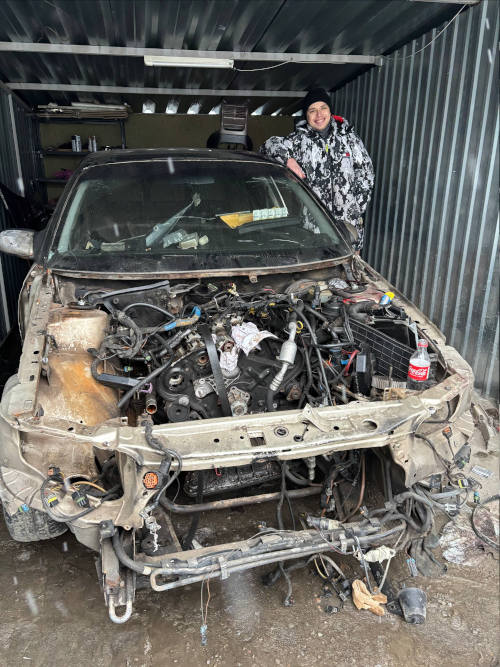
Toyota Prius
Prius' engines are highly integrated with the hybrid systems, control systems, and packaging, making the swaps very difficult. The control systems, for example, are typically integrated into the front of the car. Because of this, any conventional swaps that would normally be easy are nearly impossible with the Prius systems, as all the control systems must be replaced as well.
This is the case for all the US models. The 1st generation (2001-2003) is a sedan, while all the remaining models (2004-2015) are liftbacks. Starting with the 4th generation (2016), the engines have changed from a 1.8L (2010-2015) to a 2.0L (2023) with the M20A-FXS. With each generation, the systems become more integrated, control systems become more complex, and with each generation, the consequence of having a partially integrated system increases, as the US Priuses expect an entire system to be integrated with the engine to be swapped.
Prius systems expect an entire swapped system. This makes it necessary for an engine swap to be integrated with additional control systems that manage the engine emissions under the US emissions regulations. This makes it necessary for a swapped engine to meet several additional control system requirements.
Simply using mechanical fitment as a criterion to assess a modification's soundness is oversimplifying things. A Toyota Prius is not designed like a default transverse automatic car, which has a starter motor, an alternator, and a disconnected engine control module. The engine is integrated into a hybrid power-split system, and the control side of the system has certain expectations, such as stable torque reporting, a consistent warm-up pattern, and warm-up behavior, and interacts correctly with the hybrid transaxle and battery management system. That is why, despite the block dimensions being suitable, a Toyota four-cylinder engine might not be right for the job since 'smallness' is subjective.
When assessing suitability, the engineering of the components also needs to be considered. A Prius has a lot of complex software that most regular compact vehicles do not. If a car has been modified and the components, such as the engine mounts and cooling system, have not been designed to suit the application, the car will become a long-term diagnostic headache.
TL;DR
- Engine compatibility in a Prius means mechanical fitment, electronic integration, and emissions survivability all work together.
- An engine that fits the bay still fails if the car cannot accept its torque behavior, warm-up pattern, or control logic.
- Level 1 swaps stay close to the original engine family and preserve the Prius’s system identity.
- Level 2 swaps look manageable on paper, but cross-generation hardware and thermal differences create more integration work than most builders expect.
- Levels 3–5 are not normal engine swaps; they are full system builds.
- Difficulty rises non-linearly because wiring, cooling, calibration, and rework grow faster than fabrication alone.
- The lowest-risk swaps are same-generation, factory-adjacent replacements that keep the receiving Prius in charge of its own hardware logic.
- Later hybrid-family donors can work when used as better base engines, not as complete donor-system transplants.
- Conventional Toyota engines and cross-brand engines escalate complexity fast because they break the Prius’s hybrid-compatible operating logic.
- High-effort swaps usually require a custom control strategy, deeper packaging changes, and acceptance that the car may stop behaving like a Prius.
- The engine itself is rarely the main cost; uncertainty, debugging, and repeated correction work usually consume the budget.
- Timelines stretch because solved areas often have to be reopened after wiring, cooling, clearance, or driveline issues appear later.
- Builders most often underestimate validation, rework, and the cost of making the finished car usable rather than merely drivable.
- The most common swap failures come from fragmented wiring, unstable cooling strategy, bad driveline geometry, and accessory-drive misalignment.
- Prius swap failures are usually delayed because heat soak, repeated restarts, real load, and normal road use expose what first-start testing misses.
- OEM ECU-based swaps usually preserve better inspection and emissions outcomes because they stay closer to factory behavior.
- Standalone ECU swaps give more freedom but usually create more inspection friction and more distance from factory-like road manners.
- Legality and emissions strategy have to be planned early because they are determined by system behavior, not by whether the engine starts.
- Rebuilding the original engine, using conservative boost, or improving drivetrain behavior is often smarter when the real goal is reliability or usable performance.
- The right swap is the one that leaves the finished car more coherent, more usable, and easier to live with than the problem car you started with.
Before you start researching parts and pricing, check whether the swap you have in mind actually fits – and whether it's worth doing.
Check My Engine SwapMechanical, electronic, and emissions compatibility.
Mechanical compatibility means working with the hard points. The engine must clear the cowl, steering rack, front structure, and hood line, while landing in a position that the transaxle, halfshafts, mounts, and exhaust can 'live with' (i.e., fit within the necessary clearances). It must also fit with Prius-specific assumptions on cooling and accessory layout. The platform gives you limited spare room around the front subframe and crossmember area, and it rewards engines that keep [relatively] factory mass, angle, and service envelope. Once you deviate from the factory geometry, the project stops being a clean engine swap and becomes more structural and layout packaging.
Electronic compatibility is usually the part that kills the idea. Early vehicles have already implemented Toyota’s multiplexing strategy with CAN coupled with body and AV-side networks that communicate through a gateway ECU. By 2010, the Prius also shows CAN and LIN dependencies in diagnostic flow, and the vehicle includes immobilizer logic and broader expectations of module intercommunication. In later TNGA vehicles, that interdependence is even more pronounced as the powertrain, chassis, braking, and body systems communicate more and more state information and rely on control modules to manage the flow of power and on-off control (torque) as well as status messages. The bottom line is that an engine controller that does not meet the expectations of the network can cause significant malfunctions in the vehicle, even in situations where the engine is functioning correctly.
The required third component for the US market Prius is emissions compatibility. For the engine to be able to continue to pass inspections, it must be compatible with certain sensor strategies, catalyst actions, evaporative logic, and readiness monitor sequencing. This includes sensor behaviors during the cold-start phase, warm-up phase, and load estimation and catalyst management. All of these behaviors are interconnected to the Prius's engine start/stop function. It's not enough to just have an engine that can be forced to run. The engine must be operated in a way that is compliant with the emissions system.
The various compatibility layers of a Prius overlap. Emissions readiness and warm-up distortion can be caused by what appears to be a mechanical cooling reroute. Torque modeling and hybrid driveability can be adversely affected by altering the response profiles of the crank or throttle. A change in mount location can create different angles in the driveline, which can, in turn, change vibration and noise. This change will create noise that owners interpret as a poor engine, whereas the true fault is the layout. When Priuses are swapped, builders must not treat these different layers as individual issues. They are all part of one integrated system.
Why Engaging New Engines Fails
Even if an engine can fit, the Prius needs more than just combustion torque. It needs torque that arrives in the right sequence with the hybrid transaxle behavior, battery state, start-stop events, and traction logic. If the vehicle can’t predict or verify engine behavior, it will start throwing plausibility issues through the hybrid and chassis side of the car. This is where a promising-looking engine swap turns into a collection of persistent warning lights, fail-safe operation, reduced performance, and a car that never feels quite right in normal daily use.
The Prius will also very quickly expose poorly done calibration work. The engine doesn’t just run at a steady cruise. It cycles through start, stop, unload, reload, and coordinate with regenerative braking and battery management. This cycle will expose the cooling load, idle control, throttle modeling, and emissions logic far more quickly than they would in a simple non-hybrid commuter. An engine that “basically works” fails a lot here, because the platform keeps forcing it through transition states that expose every unfinished part of the integration.
New engines also fail on the security and networking side of the hybrid. The immobilizer side, gateway logic, body control expectations, and module communication can all stop a swap from operating like a native powertrain. Builders focus on making the engine run and overlook whether the rest of the car thinks the engine belongs there. In a Prius, the builder’s mistake is costly because the rest of the securing network is part of the operational reality of the powertrain.
Brief generational differences
Despite being among the oldest U.S. Prius models, the 2001-2003 iterations are highly complex. The 1.5-liter 1NZ-FXE engine uses Toyota's multiplex architecture, including Controller Area Network (CAN) for its primary vehicle control as well as BEAN and AVC-LAN, via a gateway ECU. It also has a pre-network architecture and a hybrid system, expecting the engine to work with the system. This model also has a hybrid system, expecting the engine to work with the system, and not a simplistic model.
2004-2009 Prius models include the 1NZ-FXE engine; however, they are also the first to use the second generation of lift-back models and a newer version of the Hybrid Synergy Drive. The layout for the engine compartment, exhaust, and thermal management is tighter, while the communication system still relies on the gateway to control the hybrid system and chassis. Like the previous generation, casual engine choice is still punishable, as the hybrid transaxle interface and network expectation are central to the car's behavior.
The 2010-2015 iterations of the Prius include a 1.8-liter 2ZR-FXE engine and a Toyota Integrated Control System (TICS). Internal Toyota documentation for the generation shows that the company uses CAN and LIN for communication as part of its diagnostic workflows, along with things like the immobilizer. For vehicle swaps, that is important as the electronic threshold is higher. Before this, mechanical adaptation was sufficient. With the expectation of integrated systems, power management, complex security, and climate controls, mechanical adaptation is insufficient.
The 2016-2022 Prius introduced the TNGA platform, a stiffer body shell, and the revised 2ZR-FXE engine. In regard to the fourth-generation model, Toyota claims, “more than 60 percent greater body torsional rigidity,” meaning the body shell does not allow much sloppiness due to poor mounting or load control. The 2023-present fifth-generation Prius also stays on an evolved TNGA platform and shifts to a 2.0-liter M20A-FXS engine. This engine provides even greater output and/newer integration baseline. However, these new models do not provide a better engine-swap host; instead, they are better at exposing flaws in a non-native engine.
Toyota Prius Architectures: Strategic Flexibility and Design Constraints.
Design and Performance of the Chassis and Structure.
Every U.S. Prius utilizes a unibody structure rather than a body-on-frame construction. This is especially important when considering that the engine, front subframe, pickup points for the suspension, steering hardware, and the body shell all share a load path. Powertrain drops are not made into an A-frame box with a good deal of separation from the body. It is a unibody structure in which the location of the mounts, loading on the crossmembers, and the stiffness of the front structure all combine to influence the overall behavior of the vehicle and the life of the engine.
The special logic of the unibody design creates extra sensitivity of the Prius to tuning of the mounts and to the front-end mass distribution. The front subframe has to deal with the powertrain and suspension load, while the cowl, firewall, and front floor are part of the management for torque and NVH input. A swap that alters the engine mass, regardless of its leverage, or the reaction torque path, is too aggressive and has side effects that extend beyond unwanted vibration. There is cowl shaking, too harsh steering, buzzing of the dash, load-sensitive axle disturbance, and a car that feels fundamentally wrong for no technically broken reason.
The latter TNGA cars extend the sensitivity further. According to the fourth generation of Toyota’s own material, a significantly greater rigidity yields a stiffer shell and a reinforced underbody. While improved rigidity is beneficial to the stock car, it makes the improvised engine mounting and poor compliance choices stand out more,e so due to the body doing less of the filtering. On those vehicles, a swap is not hidden within a soft shell; it is telegraphed to the driver by the structure.
The Prius platform allows stock-like loading to a point. It is not forgiving to powertrain position, bus axis, or mass behaving rotatively to anything like its factory configuration. The unibody begins to transmit the consequences of the poor configuration through NVH and loss of drivability long before catastrophic symptoms show. This is why the smart Prius swap evaluations focus on platform behavior, not horsepower.
Mechanical constraints (mounts, crossmembers, steering)
The first hard constraint is the interface to the Prius transaxle and front structure. The stock engine is built around Toyota’s hybrid transaxle, and not a normal stand-alone automatic or manual gearbox path. Bellhousing pattern, damper arrangement, crank to transaxle, and engine angle. All Toyota engine families have a paper-related block that may not sit properly against the Prius hybrid hardware without custom solutions that affect mount geometry and service clearance.
The second constraint is packaging around crossmembers, steering racks, and low front structures. Prius engine bays place the greatest priority on the compact hybrid, emissions hardware, and aerodynamics over swap space. The depth of the oil pan, position of the exhaust manifold, direction of the coolant outlet, routing of the intake, and placement of the accessories all compete with the steering and subframe. If the candidate engine lowers the sump, moves the exhaust to the rear into the zone of the firewall, or requires a different accessory stack, the project starts using space that the Prius does not have.
The other major constraint is cooling. Prius engines are designed to meet the hybrid duty, which means stop-start, controlled warm-up, and specific coolant behavior and exhaust-heat. A swap that increases thermal load or changes the coolant routing can create problems even before we start talking about power output. The front heat exchangers, fan strategy, and underhood airflow are all designed around the native engine family. Once the engine requires different cooling, the packaging burden increases dramatically.
The driveline angle affects the overall operation more than builders expect. The Prius operates with front-drive geometry that integrates well with the stock transaxle layout and mount positioning. Re-positioning the engine alters the axle line, operating joint angle, and torque reaction path. While these changes can be made without completely preventing the operation of the vehicle, they can result in excessive vibrations, wear on seals, unusual sensations upon launching the vehicle, and reliability issues over time. The Prius is very unforgiving with these changes because the platform layout is optimized for efficiency and refinement rather than a large mechanical tolerance band.
One more often overlooked limitation is that the stock Prius does not operate like an engine bay that has a normal starter and alternator. The starting of the engine and power management is done differently within the hybrid system; therefore, substitution of the non-hybrid Toyota swaps into this chassis does not work. That is why “same displacement” or “same family” logic is very poor. The pertinent issue is not whether the engine is a Toyota four-cylinder; instead, it is whether it aligns closely enough with the Prius powertrain interface logic to avoid structural and system-level rework.
Electronic constraints (CAN bus, BCM, ABS, security)
We begin with network architecture for electronics. Even in the early models of the Prius, the combination of CAN, BEAN, and AVC-LAN via a gateway ECU was documented in 2004, with CAN managing central hybrid and chassis communication. This means that even the oldest U.S. models do not have electronically isolated engines. They assume that information is meant to flow across modules in a structured manner. If the propulsion unit interrupts that dialogue, the fault transcends the engine control unit.
For the 2010-2015 model cars, the standards increase once more. Repair guides include references to communication checks via CAN and LIN, and the HVAC section also refers to an ECU with immobilizer codes. That implies the car is no longer monitoring for the simple condition of whether an engine is running. It is also watching to see if multiple systems receive the expected messages and if the anticipated status conditions are present. The hybrid control, security, chassis logic, and comfort systems become more interdependent and operate in such a way that it is more difficult to conceal non-native engine control strategies.
Factory Engines Offered in the Toyota Prius (All Years)
Complete Factory Engine Specification Table
The U.S.-market Prius uses three basic gasoline engine families across its life: the early 1NZ-FXE, the 2ZR-FXE in two major Prius-era calibrations, and the current M20A-FXS. The table below keeps them in one place and separates repeated engine codes by actual Prius production-era application, because code alone does not tell the whole compatibility story.
| Engine Code / Name | Displacement | Engine Type & Cylinders | Fuel Type | Valvetrain / Timing | Power | Torque | Production Years | Donor Vehicles | Known Issues |
|---|---|---|---|---|---|---|---|---|---|
| 1NZ-FXE (early U.S. Prius spec) | 1.5 L (1,497 cc) | Atkinson-cycle inline-4 gasoline | Gasoline | DOHC 16-valve, VVT-i | 70 hp @ 4,500 rpm | 82 lb-ft @ 4,200 rpm | 2001–2003 | 2001–2003 Toyota Prius | Age-related oil seepage, high-mileage oil use, cooling-system, and sensor aging on very old donors |
| 1NZ-FXE (second-generation Prius spec) | 1.5 L (1,497 cc) | Atkinson-cycle inline-4 gasoline | Gasoline | DOHC 16-valve, VVT-i | 76 hp @ 5,000 rpm | 82 lb-ft @ 4,200 rpm | 2004–2009 | 2004–2009 Toyota Prius | Water-pump seepage, coolant-control hardware aging, and oil consumption on neglected high-mileage units |
| 2ZR-FXE (third-generation Prius spec) | 1.8 L (1,798 cc) | Atkinson-cycle inline-4 gasoline | Gasoline | DOHC 16-valve, VVT-i | 98 hp @ 5,200 rpm | 105 lb-ft @ 4,000 rpm | 2010–2015 | 2010–2015 Toyota Prius; 2012–2015 Prius Plug-in; 2012–2017 Prius v | EGR clogging, head-gasket failure risk, and oil consumption on higher-mileage engines |
| 2ZR-FXE (revised fourth-generation Prius spec) | 1.8 L (1,798 cc) | Atkinson-cycle inline-4 gasoline | Gasoline | DOHC 16-valve, VVT-i | 95 hp @ 5,200 rpm | 105 lb-ft @ 4,000 rpm | 2016–2022 | 2016–2022 Toyota Prius; 2017–2022 Prius Prime | Generally better than Gen 3, but coolant seepage, pump wear, and mileage-related EGR/intake deposits still appear |
| M20A-FXS | 2.0 L (1,987 cc) | Atkinson-cycle inline-4 gasoline | Gasoline | DOHC 16-valve, VVT-i | 150 hp @ 6,000 rpm | 152 lb-ft | 2023–present | 2023–present Toyota Prius; 2023–present Prius Prime | No single dominant long-term Prius pattern yet; donor condition and crash-related cooling or accessory damage matter most at this stage |
Best Engine Swap Options for the Toyota Prius, Ranked by Difficulty
An explanation of the multiple levels of swap difficulty.
The time it takes to swap an engine is not an assumption about time to fabricate, but rather an estimate about how many vehicle systems will stop acting like factory systems after the new engine is put in. For a Prius, it means that the level is driven not by the fact that the engine doesn't fit, but by the fact that the vehicle still operates acceptably with the engine as a valid hybrid powertrain component. The lower the donor vehicle is to the original engine family, control logic, and emissions, the lower the level.
The non-linearity of the rising curve is where the difference between what is known and what is unknown. In a same-code replacement, it is known that the variables of sensor, airflow, cooling, and torque-model will remain clear, so the work remains bounded to what is known. In a cross-generation or sibling platform hybrid engine, it is still believed that there is a sharing of the basic block, but the problems become multiple: variant EGR routing, variant coolant control, variant accessory arrangements, variant ECU control, and variant exhaust heat. Once Toyota's hybrid engine family is left, or the FXE logic is left, it stops being an engine swap and becomes an integration project.
That is the reason for the dominance of electronics, heat management, and calibration at the high levels. Higher-level swap is rarely blocked by the block or the head, but it is blocked because the Prius still needs to have credible torque, consistent cold start and warm up, valid communication with hybrid side emissions, and behavior that remains factory enough. Once those conditions cease to exist, a secondary task is created by the subsystem.
Fabrication skills still matter, but by themselves, they do not increase the score. Clean brackets and good welding will not fix an immobilizer mismatch, a hybrid ECU that doesn't like the engine, or a catalyst strategy that won’t ever get stable readiness. A good fabricator will do a high-level swap really well, but that swap will still be high-level because the integration burden remains.
Level 1 Swaps (Lowest Risk, Near Bolt-In)
Level 1 swaps, in general,l are the ones that succeed the most, and this is mainly because they keep things factory-adjacent in the most important areas. Engine family, combustion type, and hybrid behavior remain in the range that the Prius already understands. This way, the transaxle relationship, torque requests, emissions logic, and thermal dynamics remain predictable. They might not be trivial jobs, but they are the least likely to create a need for open-ended troubleshooting.
Engines that are factory-adjacent are important because the Prius does not reward improvisation. A donor engine that matches the original engine code or is within the same year range of the hardware logic that the car expects increases the odds of a lean startup, stable hybrid coordination, and passing inspection. Most of the work is usually in maintaining the new engine in alignment with the old generation’s manifolds, sensors, ancillaries, and year-specific control logic.
| Engine Code / Name | Engine Type & Cylinders | Fuel Type | Donor Vehicles & Years | Valvetrain / Timing | Swap Challenges (Specific to Prius) |
|---|---|---|---|---|---|
| 1NZ-FXE | Atkinson-cycle inline-4 | Gasoline | 2001–2003 Toyota Prius | DOHC 16-valve, VVT-i | Early sedan cars are least tolerant of random donor-year mixing; throttle-body, intake, and engine-side ancillaries need to stay aligned with the original control hardware. |
| 1NZ-FXE | Atkinson-cycle inline-4 | Gasoline | 2004–2009 Toyota Prius | DOHC 16-valve, VVT-i | Gen 2 swaps work best when the replacement stays Gen 2-spec, the car reacts badly to long-block installs that ignore intake, exhaust, sensor, and cooling-hardware differences between donor builds. |
| 2ZR-FXE | Atkinson-cycle inline-4 | Gasoline | 2010–2015 Toyota Prius, 2012–2015 Prius Plug-in, 2012–2017 Prius v | DOHC 16-valve, VVT-i | Gen 3 cars care about EGR, intake, and coolant-control behavior; the safest swaps preserve the original vehicle’s external hardware and keep the replacement inside Gen 3 hybrid expectations. |
| 2ZR-FXE | Atkinson-cycle inline-4 | Gasoline | 2016–2022 Toyota Prius, 2017–2022 Prius Prime | DOHC 16-valve, VVT-i | Gen 4 donors are mechanically close, but the receiving car still wants year-correct sensors, exhaust heat-management hardware, and cooling layout, driveability, and readiness issues start appearing. |
| M20A-FXS | Atkinson-cycle inline-4 | Gasoline | 2023–present Toyota Prius, 2023–present Prius Prime | DOHC 16-valve, VVT-iE/VVT-i | Fifth-generation cars are the most software-dependent Prius models; complete donor alignment matters, partial hardware mixing can create security, calibration, and aftertreatment incompatibility very quickly. |
Level 2 Swaps (Moderate Complexity)
At Level 2, the Prius begins to differentiate between live/constructive and stalled/negatory projects/constructs. The donor engine would still likely be within the realm of Toyota’s hybrid four-cylinder world, and, postulating, the job now depends on the degree to which the recipient car’s electronics, cooling, exhaust, and accessory architecture can be made to accommodate the newer or sibling-platform hardware. While the recipient’s mechanical side is still manageable, the integration side will ultimately determine whether the swap is finished in a clean manner.
At this level, planning takes precedence over fabrication. While a builder can physically install a later model 2ZR-FXE or a Prius c long block, the swap will only be impactful if the recipient Prius is still configured with the sensor set, intake path, EGR, coolant routing, and hybrid-side responses that are expected. These types of swaps most often fail to complete because the donor seems close enough to encourage improvised and unconsidered efforts; however, every small mismatch escalates the complexity of the hybrid while simultaneously increasing the number of components and issues that could arise.
Level 2 swaps can be especially enticing because of their apparent benefit regarding donor engine availability, low mileage, or durable revisions of the engine in question. However,r Level 2 swaps are deceptive. They do not typically fail due to the engine family that is selected, but because the builder attempts to treat the cross-generation hybrid engine as if it were just another same-code replacement.
| Engine Code / Name | Engine Type & Cylinders | Fuel Type | Donor Vehicles & Years | Valvetrain / Timing | Swap Challenges (Specific to Prius) |
|---|---|---|---|---|---|
| 2ZR-FXE (Gen 4 long block into Gen 3 Prius) | Atkinson-cycle inline-4 | Gasoline | 2016–2022 Toyota Prius, 2017–2022 Prius Prime | DOHC 16-valve, VVT-i | Popular because the latter engine is a better base for a 2010–2015 car, but Gen 3 electronics still expect Gen 3-style external hardware, especially around EGR, intake, coolant routing, and exhaust-side behavior. |
| 2ZR-FXE (sibling-platform donor) | Atkinson-cycle inline-4 | Gasoline | 2011–2017 Lexus CT 200h, 2012–2017 Prius v, 2012–2015 Prius Plug-in | DOHC 16-valve, VVT-i | The long block is close enough to be useful, but complete donor electronics are not Prius-native; accessory layout and calibration details can differ enough that the receiving Prius should not be treated like a simple ECU swap case. |
| 1NZ-FXE (Prius c donor into Gen 2 Prius) | Atkinson-cycle inline-4 | Gasoline | 2012–2019 Toyota Prius c | DOHC 16-valve, VVT-i | The basic engine family matches, but the Prius c carries different water-pump and accessory logic, different packaging around intake and ancillary hardware, and the Gen 2 liftback still wants its own sensor and control expectations preserved. |
| 1NZ-FXE (late 1NZ-FXE long block into early 2001–2003 Prius) | Atkinson-cycle inline-4 | Gasoline | 2004–2009 Toyota Prius | DOHC 16-valve, VVT-i | The engine family is familiar, but the early sedan uses older control and packaging assumptions; later liftback hardware cannot be treated as a direct plug-in solution without carefully preserving the original car’s external engine environment. |
High-Effort Engine Swaps (Levels 3–5)
Levels 3, 4, and 5 should be treated as full systems builds, not sets of engine replacements in the usual Toyota sense. At this stage, the question is no longer whether the block can be fitted. The real question is, how much of the Prius are you willing to re-engineer so that the car can function with a powertrain it was not built to understand? This usually means that the hybrid integration no longer becomes the anchor of the project but the primary challenge.
Cross-brand engines add to the burden further than removing the last remains of the shared Toyota hybrid logic. Even the compact and well-used in other chassis like the Honda K-series cross-brand engines still land in a Prius shell that expects a completely different torque model, different start behavior, different network conversations, and different emissions approach. The donor vehicle may be famous, but not well known to a Prius.
Here, standalone ECU logic becomes the rule, not the exception. Once the donor engine is not a hybrid Prius engine anymore, the stock control path is assumed to be non-viable. That pushes the build toward custom engine management, custom interpretations of tach, load, and temperature behaviors, and in some cases, a practical separation from the original hybrid operating strategy. The stock Prius transaxle and the new engine may no longer be natural partners. This also widens the drivetrain question.
The redesign of packaging, driveline, and cooling also becomes a structural, not accessory, issue. New challenges are posed by larger Toyota engines, generic Otto-cycle engines, and cross-brand performance engines regarding different exhaust routing, heat rejection, mounting loads, and different axle or transaxle challenges as they relate to the Prius. Fabrication quality still matters at this point, especially since the prevailing risk is whether the finished vehicle will operate as a coherent vehicle or simply as a collection of individual problems that have been solved.
| Engine Code / Name | Difficulty Level (3 / 4 / 5) | Engine Type & Cylinders | Fuel Type | Donor Vehicles | Dominant Integration Risks |
|---|---|---|---|---|---|
| 1NZ-FE | 3 | Otto-cycle inline-4 | Gasoline | Toyota Echo, Yaris, Scion xA/xB | The block family is familiar, but the engine no longer matches Prius hybrid combustion and control logic, so torque behavior, startup strategy, and emissions behavior stop looking native to the car. |
| 2ZR-FE | 4 | Otto-cycle inline-4 | Gasoline | Toyota Corolla, Matrix, Scion xD | The displacement is close to later Prius engines, but the engine management model is not; the build usually runs into hybrid handshake problems, catalyst strategy differences, and a thermal balance that the stock Prius electronics did not expect. |
| 2AR-FE / 2AR-FXE | 4 | Inline-4 | Gasoline | Toyota Camry, Camry Hybrid, RAV4, Lexus ES 300h | Packaging and heat rejection move outside normal Prius margins, the drivetrain relationship stops being natural, and the car needs a new answer for torque management, exhaust layout, and front-end mass control. |
| K24 / K20 family | 5 | Inline-4 | Gasoline | Honda Accord, CR-V, Civic Si, TSX | A popular swap family in other platforms, but in a Prius, it becomes a custom-engine-management build with no native hybrid conversation, no native emissions path, and no factory driveline logic to fall back on. |
| 2GR-FE | 5 | V6 | Gasoline | Toyota Camry, Avalon, Sienna, RAV4 V6, Lexus ES 350 | The problem is not just fitmen, it is total vehicle balance. The engine changes packaging, cooling, driveline, and load paths so much that the Prius effectively becomes a custom chassis with a custom powertrain strategy. |
Universal Engine Swap Execution Reality
Planning & Measurement
An engine swap failure starts long before the first bolt goes in or comes out. The first milestone must be when the builder knows where the final \(system\) is in the assembly workflow. For a Prius, this means finalizing whether the end vehicle is dominating the altered caliper Prius \(sheet\) metal, it's a hybrid that is serviceable, usable, and will survive a DMV inspection, or it is drifting towards a custom project. When the answer to this question is unclear, all subsequent decisions are reactive.
Planning mistakes often come from thinking of the engine as the project and the vehicle as just a container. This mindset obscures the true constraints: control strategy, cooling behavior, hybrid interactions, emissions behavior, mount load paths, accessory pack service access after assembly, and load paths. Builders tend to measure block clearance but don't consider the package, driver, belt, and wire interfaces after assembly. A project is likely to be viable in isolation, but will collapse when the systems begin to overlap.
Measurement is also the underlying cause of the issue. The assumptions that appear small tend to be compounded. A mount moves a bit, which alters the axle, which alters the vibration, which alters the bracket geometry, which then crowds the accessories, which then alters the routing of the cooling hose,e which then complicates airflow and access. Good planning does not eliminate effort, but instead prevents a single early guess from requiring six adjustments.
The correct approach to this task should be prioritized over the correct tools for the job. The sequence for a project like this does not start with “take out the old engine and put in the new engine.” The first steps should be defining the architecture, verifying the geometry, the control strategy, and the cooling logic before you even start the swap. The first step builders take is to do e this out of order; the project is laden with problems out of scope and budget.
Engine Removal
We should not only see engine removal as part of disassembly, but it also begins the first capturable data phase of the project. The outgoing engine and surrounding systems explain to you what the vehicle requires to operate before the swap. On a Prius, this is especially important as the engine bay contains a lot more than mere mounting points. The bay sustains the original relationships of engine position, hybrid hardware, thermal management, exhaust, and electrical integrations. The project then becomes pure guesswork, as the references become lost.
What typically fails at this point is not the damage from removal; it's the loss of reference. Builders are left with a vehicle in pieces and no memory as to the relationships of the hoses, the routing of the wiring harness, the zones of clearance, the order of brackets from stack to stack, and the relationships of the engine, subframe, and transaxle. Once the replacement systems need to occupy the same functional envelopes, the original requirements of the stock systems are lost. The project then wastes effort re-discovering what the vehicle had prior.
It’s also a mistake to think the old layout was too careful or even just inefficient. True, factory layouts can look conservative, but they are doing a lot of work to get rid of several conflicts at once, including crash packaging, heat shielding, servicing, NVH, and durability. Once the stock engine gets taken out, open space can be misleadingly confident. A replacement looks easy to fit, and then the missing systems come back and take that space.
This stage also reveals whether the receiving chassis has enough value left to warrant use. A Prius, for instance, can get frustrating. Worn mounts, previous crash distortion, hidden corrosion, compromised wiring, and neglected cooling systems can thwart even a sound swap plan. The wrong shell can turn a controlled project into layered rework. Removal is when that reality becomes the most clear.
Test Fit & Clearance
Test fit is a systems checkpoint, not a celebration moment. A candidate engine is not validated simply because the block drops between the frame rails or clears the hood once. It has to occupy the bay with enough space for things to actually operate: engine movement under load, thermal growth, exhaust expansion, hose motion, belt travel, service access, and protection of nearby electronics and lines. A static fit is only the beginning of the answer.
The poor test-fit logic stems from considerations focused solely on hard interference. Builders will focus on whether metal touches metal, and stop there. Real issues arise when the engine shifts, when the cooling system gets pressurized, when the exhaust gets to sustained temperatures, or when the vehicle applies load to the driveline in actual use. Example swaps often look finished before powertrain movement breaks belts, rubs hoses, heats plastics, or misdirects load to the subframe.
When constraints box the design in, space claims become even more misleading. Belt drives, air box, shields, and catalysts all take up space. In the case of the Prius, the design is tight and destroys the interdependencies. Often, secondary constraints decide whether the swap is even possible. The block might fit, but the operating system is void.
The good projects are those that are finished and realize the most. The bad projects finish at the stage of having long blocks mounted with no thought given to airflow, access for servicing, heat shielding, maintenance, and that is after assembly. That missing illusion is more important than whether the engine made it into the bay.
Mounting & Driveline Geometry
Mounting is where the swap becomes concrete to the contractor. The not check point is whether the engine can be held in place. The real question is whether the vehicle can accommodate the mass of the engine and the torque reaction that would be produced by the engine. In a Prius, the choice of mounts affects more than just vibration.
The consequences of wrong choices are usually far-reaching. One stiff solution can make the engine feel well-controlled, but transmit harshness and fatigue into the body of the car. One soft solution can feel smooth at idle, but excessively allows motion under torque and destroys the clearances that were safe during mock-up. A mount position that seems convenient from a structural point of view looks the driveline off its natural line and creates low-level chronic stress, which only becomes apparent after real mileage.
Driveline geography can be wrong, but that doesn't stop the rest of the car from operating. When the rest of the car operates, that masks the problem until time, heart,t and load reveal the problem. Joints that are close enough can create seal wear, vibration, harshness during launches, and a general lack of sorting. A poorly placed engine will not only affect driveline, but tires, alignment,nt a, nd software as well.
The checkpoint demonstrates the value of fabrication skills, but does not change the fact that the best mount is the one that preserves system behavior, not one that merely looks strong. A clean bracket is wrong if it changes the natural path of the drivetrain through the car.
Wiring & ECU Strategy
Wiring and control strategy determine whether the swap is a functioning vehicle or just a collection of parts. The checkpoint here is simple to explain, but can be brutal – does the engine management architecture align with the end use of the car? In the case of a Prius, it cannot just be that “the engine runs.” The vehicle expects to have realistic operating data, proper communication, intelligent failsafe behavior, and a control strategy that is not a mystery after the excitement of the build is done.
The majority of stalled swaps are a result of the project finally having to pick the less desirable path between keeping OEM-style logic and going the custom control route. Nothing about either path is easy. OEM-style integration from a standalone approach eases the system, but it also means the builder is responsible for the behavior of the system, which includes idle, cold, and transient response, as well as fault management.
Enter your vehicle and target engine to see a compatibility verdict, estimated cost, required changes, and whether it's the right move for your build.
Get My Swap VerdictEngine Swap Cost & Timeline Reality
Budget Ranges by Difficulty Level
Costs aren’t linear when it comes to risk/reward scenarios. Low-risk, factory-adjacent Prius swaps, when the donor, the receiving car, and labor are all in-house, generally sit in the low to mid four figures. Moving outside labor, donor uncertainty, and rework can push the same job to the upper four figures. The key indicator is HAPT, as in “whole system accounted for,” rather than any one specific factor, when discussing the cost of a job.
Moderate complexity swaps stop residing in the mid-four-figure range and begin to tickle the low five-figure range, as most integration work is not accounted for in the donor price. More fitting, more validation, more control strategy decisions, more cooling revisions, more minor corrections, and more time parked waiting for answers are just a few areas to consider. The jump price appears disproportionate because it is. The project is now paying for more than just installation and is paying for uncertainty.
High effort swaps are in five figures almost by definition, and can exceed the value logic of the entire chassis without doing anything exotic. Most of the dominant costs are not glamorous and are a result of additional design iterations, test failures, rework for custom solutions, long debugging cycles, and the hidden cost of a car that cannot be used. The opportunity cost is part of the budget even when it is not enumerated in the invoice.
Realistic Time Estimates
Time is consistent and non-linear. A simple factory-swap can take 3 months in a structured environment w, while taking years when factoring in donor complications and scheduling gaps. Moderate-sized projects can take months to years, while high-effort builds often have no reliable timeline. Projects can take years until the architecture stabilizes.
Time is extended by questions. Redone decisions, chasing electrical, and unstable systems create poor project flow. Time is focused on areas that should have been completed. A project that doesn’t move backwards can be done quickly. Typically, most projects move backwards, removing the need to keep going back.
This also impacts the owner entirely. For the owner, the elapsed time drastically impacts the value of the vehicle. Storage lost transport utility, and a change in priorities, combined with a loss in motivation,n negatively impact the project even if no more money is spent. Instead of value, time can stretch the rationality of a technically possible swap.
What Builders Underestimate the Most
Builders most often underbudget the cost to finish as opposed to starting. Donor and visible fabrication are usually the first budget items. The loops of validation and revision are rarely accounted for. These loops often define the difference between an operating project and a usable one. Wiring revisions, correct ions cooling, heat management, small bracket reworks, hose and belt-path revisions, and repeated teardown of “finished” areas consume the margin.
They underestimate the cost of finishing because they fail to account for the cost of debugging. Debugging doesn't look like progress. A whole day spent tuning one intermittent fault may feel like a failure, even if it is protecting the whole build. This type of psychology pushes builders to move on before a build is really stable, isolating the cause of failure of the entire system. The cause is predictable: people are rushing to finish the swap before really understanding the system.
The usability of the system is perhaps the most underestimated. There is a vast difference between a car that starts and runs and one that is able to run in traffic, restart when hot, withstand variable weather, and pass an inspection. The last 20% of usability often takes more work than the first 80% of functionality.
Common failure scenarios when doing an engine swap on a Toyota Prius
Incomplete or Fragmented Wiring
Incomplete or fragmented wiring failures may lead the vehicle to appear as though it is dead. They cause intermittent behaviors that may be resistant to an easy diagnosis. Weak signal paths and incomplete logic are exposed as a consequence of heat soak, voltage variation, vibration, and time. The vehicle may drive well enough when the wiring is new, but may then become inconsistent after a long run, after sitting hot, or after several restart cycles.
Fragmented control environments can make it difficult to pinpoint an issue. Instead of recognizing that the vehicle's fragmented control environments and electrical systems are causing the problem, an operator might mistake the issue for a fueling problem, a cooling problem, or a hybrid problem. The vehicle continuously “changes its personality” and can confuse and frustrate drivers as the vehicle operates in unexpected ways and gives misleading signals.
Under-Sized or Misapplied Cooling Systems
Most cooling failures are not easily noticed. They often only become apparent when the vehicle experiences a high demand for cooling. Situations like summer heat, sustained engine load, or repeated stop-and-go traffic thrust the vehicle's thermal needs out of balance with the cooling systems that are installed. The consequence of mismatched systems results in overheating. Because of this, builders often believe, and are almost always certain, that the cooling problem has been solved, right before the vehicle proves the opposite.
The original thermal strategy of the Prius is particularly sensitive because it operates with a hybrid cycle that is closely managed. Changes to components that affect coolant flow, airflow, exhaust heat, and other elements can appear acceptable when the vehicle is cold. However, they often become problematic when the vehicle is in stop-and-go traffic. This is the point where a lot of failures begin.
Misaligned Driveline Angles
Issues with driveline angles often do not draw attention to themselves from the outset in a diagnostic manner. Instead, problems such as vibration, seepage from seals, an unusually low speed harshness, or a slightly tense vehicle that is under load come to the forefront. Because the vehicle is in a mobile state, owners often normalize this behavior and seek secondary explanations for the problem. The continued use of the vehicle will apply the stresses caused by a geometry problem each mile driven.
The passage of time often illustrates the failures of a design due to real suspension play, multiple launches, and heat cycles, showing what the assembly process has hidden. In the short term, a Prius with driveline misalignment and suspension issues may be roadworthy, but it will never get better. Instead, it will become more familiar with its wrongness.
Accessory Drive & Belt Geometry Issues
The classic delayed failure of accessory drive issues is because of the reliance on temperature, the condition of the belt, and sustained motion. During assembly, if the belt path is set to look stable, this may not be the case once the engine moves in its mounts, once heat changes the belt’s alignment, and once the accessories are subjected to cycles of load. After those conditions are satisfied, the belt will begin to shed, the assembly will begin to make noise,e and components will approach failure in a pattern that looks chaotic, but is the result of poor drive belt geometry.
The issues are often underappreciated merely because they operate in the background of the overall narrative of the swap. The builder gets focused on the engine and transaxle, and shifts focus until they notice the “small” issue that the accessory system was never operating in a stable plane. In a finished road car, that is not a small issue.
Legal & Emissions Considerations (US)
Swaps Using OEM ECUs Instead of Aftermarket ECUs
OEM ECU-based swaps usually keep more of the logic-based inspection systems and diagnostics routines that systems expect. This does not mean that swaps are legal and easy, but it typically means the vehicle will still operate like something the testing environment can comprehend. Regarding behavior and fault reporting, the mission system's plausibility remains closer to factory levels. In the real world, that is more important than elegant design.
For a Prius, OEM-style control also helps maintain the connection between engine operation and the rest of the vehicle’s expectations. The closer the control swap is to a native control environment, the more likely the vehicle is to be usable, diagnosable, and less likely to be scrutinized during inspection-driven ownership.
Swaps Using Standalone ECUs
While Standalone ECUs provide more control, they also remove the protection of factory systems. This is beyond the realm of “can the car understand this engine” to “can this custom control system satisfy all the requirements of road use.” The latter is a much steeper challenge. Even when the engine runs extremely well, the testing environment, including the rest of the vehicle, may still consider the car incomplete.
This is why standalone control systems are most effective in projects that abandon the factory-style ideal. If the objective is to maintain full road usability, predictable diagnostics, and a user-friendly environment, a standalone control system is likely to increase the gap between technical and practical success.
Insubstantial arguments about the reality of inspection neglect the obvious. Vehicles that can easily be interpreted as OEM machines are likely to survive inspection cycles with little drama. Vehicles that behave like a one-off rather than a machine with an OEM-style build are more likely to show custom choices during each inspection. The problem here is of custom choices, rather than compliance; it is the abstract, it is the problem of repeatability.
Inspection reality shifts the narrative. “It runs fine” is an insufficient explanation.
When an Engine Swap Is the Wrong Solution
Rebuilding the Existing Engine
When the goal is to build a reliable car, rebuilding the existing engine is usually the best answer. Rebuilding an engine also keeps the project within a known diagnostic system and keeps everything else intact: control logic, cooling system, access to service, and emissions. Therefore, for Prius owners, the ‘for sure’ is more valuable than the theoretical potential.
Rebuilds are also more valuable as the chassis value increases. If the shell, hybrid system, and intended use of the chassis encourage normal road ownership, a solid rebuild solves the problem without creating five new ones. It is rarely the most exciting path, but it is often the most rational.
Conservative Forced Induction
Sometimes a mild boost may serve a power complaint more directly than a full swap, as long as the base engine and some control strategy are kept inside a disciplined operational envelope. The reason is straightforward; the car remains in the original architecture. This means, for the most part, fewer unknowns in areas such as mounting, driveline geometry, and packaging. The question changes from how to reinvent the whole vehicle to how much added load the existing system can handle.
This is not to say it is easy, and it is not universally applicable to Priuses, but the point is more focused than it may seem. If the real complaint is, ‘the car feels weak,’ a controlled power increase may provide a smaller system answer than replacing the engine completely. Swapping the engine out as a performance solution option should not be the default response.
Gearing & Drivetrain Optimization
Sometimes the engine really is not the limiting factor. The vehicle may need a different response profile, a more powerful tractable use, less loss from the system, or a more honest definition of the vehicle's purpose. Optimizing the drivetrain and vehicle behavior can often resolve the owner's complaint without destroying the architecture that is already working. This can be especially true of a Prius.
This is why good decision-making starts from the complaint and not from an imagined solution. If the owner wants more usable acceleration, more reliable day-to-day performance, or simply less hassle over the life of the vehicle, the answer may not even be in the engine bay at all.
Final Rule: Selecting an Appropriate Tool
An engine swap is only reasonable when the new car is more coherent than the problem car you started with. If the new car increases cost, complexity, inspection friction, and diagnostic ambiguity faster than it improves real utility, it is not the right tool. On a Prius, that threshold comes sooner than a lot of builders expect because the platform is highly dependent on systemic agreement. Contrary to popular belief, it is not the most 'bold' decision that is the right decision. Rather, it is the decision that retains the most function per dollar, per month, and per mile.
Frequently Asked Questions
Why does a 2016–2022 2ZR-FXE donor not behave like a simple answer for a 2010–2015 Prius?
On paper, the engine code makes the swap look easy. Both the 2010–2015 Prius and the 2016–2022 Prius use the 1.8-liter 2ZR-FXE, and the later Prius Prime keeps that same basic engine family as well. The problem is that the receiving car does not evaluate the engine as a bare long block. It evaluates the whole operating package, including how the engine warms up, how it communicates with the rest of the car, how the external hardware is arranged, and how the chassis reacts to it.
That is why this swap succeeds when the builder treats the later donor as a better base for the original car’s hardware, not as a complete later-generation transplant. If the project keeps the receiving Prius in charge of its own sensors, cooling logic, emissions behavior, and hybrid expectations, the latter engine can be useful. If the builder assumes that “same code” means “same vehicle logic,” the swap usually turns into a long cleanup job instead of a clean upgrade.
Do the 2001–2003 and 2004–2009 Priuses really belong to the same swap family just because both use 1NZ-FXE?
They belong to the same engine family, but they do not behave in the same swap environment. The 2001–2003 U.S. Prius is the early sedan, while the 2004–2009 car is the later liftback with a more mature Hybrid Synergy Drive layout and a different packaging context. Both use the 1.5-liter 1NZ-FXE, but they do not package or manage that engine in the same way, and that difference matters once a swap moves beyond the bare long block.
The practical mistake is assuming that a shared engine code removes generation friction. It does not. The earlier car rewards closer donor matching because its whole vehicle environment is older and less forgiving of casual donor mixing. The latter liftback gives you a more familiar Prius architecture, but it still wants its own intake, cooling, exhaust, and control assumptions respected. Treating the two as one easy donor pool usually creates more adaptation work than the engine code suggests.
Does a Prius v donor make sense for a regular Prius, or does the wagon context create its own problems?
A Prius v donor makes sense only if the builder understands what is being borrowed. The wagon uses the same 2ZR-FXE engine family as the third-generation Prius, which makes it attractive as a donor when standard Prius engines are tired, scarce, or expensive. That shared engine code is real, but it does not erase the fact that the Prius v lives in a larger, differently packaged vehicle with its own external hardware context and thermal behavior.
The smart way to think about a Prius v donor is as a source for compatible engine architecture, not as a full operating template. If the receiving Prius still dictates the final hardware arrangement, the donor can work well. If the build starts importing too much wagon-side logic into a standard liftback, the swap loses the simplicity that made the donor attractive in the first place. The wagon does not ruin the idea, but it punishes lazy assumptions about interchangeability.
Can a Prius c 1NZ-FXE rescue a Gen 2 Prius, or does that usually create a voidable mismatch?
The Prius c is tempting because it also uses a 1NZ-FXE, and that makes it look like a natural answer for a worn 2004–2009 Prius. In reality, it is only a useful donor if the project stays disciplined about what is being transferred. The basic engine family aligns, but the Prius c is a later, smaller hybrid with its own accessory, cooling, and packaging context, while the Gen 2 liftback still wants Gen 2 behavior around the engine.
This is the kind of swap that fools builders into thinking they are staying conservative while they quietly create integration work. If the long block is the goal and the receiving car keeps its own external logic, the idea can be defensible. If the donor is treated as a complete engine-side system, the project usually gains complexity without gaining much real advantage. The overlap is real, but it is narrower than the engine code makes it appear.
Does a Prius Prime donor help a regular Prius swap, or does plug-in calibration make the match less useful than it looks?
A Prius Prime donor helps only in a limited sense. The 2017–2022 Prius Prime still uses the 2ZR-FXE, so as an engine-family donor, it stays closer to a regular fourth-generation Prius than most outsiders do. The catch is that the Prime is not just a Prius with a charger port. It lives inside a plug-in hybrid operating strategy with its own broader hardware and control context, and that changes how useful the donor becomes once the swap moves beyond the bare engine assembly.
That means the Prime is usually most valuable as a source of core engine architecture, not as a complete transplant idea. If the receiving Prius remains the authority for its own operating logic, the donor can still make sense. If the builder expects the plug-in context to drop into a non-plug-in car cleanly, the project often becomes harder than a standard same-generation donor swap for no corresponding gain in road behavior.
Why are 2023+ Prius swaps more punishing even before the fabrication gets serious?
The fifth-generation Prius changes the equation before a wrench ever touches the car. It moves to the 2.0-liter M20A-FXS, increases output, and continues the newer Prius direction of tighter integration rather than looser packaging. The earlier fourth-generation move to TNGA already brought a major jump in body rigidity, and the newer cars build on that more modern vehicle logic instead of relaxing it.
In practice, that means the modern Prius exposes bad decisions faster. A sloppy mount strategy, a loose interpretation of control logic, or an incomplete thermal plan does not disappear inside a softer, simpler shell. The car reports it back through NVH, driveability, and integration friction. That does not make late cars impossible, but it does mean the build has less room to hide halfway-finished engineering.
When does a later long block become smarter than rebuilding the original Prius engine?
The latter long block becomes smarter when it reduces a known weakness without forcing the rest of the car to change identity. That is why the common Gen 4 2ZR-FXE long-block idea for a Gen 3 Prius gets so much attention. The appeal is novel. The appeal is that the builder can sometimes gain a better base engine while keeping the receiving vehicle’s own external hardware, control logic, and road manners in charge.
The rebuild remains the better answer when the vehicle already works well as a system, and the owner mainly wants reliability back. A swap only earns its place when the new engine solves more than it disturbs. If the donor creates fresh uncertainty in wiring, cooling, warm-up behavior, or inspection outcomes, then the project has traded one known engine problem for a much larger vehicle problem. That is not a better decision, even if the donor engine itself is stronger.
Why do low-mileage donors still create bad Prius swap outcomes?
Low mileage tells you very little about system fit. A clean donor can still come from the wrong generation, the wrong hybrid context, or the wrong external hardware arrangement for the car receiving it. Prius swaps fail more often because the donor was conceptually wrong than because the donor had too many miles. Mileage matters, but on this platform, it matters after architecture fit, not before it.
That is why a higher-mileage same-generation donor can be the better decision. The builder is buying a narrower problem set. Wear is visible and finite. Integration mismatch is harder because it multiplies into cooling, wiring, hybrid behavior, emissions behavior, and diagnostic clarity all at once. A low-mileage donor is only an advantage when it arrives inside the right system boundaries. Outside those boundaries, it just makes the wrong choice look more attractive.
Why do some Prius swaps look finished, drive for a while, and then start unraveling?
Because the first successful drive does not test the whole car. Early operation hides many of the problems that matter most on a Prius: heat soak, repeated restart behavior, long-idle cooling stability, hybrid transition quality, and the way the car behaves after several complete warm-up cycles. A swap can feel acceptable when cold and still be fundamentally unfinished once the vehicle starts operating like a real daily driver.
The delayed failure pattern is what makes Prius projects deceptive. Small weaknesses in wiring, belt alignment, mount control, or cooling strategy do not always create immediate drama. They wait for time, temperature, and repetition. That is why a swap that “runs and drives” can still be a poor result. A Prius is not validated by one good outing; it is validated by whether it keeps the same personality after weeks of ordinary use.
When does preserving the stock Prius ECU path stop being worth the effort?
The stock ECU path stops being worth it when the donor engine no longer behaves like something the receiving Prius can honestly interpret. As long as the engine remains close enough to the original family and the builder can keep the car’s expected operating behavior intact, OEM-style control usually preserves the most usability. Once the donor demands too many exceptions, workarounds, or false signals, the stock path becomes less of an advantage and more of a trap.
The key tradeoff is not convenience; it is clarity. Keeping the stock-style path is valuable when it keeps the car diagnosable, inspection-friendly, and consistent. It becomes wasteful when the project spends endless time forcing factory logic to manage a powertrain it was never meant to understand. At that point, the build has usually crossed from a careful swap into a custom system, whether the builder admits it or not.
Can you put a Corolla engine in a Prius and keep the car behaving like a Prius?
That idea usually sounds better than it works. The ordinary Corolla engine and the Prius engine can look close on paper because they come from the same manufacturer and similar displacement ranges, but the Prius does not care about brand familiarity. It cares about hybrid-compatible behavior. Once the donor stops being an FXE-style hybrid engine and starts being a conventional Toyota engine, the build leaves the easiest decision zone immediately.
The real issue is not whether the engine can be mounted. It is whether the finished car still acts like a Prius rather than a custom shell with an unrelated Toyota engine inside it. A Corolla-based idea can make sense only if the owner accepts that the project is now redesigning vehicle behavior, not just replacing a failed engine. For most street-driven Prius builds, that is a much bigger shift than the donor’s familiar badge suggests.
Does “same Toyota four-cylinder” reasoning ever work on a Prius, or is that the wrong filter from the start?
It is the wrong filter from the start. On many ordinary front-drive Toyota platforms, engine-family similarity gets you far enough to make an engine-swapping conversation productive. On a Prius, the engine is too tightly tied to hybrid operating logic for that shortcut to stay useful. A same-brand four-cylinder can still arrive with the wrong combustion strategy, wrong torque behavior, wrong accessory layout, wrong heat pattern, and wrong control assumptions for the car receiving it.
The better filter is not “Is it a Toyota four-cylinder?” but “Does it preserve the vehicle’s system identity?” That question is stricter, but it is much more honest. Once the answer becomes no, the project should be judged as a custom build, not as a conservative Toyota-to-Toyota swap. That distinction saves more time and money than most donor-shopping strategies do.
Why does the 2016+ Prius chassis make sloppy swap decisions easier to feel from the driver’s seat?
Because the later chassis hides less. Toyota’s shift to TNGA on the 2016 Prius brought a major increase in body rigidity, with Toyota describing an increase of more than 60 percent in torsional rigidity compared with the previous model. That helps the stock car, but it also means the structure filters fewer mistakes for the builder. Mount harshness, poor driveline line-up, and awkward load paths reach the cabin more honestly.
That matters in decision-making because a later Prius does not merely demand a cleaner swap on paper; it reports poor engineering more clearly in use. A compromise that might have felt merely acceptable in an older, softer shell can feel unfinished in a TNGA car. The newer platform is no less swappable because it is weak. It is less forgiving because it is better defined.
Stop comparing specs in your head. Enter your Toyota Prius and the engine you want – get a structured verdict with cost, complexity, and a clear recommendation.
See If This Swap FitsYears
No year pages with content are configured for this model yet.